Positive Leadership Limited is a strategic leadership and corporate finance advisory firm. We use our considerable experience to provide unique perspectives and innovative solutions which help corporate leaders unlock maximum value from complex business challenges. There is no dress rehearsal for delivering answers to critical business challenges. When you are under intense pressure to succeed, we help deliver the vitally important marginal gains which let your business excel and win.
Tuesday, January 12, 2010
Leadership Coaching
Monday, January 11, 2010
M&A Skills Honed as Athletes
Stitzer has engineered more than 40 transactions since joining Cadbury Plc as a Columbia-trained mergers and acquisitions lawyer. In 2003, the Pennsylvania-raised CEO outbid Nestle SA for chewing-gum maker Adams Inc., making Cadbury the world’s biggest confectioner. The U.K. company held that rank until it was displaced by Mars Inc.’s $22.6 billion purchase of Wm Wrigley Jr. Co. in 2008.
Rosenfeld has spent more than 25 years at Kraft, with a two- year interruption in 2004 to run PepsiCo Inc.’s Frito-Lay snack- food unit. Last year, Forbes magazine ranked her No. 6 on its list of the world’s most powerful women, three behind PepsiCo CEO Indra Nooyi.
Both CEOs have honed their competitive skills as athletes. Rosenfeld, who is also Kraft’s chairman, played four varsity sports in high school and chose Cornell University as her alma mater partly because of the women’s athletic program. Stitzer, who has dual U.S. and U.K. citizenship, paid for law school at Columbia University by playing professional tennis.
M&A Skills Honed as Athletes
A Test of Character
Questions of character are being posed again today, after decades of neglect. This character revival is occurring as politicians and policy-makers in the UK realise that many of their most cherished goals – for social mobility, co-operation, social responsibility – cannot be met through either the machinery of the state or the magic of the market. Character is an old-fashioned term for a set of pressing contemporary problems.
For more, see - http://www.telegraph.co.uk/news/newstopics/politics/david-cameron/6965133/David-Cameron-A-test-of-character.html
A Test of Character
Dealing with Tough Days
Here are some ideas for dealing with these tough days:
1. Every problem or crisis is an opportunity to build your leadership skills along with your confidence and credibility.
2. Problems create teachable opportunities. Don’t waste these opportunities.
3. It’s the challenges that you and your team conquered that you will remember. Make some memories!
4. Remember that you don’t have to carry the weight of the world on your shoulders. If you’ve done your job and earned respect, your team members are there to help ease the burden. Ask for help.
5. People aren’t programmed to act and respond in ways that always fit your plans. Losing a great employee is painful, but if it has to happen, ensure that the relationship transitions to one of valued and always welcome friend.
6. Be thankful for feedback that says that you can improve. At least someone cares.
7. Leaders earn dividends over the long term. Your payoff comes a decade from now when the people that you are leading today are rising to new heights in their careers. They did the work but perhaps you played a small role along the way. Take pride in their accomplishments.
Dealing with Tough Days
Sunday, January 10, 2010
How do You Define “Ethical Leadership”?
(1) Perspective- Working hard to see reality clearly
Many of us view reality as things being just the way they are (at face value), while others understand that our view of reality is based on our beliefs, and that our beliefs are based on our past experiences.
(2) Courage - Doing what is required to get the job done
Failure in leadership is not due to the lack of ideas, but due to the decisions we make after we feel the “tight gut.” It is the ability to be uncomfortable and do the right thing anyway.
(3) Integrity- Doing what is required without violating personal integrity
Integrity is simply obedience to the unenforceable. It is doing the right thing when no one is looking and you wouldn’t get caught doing otherwise.
An individual, a company or even a society’s “brand” is defined to a great extent on ethics. On an individual level, we have to have the courage to be virtuous and do the right thing even when we feel like not doing it. We grow our “virtue muscle” each time we get through the thirty seconds of discomfort – that “tight gut.” We have to work hard not to retreat into cynicism as a protection against feeling bad. One of the best ways to enhance this trait is by working with someone who has higher integrity than us – thereby raising our level of integrity by the association.
On an organisational level, the extremes are from total bureaucracy to total anarchy. In total bureaucracy, lines of integrity are never crossed due to the rules in place, yet individuals are miserable and the company cannot adapt quickly. In total anarchy, the absence of boundaries causes the atmosphere to be chaotic and the company to experience unnecessary loss. The goal in the organisation is to be in the middle of these two extremes and experience “obedience to the unenforceable.” What companies need are employees that will do the right thing in alignment with the direction of the company even when no one is watching.
On a societal level, there are more controls on people’s integrity than ever before. These laws while urging compliance can create cynicism. The more individuals show a commitment to being a value-based society, the more everyone moves toward compassion. The more time we spend in shaping other’s integrity, the more our fabric has been strengthened as a society.
How do You Define “Ethical Leadership”?
Saturday, January 09, 2010
Why Integrity and Values Matter in Business
New Leadership Styles Emerging from the Economic Crisis
Building Your Own Business
There are certain attributes that entrepreneurs possess that determine how successful they will be as a business owner. These are success principles that entrepreneurs live by which ensure that they will overcome obstacles and achieve success.
Take Control of Your Life
Making the decision to transition into entrepreneurship means that you have decided to take control of your life. This means that you must maintain a mental attitude of being in control instead of blaming everything on other factors. Not taking control and placing the blame elsewhere does not get you where you want to go as an entrepreneur and holds you back from moving forward with your business.
Persistence
Successful entrepreneurs realise that persistence is one of the attributes that will ensure your success. If you maintain a winning attitude, the obstacles that are bound to crop up will only be seen as temporary setbacks and part of the journey to reaching your goals.
Planning With an End Goal in Mind
Part of good leadership skills is the ability to plan with an end goal in mind. Successful entrepreneurs know how to look at the big picture and then set measurable goals that will ensure that they reach the end goal. Without the ability to set goals, you are navigating the high seas without a compass and ensuring that your business will fail.
Involvement
Successful entrepreneurs are strong leaders because they are willing to take the bull by the horns and get involved with their success. While others are waiting for what they want to come to them, entrepreneurs are going out and getting it.
Fear
Instead of allowing fear to paralyse their actions, successful entrepreneurs recognise fear as a natural part of the process and forge ahead anyway. If you let fear overcome you, the chances of achieving success with your business will be reduced.
Risk Tolerance
Successful entrepreneurs and leaders already know that failure is part of achieving their goals and are willing to take the calculated risks anyway. If you take calculated risks wisely you will help your business to forge ahead as well as learn from your failures.
Self-Confidence
Successful entrepreneurs get to where they are going because they maintain a positive mental attitude and believe in their abilities to achieve their goals.
Hard Work
Successful entrepreneurs are willing to work hard and do not give up as soon as something is difficult. Instead they realise that to get to their dreams they also have to endure the hardships and obstacles that are a natural part of the journey.
These are a few of the attributes that are important to becoming successful with your own business. Without these attributes it does not matter how well you have planned your business. It will not succeed if the person behind the planning is not motivated and goal-oriented.
If you do not have all of these attributes you can always work on developing them by surrounding yourself with people that have an entrepreneurial mindset. If you have already decided to take the leap, you have already taken an important step toward becoming a successful entrepreneur.
Building Your Own Business
Friday, January 08, 2010
Leadership Traits
Top Positive Leadership Traits
1.Fair – No favouritism, evaluations (appraisals & reviews)
2.Knowledge – Of job, smart, on policy & procedure, what’s expected of them
3.Honesty
4.Communication – Open, Effective, Know when to speak, Good interpersonal skills
5.Decisions – Make one, quick, good, tough, does right thing,
6.Involve Troops (people), standing behind decisions, shares it
7.Consistency
8.Experience – street minimum 5-10 years, earned their way
9.Support – growth, officers, personal & professional develop
10.Trust – Believe in officers, is trustworthy themselves
11.Integrity
12.Common Sense
13.Flexibility
14.Respect – Treats officers (teams/ people) with, earns it themselves
15.Approachability
Top Negative Leadership Traits
1.Micro Manage – Does
2.Favouritism – Friendship first, plays them
3.Selfish – Self centred, self serving, self promoting
4.Indecisive – Second guessing
5.Inconsistent – Shift priorities
6.Knowledge – Pretend to know everything, never wrong, not of job, know-it-all
7.Decisions – Not making any, emotional, inability to make any
8.Vindictive
9.Communication – Poor, non communicator, dishonest
10.Hypocritical – “Do as I say, not as I do”
11.Close Minded – Not open to suggestions, won’t change mind
12.Dishonest
13.Discipline – Selective, more concerned with, group vs. individual, double standards, name calling, not recognition, heavy handed
14.Inexperience
15.Responsibility – Not taking, shirks it
Taking the time to ask our people what traits they like and dislike in their leaders can be a valuable first step in any leadership development programme.
Leadership Traits
Leadership Challenges Facing the Military
"The key to the prevention of suicide is positive leadership and deep concern by supervisors of military personnel and [Army] civilian employees who are at increased risk of suicide," the new publication explained.
Factors contributing to suicide are said to include loneliness ("an emotional state in which a person experiences powerful feelings of emptiness and spiritual isolation"), worthlessness ("an emotional state in which an individual lacks any feelings of being valued by others"), hopelessness ("a strong sense of futility, due to the belief that the future holds no escape from current negative circumstances"), helplessness, and guilt ("a strong sense of shame associated with actions they believe are wrong").
The Army directed its commanders to carry out a series of efforts to promote soldiers' health, to reduce the stigma associated with addressing mental health issues, and to "manage at-risk soldiers, to include processing for separation as appropriate in a timely manner."
The New York Times recently described the rise of military suicide as a "near epidemic," and reported that 133 active-duty U.S. Army soldiers committed suicide this year through the end of October, making it likely that last year's record of 140 will be surpassed. ("Families of Military Suicides Seek White House Condolences" by James Dao, November 26.)
In its new publication, the Army said it is not always possible to detect or predict suicidal intent, and that eliminating suicide altogether was not a realistic objective. "Some suicides may be expected even in units with the best leadership climate and most efficient crisis intervention and suicide prevention programs. Therefore, it is important to redefine the goal of suicide prevention as being suicide risk reduction [which] consists of reasonable steps taken to lower the probability that an individual will engage in acts of self-destructive behavior."
See "Health Promotion, Risk Reduction, and Suicide Prevention," Department of the Army Pamphlet 600-24, November 24, 2009.
Leadership Challenges Facing the Military
Thursday, January 07, 2010
Driving Positive Leadership
Here are his thoughts on what drives positive leadership:
Think big picture
“You need to think big picture. Ask yourself: what is the greater organisational objective? A good leader needs to have the ability to think like a generalist, to broaden the lens beyond the current scope.”
Hire top talent
Kidder sees people at the core of any organisation’s success. “Starting with my days at McKinsey, it is tremendously powerful to work in a high density of smart people, it is absolutely infectious and drives peak performance.”
Cultivate team spirit
“People in an organisation need to feel like they are part of something special. Similar to my experience at McKinsey where, once joined, people embrace a lifetime fraternal bond, it is key for an organisation’s success to nurture these connections.” Starting with the board, Kidder led his group of new directors through a 3-day intense orientation program. Interestingly, for the first day, the board did nothing but drive every model that Chrysler makes, with engineers in the passenger seats who would explain the details.
Focus on opportunities
Human energy plays a central role in a positive change agenda. Focusing on strengths, optimism and opportunities, Kidder confirms: “Sergio Marchionne’s (the ceo of Fiat and Chrysler) mantra is: ‘everything is up for change’. I personally support his notion that nobody is supposed to be locked in, lifting artificial constraints put on people.”
Effectively listen
He applauds Sergio Marchionne’s ability to deeply listen to concerns and ideas that subordinates and stakeholders share with him. In line with this, as chairman, Kidder regularly sets out to speak with decision-makers in the firm to see what changes need to be made and checks whether there are any strategic disconnects or red flags: “I am an additional pair of ears, here to support Sergio in his role.”
Clearly communicate
Kidder emphasises the importance of having open communication between an organisation’s leadership and its employees and stakeholders: “We need to let our people know what our vision is, where our priorities are and what we strive to achieve.”
Empower people and hold them accountable
When Kidder became CEO of Borden, then a very bureaucratic and highly diversified structure, one of his first decisions was to decentralise the firm. Kidder gave individual CEOs decision-making power, encouraged them to take risks, to succeed and also to fail. Also new to the firm, these business leaders were held accountable for their results, which drove a cultural change and ultimately had a positive effect on bottom line.
Engage leaders who possess ‘the guts to make a decision’
A proponent of participative leadership, Kidder is strongly opposed to the concept of shared governance, a model under which all constituents need not only be heard but also have to agree on next steps before action can be taken: “This, to me, is really the absence of leadership. Such an approach lacks clarity and it slows down decision-making unnecessarily.”
So why does a 64 year old executive who has accomplished everything prefer helping Detroit to kicking back in the vineyards of southern California? Because – for him – the rewards of positive leadership make it a journey worth pursuing.
Driving Positive Leadership
Wednesday, January 06, 2010
Avoiding the Unforced Error

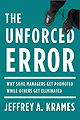
We all make them. Ethics breaches and scandals and performance-related turnover are increasingly found in today’s headlines. As in tennis, the unforced error is made by someone with the ability to keep the ball in play but who makes a mistake, resulting in the loss of a point. To improve your game you need to develop the habits that will help you keep the ball in play. It is your performance over time—a steady game—that will get you where you want to go. That’s what The Unforced Error: Why Some Managers Get Promoted While Others Get Eliminated
The most dangerous errors—and the one discussed in this book—are “the ones we don’t recognise, so we can’t fix them before the damage is done.” Krames divides unforced errors into two groups: the unforced operating error (the ones we all make in the course of doing our job; a bad call) and the unforced nonoperating error (errors not directly related to the conducting of business, but can shatter a career nonetheless - errors of character). Krames writes, “There are seldom excuses for unforced nonoperating errors. You have to have the awareness, self-control, and maturity to avoid them.” The focus of this book is the former kind, the unforced operating error.
There is a key to avoiding unforced errors. Not surprisingly, the key is humility. “That’s because humility—one of the most underrated of all leadership qualities—is essential to developing the strength and consistency to avoid unforced errors.” It’s the kind of humility that comes from having the self-confidence to admit mistakes, blind spots and then move on to correct the mistake. Rarely would you be told that you were fired due to a lack of humility, but it is the trigger for so many unforced errors. Krames successfully helps you to recognise an unforced error when you see it. In each chapter that covers a specific unforced error, he offers sensible and pragmatic advice on how to avoid these “career killers.” His advice includes:
- Never say the ball was out by a mile. Face reality at all times.
- Nothing is as important as people decisions. Get the right people.
- When you do make a people mistake, fix it as quickly as possible.
- Don’t overlook the wild card. Develop the next generation of leaders.
- Keep your game inbounds. Living and leading by the rules.
- Step up to the net. Take ownership of your part of the court.
- Watch the whole court. Find out who the real line judge is in your game and make sure they know how you’re doing.
Avoiding the Unforced Error
Leadership Lessons for the New Year
To be a great leader, you have to be intensely focused on the core mission of your organisation: know it, understand it, and live it. Make sure everyone in your organisation can answer these questions: Who are we? What do we do? Whom do we serve? At the end of the day, the mission is the true North Star that guides every action you take.
Leadership Lessons for the New Year
Tuesday, January 05, 2010
Leadership Lessons for the New Year
The actions of great leaders are consistent with their words. Saying the right thing doesn’t mean much. Doing the right thing means everything when you want people to follow you passionately.
Leadership Lessons for the New Year
Treating People with Respect
'Q. What are the most important leadership lessons you’ve learned?
A. I was a mechanic in the Navy. And mechanics in the Navy are like mechanics in airlines. You may have more stripes than I do, but you don’t know how to fix the airplane. You want me to fix it? You know how much faster I could fix the airplane when I wanted to, than when I didn’t want to? So I’ve always felt that if you treat me with respect, I’ll do more for you.
As I went up the ladder in the Navy, I never forgot what it’s like to be down the ladder, and that being good at your job is predicated pretty much on how the people working for you feel.
Here’s my theory: Let’s say we’re all midlevel managers, and one V.P. slot is going to open up. I’ve got 10 guys working for me, and for the last five years, every time I got any recognition, I said, “Bring them on the stage with me.” Who do you think is going to get the job? I’m going to get the job.
Q. How did you put together the team back in the early 1990s to turn around Continental Airlines?
A. I hired the best people. The sickest patients need the best doctors, so you can’t skimp on this stuff. I took the 20 top guys and I said: “I’ll create a bonus plan so that if we hit these numbers, I get paid and you get paid. And either all of us are going to get paid, or nobody’s getting paid.” And I never missed.'
For the full interview, see - http://www.nytimes.com/2010/01/03/business/03corner.html?ref=business
Treating People with Respect
Monday, January 04, 2010
Discovering Your Strengths
It’s ironic that your strengths can be so easy to overlook, because they’re clamoring for your attention in the most basic way: Using them makes you feel strong. All you have to do is teach yourself to pay attention. Try to be conscious of yourself and how you feel as you’re completing your day-to-day tasks. Most of the time, we’re so focused on getting our work done that we don’t really have time to notice how we feel about it. At the end of the day, we go home and tell our loved ones that it was a good day or a bad day, but we haven’t made the effort to notice why the day feels good or bad as it happens.
When you make the conscious effort to notice yourself at work (or at play, for that matter), you will find that you experience what are called “strong-moments” throughout your day—times when you feel invigorated, inquisitive, successful. Those moments are the best clues as to what your strengths are.
There’s also a simple acronym to help you recognise the signs of strength: SIGN.
•S - Success: Do you feel a sense of accomplishment about finishing a task?
•I - Instinct: Do you instinctively look forward to this task?
•G - Growth: Are your synapses firing? Are you mentally focused?
•N - Needs: Does this task fulfill one of your needs?
If you notice yourself feeling any of those feelings while doing a task, chances are that activity is one of your strengths.
Discovering Your Strengths
Sunday, January 03, 2010
Who Would You Rather Follow?
"When I left the dining room after sitting next to Gladstone, I thought he was the cleverest man in England. But when I sat next to Disraeli I left feeling that I was the cleverest woman."
Perhaps you know leaders like Gladstone—confident individuals who exude wit, intelligence, and charisma. Whenever you're around them, you cannot help but notice their charm…because they make every effort to parade their brilliance in front of you. However, you would most likely prefer to follow someone like Disraeli, a leader who would rather draw out the best in you than strut his or her personal greatness.
In relationships, be impressed with others instead of trying to make an impression. Throttle back on the urge to make your presence felt, and instead look for ways to esteem those around you. By expressing genuine interest in the people in your life, you'll win friends and gain favour.
Who Would You Rather Follow?
Saturday, January 02, 2010
Characteristics of Greatness
How great athletes think:
1. It’s personal
They hate to lose more than they love to win. People that aspire to greatness know that defeat just isn’t an option.
2. Rubbing elbows
They understand the value of association. We become the people that surround us. Those of us who are aspiring to greatness, it is our job to rub elbows with the right people and to learn what makes them successful and what keeps them going. In turn, it is up to them to help us better ourselves. And if you can’t change the people around you, then choose different people to be around. Think about it.
3. Believe
They have faith in a higher power. It is proven that a strong spiritual commitment, and a strong belief in faith is linked to a positive outcome. In our current economic state, always remember the power of a positive mind-set and the importance of belief in beating the impossible.
4. Contagious enthusiasm
They are positive thinkers… They are enthusiastic… and that enthusiasm rubs off. When you’re trying to work through your challenge-professional or personal – do so with the belief that the best is yet to come. Stay positive.
How they prepare:
5. Hope for the best but…
They prepare for all possibilities before they step on the field. Even if you are an eternal optimist, you also need to be a realist. So contingency-plan.
6. What off-season?
They are always working towards the next game… The goal is what’s ahead, and there’s always something ahead. if you visualise where you want to be and work backwards from there, you can always be moving the ball forward.
7. Visualise victory
They see victory before the game begins. Positive visualisation is a proven ingredient of a successful outcome.
8. Inner fire
They use adversity as fuel.One thing in life is certain… none of us gets through without adversity. What matters is that we find the strength to work through it. When we are knocked down, it may take hours, days, weeks, or months, but we need to get back up.
How they work:
9. Ice in their veins
They are risk-takers and don’t fear making a mistake. Failure is one of our greatest teachers.
“I’ve missed more than 9,000 shots in my career,” NBA legend Michael Jordan, who was known for his late-game heroics in addition to six national titles, once said. “I’ve lost almost 300 games – 26 times, I’ve been trusted to take the game winning shot and missed. I’ve failed over and over and over again in my life, and that is why I succeed.”
10. When all else fails
They know how – and when – to adjust their game plan. Flexibility and adaptability is essential to survival.
11. Ultimate teammate
They will assume whatever role is necessary for the team to win. Individual accomplishments are important, but the sum is always greater in value than the individual parts. How much do you step up to help those around you? When others around you thrive, you thrive as well.
12. Not just about the cash
They don’t play just for the money. It’s never about the money. And if it is, it’s about the wrong thing. The money will come if you follow your passion… if you become a part of something bigger than yourself.
How they live:
13. Do unto others
They know character is defined by how they treat those who cannot help them. One of the greatest sources of satisfaction is helping others, from a truly altruistic standpoint. We all have something to give… our time, our experiences, our compassion.
14. When no one is watching
They are comfortable in the mirror… they live their life with integrity. “What matters is not what you do when everyone is watching. What matters is what you do when no one is watching.” Your ultimate accountability has to be to yourself.
15. When everyone is watching
They embrace the idea of being a role model. As leaders, we have an obligation to promote positive leadership, and demonstrate the positive influence we can have on others. Our actions shape those coming behind us.
16. Records are made to be broken
They know their legacy isn’t what they did on the field. They are well-rounded. A legacy isn’t what you took from this world. A legacy is what you leave behind.
Characteristics of Greatness
Friday, January 01, 2010
Thursday, December 31, 2009
Moving from 'Survive to Thrive' in 2010
While the stock market has bounced back off its low for the year, economic and organisational growth is still hard to come by. Speaking with business leaders across a wide spectrum of industries one major question seems to resonate broadly: Now that we’ve survived in this tough environment, how do we return our focus to thriving?
Leaders and mangers have learned a lifetime worth of lessons about how to do more with less; leaders and organisational members have learned how to maintain competitive and financial positioning during adversity.
Setting goals on survival was necessary, but it will not suffice going forward from here. Business leaders who don’t begin to focus on how to thrive in the new economic reality simply won’t. Worse, survival strategies get shakier the longer the need to engage in them.
So as you complete your annual organisational goal-setting practice, how should you recalibrate your focus? How do you create a way up and onward, and motivate your team or organisation to get there? Here is a short list of practices that will help you set goals that align with a new, more positive and thriving-focused organisation.
Frame your goals positively.
Your team or organisation will focus on what you put in front of them. Create goal statements which include positive phrases rather than negative ones. For example, if an organisation had 100 new sales contracts last year, and this year will be tougher, your team may work harder to close 95 new sales contracts than to keep sales within 5-10 percent of last year’s production.
Always create a goal structure which emphasises what you do want, rather than limiting what you don’t.
Maintain a present and future outlook.
As a rule of thumb, comparison goals are difficult to use to motivate team members when faced with such an environment. Goals which relate to a percentage of growth or decline over a previous year keep the team focused on what happened last year, rather than what will happen this year.
Create goal statements that orient your team on the present and what is to come in the future.
Goals need to be specific and measurable.
Broadly defined goals tend to become abstract in the execution. Think about what the outcome of each goal will achieve and how specifically progress can be measured during the year. Whenever your team reaches a milestone metric, recognise and celebrate the progress.
Over-communicate goals and progress.
Once you have a goal statement that is positive, present and future oriented, specific and measurable, you have a great leadership opportunity. Remember the statement that teams and organisations focus on what is in front of them. Keep your goals in front of your organisational members.
If the goal is presented in this positive manner, over communicating it is a good thing. It emphasises where you are going - not where you have been.
Leaders who excel in this type of goal setting don’t end their work when the goal statement is written. These statements become the language of leadership in the coming year. Help your team understand how their individual roles relate to the organisational goals. Help them see how the tasks that they are assigned support the team in realising those goals.
Create an organisational focus on thriving in 2010 rather than surviving. Doing so will require some new thinking, innovation, and committed persistence. Having learned how to do more with less, use these creative building blocks to continue to enhance your team’s efficiency.
Positively framed goals and clear, consistent communication of these efforts will help you to lead your workgroup or organisation toward improvement and success in the coming year.
You have survived. Now take the opportunity to thrive. Engaging in a positive, purposeful leadership style will assist you in motivating your team and creating a resilient and focused organisation this coming year.
Moving from 'Survive to Thrive' in 2010
Leadership Resolutions for 2010
Motivating yourself:
1.Keep a positive outlook. When you experience challenges, you’ll find optimism works wonders.
2.Believe in yourself. Guess what – there’s no-one else in the world like you!
3.Set yourself meaningful and achievable goals – keep measuring your success.
4.Develop and follow an action plan.
5.Find ways to enjoy what you’re doing.
6.Keep your enthusiasm levels high. Celebrate your successes / achievements.
7.Be kind to yourself. Self-criticism will lead you nowhere.
8.Move on from your mistakes. Learn from them and grow.
9.Avoid negative people. Know when to cut lose and move away. Surround yourself with successful, positive people.
10.Never stop learning.
11.Know that you will succeed!
12.Set yourself new challenges.
Motivating others / motivating your team:
1.Let your positive outlook be infectious. Spread it around.
2.Tell and show your team you believe in them.
3.Work to set meaningful, measurable and achievable goals.
4.Develop an action plan with them and help them stick to it.
5.Keep it fun for them.
6.Acknowledge and recognise their achievements, privately and publicly.
7.Never criticise. Instead, commend their achievements, make recommendations and lead by example.
8.Don’t worry about their mistakes. They need to make them. Your role is to help them learn by doing.
9.Overcome any negativity with action plans, tips, training and new ideas.
10.Show them, by example, how to duplicate themselves.
11.Keep dreams alive by constantly reinforcing the big picture.
12.Encourage them to keep setting challenges for themselves.
Leadership Resolutions for 2010
Wednesday, December 30, 2009
Focus on Leadership in 2010
Solid business results that stand the test of time do so for one reason and one reason only: consistently excellent leadership. Products and services change with the demands of the market. Individual leaders come and go. The key is to create an organisational culture that ensures great leadership today and tomorrow.
We recommend that you institute proven across-the-board behaviours that don’t depend on particular individuals. These five leadership tactics will help you see significant changes by the end of 2010:
1. Move low performers. Despite the layoff ax so many companies have wielded during the past year, low performers still work inside many organisations and they are causing big problems. Turning a blind eye to these individuals in your organisation squelches profitability. Why? Because middle performers get pulled down to the low-performer level, while high performers either a) disengage or b) leave.
2. Accentuate the positive. The next time you’re having lunch in a restaurant, listen in on the conversations at nearby tables. Chances are, you’ll hear people griping about their workloads, difficult clients, annoying colleagues, or the ridiculousness of corporate policy. Everyone does it, but if they realised how harmful it is to their company, perhaps they’d think twice. The solution is to hone the fine art of managing up.
3. Make a real connection with employees. Think of a doctor making her daily rounds to check on patients. Well, 'rounding' helps you communicate openly with your employees, allowing you to regularly find out what is going well and what isn’t going well for them at the company. But remember it’s not just empty “face time”—it’s rounding for outcomes, which means the process has a serious purpose.
4. Say thanks. In fact, put it in writing. Send thank you notes to employees who do an excellent job. But that doesn’t mean just sending the occasional note when someone goes far above the call of duty. It means literally mandating a specific number of thank you notes for leaders to send to the people they supervise. People love receiving thank you notes. They cherish them.
5. Don’t just recruit great employees. Re-recruit them. If you plan to hire in 2010—and as the recovery (hopefully) picks up steam, many will—here’s a relatively easy step you can take that will pay off in a big way. We all know employee turnover is expensive. But did you know that more than 25% of employees who leave positions do so in the first 90 days of employment? To retain a new team member, the leader needs to build a relationship. Scheduling two one-on-one meetings, the first at 30 days and the second at 90 days, has an enormous impact on retention that directly turns into savings for your organisation.
Once you start implementing these tactics, results quickly follow. Your employees will see that you care about them, which boosts morale, improves performance, leads to happier customers and higher profits. Creating satisfied employees is of critical importance, especially right now.
Focus on Leadership in 2010
From the Court to the Boardroom
Judging from his relationships with former players, perhaps the greatest business lesson to be learned from Wooden is how leaders should treat the people around them. "Make those under your supervision understand that you really care for them, not just for what they're doing in the corporation but that you really care for them," Wooden says. "I think anyone in a supervisor position has to do that." For him, that meant letting his players know they weren't playing for him, but with him as they worked toward a common goal. "My success was largely dependent on the type of youngsters I had under my supervision," he adds.
The mark of a great leader is someone who's successful over time, and that's just what Coach Wooden has proven to be.
From the Court to the Boardroom
Coaching: How the Best Leaders Teach
Its not easy to teach people how to think, yet this skill is a must for effective leadership. It requires patience and foresight...and time. Yet if we don't teach others how to think on their own, we waste time in the long run because our team will be forever dependent upon our knowledge base for answers.
- Listening - Through the gift of listening, leaders demonstrate humility and respect. Additionally, new ideas often emerge when people process out loud.
- Creating Awareness - Great questions create learning because they encourage thinking. The process of answering a question creates more learning than a "lecture".
- Planning and Goal Setting - A good action plan teaches us to stretch beyond what we might ordinarily think possible.
- Managing progress and accountability - Done well, accountability teaches us to celebrate our success and to reflect and course correct if necessary.
Coaching: How the Best Leaders Teach