Positive Leadership has also been recognised as a Top 50 Leadership Expert to Follow on Twitter.

Follow us on Twitter @posleadership


LEADERSHIP IS A PROCESS OF SOCIAL INFLUENCE, WHICH MAXIMISES THE EFFORTS OF OTHERS TOWARDS THE ACHIEVEMENT OF A SHARED GOAL.
Showing posts with label Character. Show all posts

Tuesday, March 25, 2014

Positive Leadership: The Science of Character


Share/Save/Bookmark

Friday, October 25, 2013

Positive Leadership: Principles


Share/Save/Bookmark

Tuesday, August 27, 2013

Positive Leadership: Hire Character, Train Skill

‘Hire character, train skill’ - as a leader, the next time you think of measuring your success, consider counting a different number, that is the number of great leaders (inside and outside your organisation) that you helped nurture and helped create!

Share/Save/Bookmark

Wednesday, April 10, 2013

Positive Leadership: The World's Most Reputable Companies


Leaders ought to be more concerned with character than with reputation. "Character is like a tree, reputation is like a shadow. The shadow is only what we think it is, the tree is what it really is" Abraham Lincoln


Share/Save/Bookmark

Tuesday, March 26, 2013

Positive Leadership: Breaking Out of Your Comfort Zone


Douglas Conant is an introvert.

But when he took over as president and CEO of struggling Campbell Soup Co., he realised he had to break out of his comfort zone, get in front of his staff, and make some bold declarations from the get-go……
Campbell was in rough shape when Conant joined the company in January 2001. …Conant took a good long look at staff morale and didn't like what he saw.

"We had a toxic culture. People were understandably jaundiced with management," he said. "It was hard for me to imagine that we could inspire high performance with no employee engagement."….

To improve the culture in the workplace, Conant started at the top. He held weekly staff meetings and used a scorecard that evaluated each leader's performance. He created a leadership model that outlined expectations. The number one expectation was inspiring trust--and that meant managers had to have a certain level of both "competence and character," he said.

"You have to know what you're doing, and you have to do what you say you're going to do. Before you have the moral authority to lead your team, you have to inspire trust," he said. "Trust is the one thing that changes everything. In a high-trust culture, it's so much easier to get things done."…… How could we be a higher-ambition company if we didn't have higher-ambition leaders?"……

Many people weren't cut out for the job. In the first three years, 300 of the top 350 leaders at the company exited. Conant focused on making those who stayed and were committed to the mission feel good about their work. In fact, he went so far as to write 10 to 20 handwritten personal notes to employees at all levels of the organization each day to recognise those who were performing well. During his 10-year tenure as CEO, that added up to over 30,000 notes to his 20,000 employees. Conant started to feel a change in the work atmosphere……..

Conant established two performance metrics to measure progress, one based on economic value, measured by shareholder returns compared to competitor companies; and the other based on social value, measured by the Gallup Employee Engagement Index……

The company made steady progress in both areas. For the six years preceding July 2010, Campbell's cumulative total shareholder return was 64%, nearly five times the 13% return of the S&P 500. And by 2010, the Gallup Employee Engagement Index showed that for every 17 engaged employees, only one was disengaged, a ratio that exceeded Gallup's "world-class" benchmark of 12:1. More impressively, the engagement ratio for the top 350 leaders was an amazing 77:1…..

……And ultimately, Conant found that as CEO, taking centre stage and leading the efforts made all the difference. Perhaps just as importantly, he knew his company subscribed to what he preached.
"CEOs must lead from in front. And we have to behave our way to more credibility," said Conant, who retired from Campbell in 2011 and is now founding CEO of Conant Leadership. "It's not what you say, it's what you do."  

For the full article, see: http://hbswk.hbs.edu/item/7133.html

Share/Save/Bookmark

Wednesday, November 07, 2012

Positive Leadership: The Qualities of the Most Successful US Presidents


Knowing the traits that forged the best U.S. presidents could have helped US voters grasp what's necessary to succeed in the Oval Office. Here are some interesting historical perspectives on the key qualities needed for success:

• Show vision. The best-rated presidents conveyed the direction they wanted to take the nation. Abraham Lincoln and George Washington, fixtures at the top of historical rankings, exuded that quality of setting a futuristic tone. Thus Washington shaped the presidency, and Lincoln reshaped the nation. Ronald) Reagan had it too. His concept that it was possible to win the Cold War was visionary. Almost no one else, in or out of government, thought there was any prospect of that.

• Have self-confidence.  Washington was secure enough to recruit the greatest minds ever assembled in a Cabinet: future high-ranking Presidents, Thomas Jefferson and James Madison, plus Alexander Hamilton. The first president knew he needed their help to shape the nation. Lincoln, a one-term congressman, had no problem deferring to or overruling his secretary of state, William Seward, who many thought was more qualified to be president.

• Be humble. It's not just that Lincoln had the ability to reject advice from more qualified people. It's that sometimes he listened to the advice, took it seriously and changed his mind. The 16th president could acknowledge that he very well might be wrong on issues. That attribute prevented Lincoln from making the catastrophic mistakes that someone who lacked humility might make. Washington and Lincoln were secure enough that they didn't feel they were the smartest people in the room. The same could be said of Harry Truman. The 33rd president called George Marshall the greatest man in the country and that if the former Army chief of staff could take the presidency, he'd resign in a minute.

• Character does matter. The top-ranked presidents who were most upstanding were Lincoln, Washington, Reagan, Truman and Dwight Eisenhower.

• Be diverse. Career politicians were less capable as president when rated against men who entered office with varied backgrounds. Some soldier-presidents — such as Washington, Eisenhower, U.S. Grant and Truman, with their sense of management were highly capable presidents. The ones who didn't plan on being president from the time they were little tended to excel! For example, political ambition came to Ronald Reagan late in life and Washington thought he'd die a soldier. As it turned out, the general won the Revolution and became the father of the USA.

Share/Save/Bookmark

Sunday, September 30, 2012

Positive Leadership: Winning the Ryder Cup


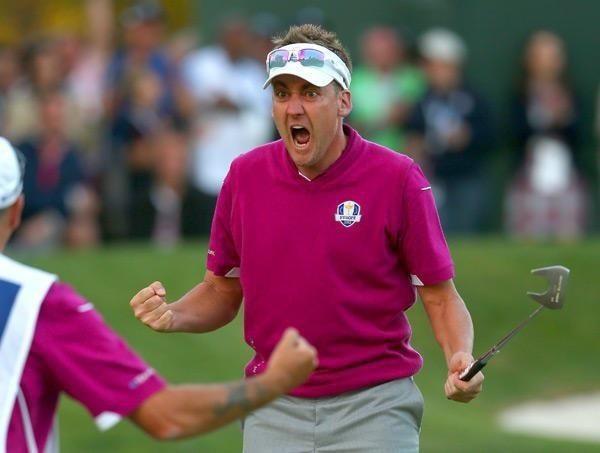
If this Ryder Cup is to be saved by Europe then each of the team has to take inspiration from Ian Poulter and find the champion within themselves. 

It's simply a matter of pride and, of course, passion.

There are few lonelier places in sport than the final day singles of a Ryder Cup. Nowhere to hide, no-one to hide behind. These men are on their own. Still a team but on their own. While stroke play might be the better test of golf, match play is by far the better test of character. 

Twelve points to be won by twelve great golfers. It can be done! Good luck Team Europe!

Share/Save/Bookmark

Wednesday, June 06, 2012

Positive Leadership: The Olympic Spirit - Never Quit!

Derek Redmond is best remembered for his performance at the 1992 Olympic Games in Barcelona where he tore his hamstring in the 400 metres semi-final but fought through the pain and, with assistance from his father, managed to complete a full lap of the track as the crowd gave him a standing ovation.

The incident has become a well-remembered moment in Olympic history, having been the subject of one of the International Olympic Committee's 'Celebrate Humanity' videos and been used in advertisements by Visa as an illustration of the Olympic spirit and featured in Nike's "Courage" commercials in 2008.


Share/Save/Bookmark

Thursday, May 31, 2012

Positive Leadership: Demonstrable Values and Integrity are Key to Economic Recovery


Giving the sixth annual ICAS Aileen Beattie Memorial Lecture recently, Douglas Flint CA, the Group Chairman of HSBC Holdings PLC, said that while the financial crisis was a “great opportunity to move things forward to learn lessons, [and] to fix things that need fixing”, it was also an opportunity for some “to take advantage of people’s fear of repetition to offer seductively attractive remedies that only address symptoms rather than causes”.

As well as addressing the fixes needed in the financial system, Flint said, it was important offer a positive vision and “to focus on what we want the wider financial system and banks in particular to do”.

Flint said restoration of confidence was important to recovery, and if this were to happen there needed to trust in leaders, in their motives and their data.

He emphasised the importance of behaviour: “the greatest opportunity for improvement will come from defining, teaching, reinforcing, rewarding and enforcing values in terms of behaviour”.

If behavioural values are to be relied upon it requires trust in organisations, Flint said. Assurance that this trust has been earned has to be built into the system.

He urged regulatory and public policy bodies to think more deeply about how to understand - “and if necessary shape” - the character and culture of the organisations critical to the financial system.

He said people should “care more about tone from the top, how individuals are screened for behavioural characteristics when recruited or promoted, how ethics and values are taught and reinforced, how values are enforced and rewarded”.

Flint listed the elements he felt needed to be embraced: “independence of thought, character, judgment, accountability, responsibility, a duty that goes beyond one’s own self-interest or the narrow interest of one’s employer to one’s underlying principles and integrity”.


Share/Save/Bookmark

Tuesday, May 22, 2012

Positive Leadership: Performing with Integrity and Character

Still as inspiring as the first time we saw it!


Share/Save/Bookmark

Friday, April 06, 2012

Positive Leadership: What is Character?


"Good character is the quality which makes one dependable whether being watched or not, which makes one truthful when it is to one's advantage to be a little less than truthful, which makes one courageous when faced with great obstacles, which endows one with the firmness of wise self- discipline."  - Arthur S. Adams

Share/Save/Bookmark

Wednesday, December 21, 2011

Positive Leadership: Integrity in Golf


In 1955, Arnold Palmer played with Gene Sarazen, the 1935 winner, in his first competitive round at the Masters. He dined frequently with Bobby Jones, battled Jack Nicklaus in his prime and has known every significant golfer since. 

What is it about golf that he most values and wants to pass along to a younger generation?

"The integrity of the game. It's hard to describe what I mean by that. You immediately think of honesty, but it's more than that. It's a lifestyle. It's something people see. It's something that golf delivers to the public like no other sport.

Truthfulness is part of it. Most of the golfers I've known along the way had good character. Certainly the best ones did. That doesn't mean they never did anything wrong. They all had a drink now and then, but the top golfers generally have all been upstanding. I think that's very important to impress on the young players.

Integrity, in Palmer's mind, isn't far removed from style. The way a player dresses and walks and comports himself feeds into the way he plays. You could spot Hogan or Nelson halfway across the course, just walking, not even swinging, and know instantly who they were. They owned who they were.”

Share/Save/Bookmark

Friday, November 11, 2011

Positive Leadership: Beating the Odds

Beating the odds in a fight against a deadly cancer for most people would mean staying alive. For Mark Herzlich, who was diagnosed with bone cancer while he was a football star at Boston College, living meant playing football in the NFL.


Share/Save/Bookmark

Thursday, November 03, 2011

Positive Leadership: The Importance of Character Education


Share/Save/Bookmark

Thursday, June 09, 2011

Positive Leadership: Character vs Charisma

Leadership expert, John Maxwell, author of The 21 Indispensable Qualities of a Leader: Becoming the Person Others Will Want to Follow speaks about Character vs Charisma:


Share/Save/Bookmark

Wednesday, April 27, 2011

Positive Leadership: A Video Every Leader Will Benefit From Watching

In one of the most memorable races in Olympic history Derek Redmond of Great Britain finishes his 400m Semi-Final crying on the shoulder of his father. Powerful. Utterly Olympic.

This take on Redmond's historic Olympic run gets the goose bumps going, but also drives home some valuable leadership lessons. We're all subject to disappointment and failure, but leaders are defined and remembered for how they react in times of crisis. Similarly, the people we surround ourselves with are often the keys to our achievements, helping us through when the going gets tough. When your time comes, how will you react, and who will help you through the finish line?


Share/Save/Bookmark

Monday, March 21, 2011

Positive Leadership: Stuart Holden

Bolton Wanderers midfielder Stuart Holden, who comes from a Scottish family, albeit he plays for the USA, has been ruled out for six months as a result of the injury he sustained in a challenge on Saturday. 

Today's comments from his manager, Owen Coyle, sum up why this talented footballer has played in the World Cup Finals for his country:

"First and foremost our main concern is for Stuart and his recovery. He will get all the time and support that he needs. Stuart has been outstanding for me this season and he has shown in his performances that he is one of the best midfielders in the Barclays Premier League. He has such desire, strength of character and a winning mentality, and he will draw on all those attributes in his rehabilitation."

Share/Save/Bookmark

Tuesday, March 08, 2011

Positive Leadership: Leadership & Capability


Former HP ceo, Carly Fiorina explains that leadership is about three things: capability, collaboration and character. 

She stresses the importance of capability, which is about asking questions and listening to answers. It is also about celebrating new ideas and taking initiative to try new things. She insists that a continuous learning process is important to strengthen an entrepreneur's capability


Share/Save/Bookmark

Thursday, December 09, 2010

Performance and Fulfillment

In business you need high performance. In life, you need a sense of fulfillment. In leadership you need both. 

Performance is external. Fulfillment is internal. Performance comes from achievment of something beyond yourself, whilst fulfillment emerges and grows from within - when your achievements are congruent with a consciously held purpose and the values that you choose to define your character.
                           
Performance requires rules and discipline to control some 'part' of your life. Fulfillment is the freedom to choose your response without manipulation.

Performance is to prove something. It requires finite measurement. Without proof, there would be no performance.

Fulfillment means you dont need to prove anything. Fulfillment is endless and unmeasurable. It flows from a sense of completeness. When your whole life environment feels fully integrated, you don't need more of anything.

Performance requires you to consume something - resources, time, your skills or energy. In order to achieve a certain performance you have to spend something. Fulfillment doesn’t need anything. It creates something good out of the current state, whatever that is. It is never expensive. It gives you something instead of taking something away.

Effective leadership flows from inside out, not from outside in. Effective leaders integrate performance and fulfillment, not choose between them. Success in business requires high performance. Success in life requires a sense of fulfillment.

In leadership, you need both together.

Share/Save/Bookmark

Tuesday, November 23, 2010

What is an Authentic Organisation?

An organisation is authentic when its actions, its character, and its sense of purpose are aligned with and support each other. 

An organisation can be authentic only when: 
  • The organisation knows ‘who it is” and what characteristics make it distinctive. 
  • People in the organisation understand why these distinctive features are meaningful.
  • The organisation knows what it is striving to create in this world. It has a sense of purpose that goes beyond the products and services it offers.
  • The organisation knows how its distinctiveness fuels and adds unique insight to the pursuit of organisation’s purpose.
  • The organisation has a few signature actions, behaviours and products that bring to life the organisation’s meaning, and move it towards its purpose.
  • Both the purpose and the distinctive, meaningful characteristics of the organisation resonate with stakeholders and draw members, customers, and constituencies to the organisation.
  • The organisation actively supports its members, customers, and constituencies in their own authenticity as they work with the organisation to achieve its purpose.


Share/Save/Bookmark