Positive Leadership Limited is a strategic leadership and corporate finance advisory firm. We use our considerable experience to provide unique perspectives and innovative solutions which help corporate leaders unlock maximum value from complex business challenges. There is no dress rehearsal for delivering answers to critical business challenges. When you are under intense pressure to succeed, we help deliver the vitally important marginal gains which let your business excel and win.
Wednesday, November 07, 2012
Positive Leadership: The Qualities of the Most Successful US Presidents
Tuesday, October 23, 2012
Positive Leadership: C.K. Prahalad on Leadership
Wednesday, May 23, 2012
Positive Leadership: The Importance of the Softer Side of Leadership
Thursday, April 12, 2012
Positive Leadership: Humility in Great Leaders
Many people lack this trait, which is why, if they are in a leadership position, they fail long term. Those who truly want to be first need to put themselves second.
Former Super Bowl winning NFL coach, Tony Dungy powerfully shares why he is second in this video:
Positive Leadership: Humility in Great Leaders
Thursday, March 10, 2011
Positive Leadership: Leadership Lessons from Walmart
Monday, July 12, 2010
The 5 Characteristics of a CHAMP Leader
Thursday, May 13, 2010
Bono at 50: The Leader We Need
The most important problems confronting us now, including a precarious global financial system and an equally vulnerable environmental system, do not come in separate buckets labelled "business" and "public policy." These are challenges that are smashing through older boundaries and helping redefine organisational place and mission.
Bono, like Abraham Lincoln 150 years ago, has not let himself become isolated in an elite atmosphere. He has used his touring and travels as classrooms to help him understand the hopes, dreams and tribulations of his fellow citizens, whom he often calls his brothers and sisters. And he has used this knowledge to light his way, his music and his leadership.
Bono at 50: The Leader We Need
Wednesday, May 05, 2010
BP Boss Needs to Do More
Sunday, May 02, 2010
Great Leaders are Fair Leaders
Thursday, April 08, 2010
Sunday, February 28, 2010
Values Based Leadership
“I wrote ‘The Imperfect Leader’ to explore the ‘not-so-secret’ secrets of transformational leadership,” Taylor writes in his introduction. “It takes a leader who embraces a worthy mission, envisions a compelling, preferred future, and then leads from personally-held core values to engage and motivate employees to exceptional performance through values-based leadership.”
The book is appropriate for anyone who finds themselves in a leadership position, be it the upper echelons of corporate management or a small subcommittee, school, church or even at home.
The elegantly-written narrative acquaints the reader with Josh McCall’s plight: he is drawn to leadership positions and does reasonably well in them. Unexpectedly, he finds himself unemployed, humiliated and unable to provide for his family. At first he is insulted by leadership-expert George’s questions: “What are you trying to do, and what about you is standing in the way?” It does not take long before the two men are meeting weekly in a coffee shop to discuss values-based leadership. Through their discussions, George’s presentation and a meeting with a local business owner who successfully puts the values into practice, the reader gains an understanding of this common-sense leadership philosophy.
Interspersed throughout the book are the main tenets of values-based leadership to aid the reader in examining the framework of the philosophy. “Humility is the one indispensable trait of truly values-based leaders.” Humility is also almost impossible for the characters to define.
Nonetheless, the message here is that a good leader is not after personal gain and status but a positive, satisfying, encouraging environment for those they lead and clients they serve. Everyone must share the organisation’s values to achieve superior and transformational results.
Values Based Leadership
Wednesday, February 17, 2010
How to Become a Positive Leader
To become a person of integrity and a positive influencer, you need to develop the following qualities:
1. Fulfill your commitments-one of the surest ways to break trust with people is to renege on a promise. Hence never promise anything you can’t or don’t intend to keep.
2. Live honestly- choose to be truthful; avoid telling lies. Avoid hypocrisy and duplicity; be consistent in your character with everyone. This will make people have good impressions about you.
3. Exemplify humility-People tend to distrust someone they perceive to be driven by ego, jealousy or an air of superiority. Humility is one of the hallmarks of an effective leader and a positive influencer.
4. Imbibe an attitude of service- leadership is all about serving others and not an opportunity to be served. Sir Wilfred T. Grenfell says “the service that we render to others is really the rent that we pay for our room on this earth.” Leaders are to give of their time, energy and gifts to others.
5. Do the first things first- Resist the temptation to do the easy and quick activities because these are often the trivial things. Zig Ziglar says “when you do the things you have to do when you have to do them, the day will come when you can do the things you want to do when you want to do them.”
How to Become a Positive Leader
Tuesday, February 16, 2010
Why Sport Matters
Why Sport Matters
Friday, February 12, 2010
Five Ways for a Leader to Motivate the Team
2. Jump into the Trenches – You need to be humble and hungry. Humble in that you seek to learn, grow, and improve every day, and hungry with a passion to work harder than everyone else. Now is not a time to be barricaded in your office. Now is a time to be in the trenches with your people, leading, working, and building a successful future.
3. Fill the Void - These are uncertain times. Employees are questioning how their industries and jobs will be impacted by the current economy. They’re unsure about what actions to take. Unfortunately this uncertainly creates a void and where there is a void, negativity will fill it. In the absence of clear and positive communication, people start to assume the worst, and they will act accordingly. Make transparency the norm, not the exception—after all, the more you communicate, the more you foster trust, and the more loyalty is built. Talk to your team members often, and let them know where they stand. Host frequent town hall meetings, host a weekly conference call, send out a daily email, and share your positive vision for the future. As a leader, you must continually communicate, communicate, and communicate.
4. Share a Positive Vision – Rally your team around a positive vision for the road ahead. Instead of being disappointed about where you are, decide to be optimistic about where you are going. Vision helps you and your team see the road ahead and it gives you something meaningful and valuable to strive towards. Discuss where you have been, where you are going and why you are going there. Martin Luther King Jr. had a dream/vision and he changed the world with it. Share your dream and improve your organisation with it. After all, if you think your best days are behind you, they are. If you think your best days are ahead of you, they are.
5. Teach Your People to Be Heroes, Not Victims - Heroes and victims get knocked down. The distinction between the two groups lies in the fact that heroes get back up while victims simply give up. Help your employees to realise that they are not victims of circumstance. Rather, remind them that they have a high locus of control—in other words, they have a significant influence over how things turn out. Faith and belief in a positive future lead to powerful actions today! Life is a story, and the story we tell ourselves and the role we play determines the quality and direction of our life. The most successful people and teams are able to overcome adversity by telling themselves a more positive story than the rest. Instead of a drama or a horror movie, they define their life as an inspirational tale. Instead of being the victim, they see themselves as a fighter and over-comer.
Five Ways for a Leader to Motivate the Team
Tuesday, February 09, 2010
Being a Champion
Being a Champion
Monday, February 01, 2010
What Sets Roger Federer Apart as a Sporting Leader
This is a very interesting article and well worth reading -
http://www.brisbanetimes.com.au/sport/tennis/theres-only-one-roger-federer-20100129-n26k.html
What Sets Roger Federer Apart as a Sporting Leader
Thursday, January 28, 2010
Attitude is a Key Value of Positive Leadership
Attitudes can be either positive or negative. The notion of a positive attitude can be looked at from a whole variety of important dimensions, including courage, confidence, passion, enthusiasm, humour, patience, happiness and humility. A positive attitude often includes a simple smile.
While it's more common to promote a positive attitude, negative aspects can pop-up quite easily -- like arrogance, selfishness, complaining, comparing and judging others. These are dimensions of attitude that don't serve us well or for very long.
For this occasion, let's look at attitude from a couple of perspectives, enthusiasm and optimism.
Enthusiasm is derived from the Greek word for spirit. When you're enthusiastic, what spiritual well are you calling upon? Some say it's a virtue that inspires others to action even while it pushes fear and worry away for others.
Enthusiasm is contagious, but you can't pass it on unless you've got it yourself. George Bernard Shaw once said, “A candle loses nothing by lighting another.”
Greeting people with “I'm feeling great today” rather than just “I'm fine” or “OK” can set the tone for your conversations. Think about how a smile communicates your attitude. And a good belly laugh can really feel great, too.
People just naturally want to be around others who are upbeat. Enthusiasm is an attitude that we can choose.
Some wise person once said that an optimist is a human manifestation of spring. And springtime is when we're looking forward, we're planting, we're starting new projects, we're upbeat. This kind of positive outlook is a huge asset for anyone -- students, teachers, parents and leaders.
Humility is another valuable element of attitude. While some people think of this quality as meekness -- some say weakness -- it's more about respect and an unpretentious way of holding yourself.
As opposed to exalting yourself, it's about having a healthy ego. To many people, humility is born from one's spiritual perspective and has to do with yielding to a higher power, however you conceive of that. In the end, if you say you're humble, you're probably not.
There are lots of ways to work on your attitude. Here are just a few: be courageous and take calculated risks; try being patient; have confidence in your abilities; be open to seeing new possibilities; start your day with quiet reflection; and be grateful for the blessings you've received.
Viktor Frankl, the Holocaust survivor, once referred to attitude as “the last of the human freedoms.” Attitude is a choice. Choose well !
Attitude is a Key Value of Positive Leadership
Wednesday, January 06, 2010
Avoiding the Unforced Error

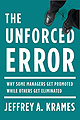
We all make them. Ethics breaches and scandals and performance-related turnover are increasingly found in today’s headlines. As in tennis, the unforced error is made by someone with the ability to keep the ball in play but who makes a mistake, resulting in the loss of a point. To improve your game you need to develop the habits that will help you keep the ball in play. It is your performance over time—a steady game—that will get you where you want to go. That’s what The Unforced Error: Why Some Managers Get Promoted While Others Get Eliminated
The most dangerous errors—and the one discussed in this book—are “the ones we don’t recognise, so we can’t fix them before the damage is done.” Krames divides unforced errors into two groups: the unforced operating error (the ones we all make in the course of doing our job; a bad call) and the unforced nonoperating error (errors not directly related to the conducting of business, but can shatter a career nonetheless - errors of character). Krames writes, “There are seldom excuses for unforced nonoperating errors. You have to have the awareness, self-control, and maturity to avoid them.” The focus of this book is the former kind, the unforced operating error.
There is a key to avoiding unforced errors. Not surprisingly, the key is humility. “That’s because humility—one of the most underrated of all leadership qualities—is essential to developing the strength and consistency to avoid unforced errors.” It’s the kind of humility that comes from having the self-confidence to admit mistakes, blind spots and then move on to correct the mistake. Rarely would you be told that you were fired due to a lack of humility, but it is the trigger for so many unforced errors. Krames successfully helps you to recognise an unforced error when you see it. In each chapter that covers a specific unforced error, he offers sensible and pragmatic advice on how to avoid these “career killers.” His advice includes:
- Never say the ball was out by a mile. Face reality at all times.
- Nothing is as important as people decisions. Get the right people.
- When you do make a people mistake, fix it as quickly as possible.
- Don’t overlook the wild card. Develop the next generation of leaders.
- Keep your game inbounds. Living and leading by the rules.
- Step up to the net. Take ownership of your part of the court.
- Watch the whole court. Find out who the real line judge is in your game and make sure they know how you’re doing.
Avoiding the Unforced Error
Friday, December 18, 2009
Derek Jeter - Sports Illustrated's 2009 Sportsman of the Year
'Derek Jeter of the New York Yankees captained the U.S. team in the 2009 World Baseball Classic, after which MLB commissioner Bud Selig sent him a letter of thanks in which he called him "Major League Baseball's foremost champion and ambassador."
"You embody all the best of Major League Baseball," Selig wrote in the March 30 letter. "As I mentioned to you in our recent telephone conversation, you have represented the sport magnificently throughout your Hall of Fame career. On and off the field, you are a man of great integrity, and you have my admiration."
For those achievements, but most especially for the principled, selfless manner in which he earned them, Jeter is SPORTS ILLUSTRATED's 2009 Sportsman of the Year. He is the first Yankee to win the award in its 56-year history and only the third baseball player in the past 34 years to win the award alone, joining Orel Hershiser (1988) and Cal Ripken Jr. (1995).
Jeter is an anachronism if you believe that manners and humility, the pillars of sportsmanship, are losing ground in an increasingly stat-obsessed, self-absorbed sporting culture in which the simple act of making a tackle, dunking a basketball or getting a base hit calls for some burlesque act of celebration, a marking of territory for individual purpose. Jeter is the unadorned star, and not only in the literal sense in that he is free of tattoos, piercings, cussing, posses and the other clichés of the big-time-jock starter kit. The actress Kim Basinger once captured the essence of Jeter as well as any scout, telling SI in 1999, "He's a hunk, and I don't even like that word. Women like guys who have a big presence but sort of play it down. It's very appealing."
Such uncalculating humility, alloyed to his formidable skills, is the same attribute that makes Jeter so appealing to teammates and foes alike.
Jeter's rare gift as a superstar athlete is that he doesn't so much inspire awe as he engenders comfort. To be around Jeter is to truly believe that things are going to turn out well, whether you are a fan who still wants to believe in the inspirational quality of sports and the people who play them, or a Yankee who wants to believe there is some way back from three runs down, five outs from elimination, against Pedro Martinez in his prime.
"Everything he does has such a grace about it," Oakland A's general manager Billy Beane says. "Even now, this last postseason, people would say to me, 'You must be rooting against the Yankees.' But you know, maybe because of Jeter, the Yankees know how to win. It's not an act. The Yankees' brand name in this era is that it is Jeter's era. It's similar to what DiMaggio was in his era."
Eight years ago, to his recollection, Beane watched Jeter run out a routine ground ball to shortstop in the late innings of a routine game in which the Athletics were beating the Yankees. Jeter ran down the first base line in 4.1 seconds, a time only possible with an all-out effort. Beane was so impressed by the sprint that he ordered his staff to show the video of that play to all of the organisation's players in spring training the following year.
"Here you have one of the best players in the game," Beane says, "who already had made his money and had his four championships by then, and he's down three runs in the seventh inning running like that. It was a way of showing our guys, 'You think you're running hard, until you see a champion and a Hall of Famer run.' It wasn't that our guys were dogging it, but this is different. If Derek Jeter can run all out all the time, everybody else better personally ask themselves why they can't."
Told the story, Jeter says, "It makes you feel good whenever anybody appreciates how you do things. My whole thing is, you're only playing for three hours a day. The least you can do is play hard. You have what, four or five at bats? O.K., it's not difficult to run, to give it a hundred percent. It's effort. You don't have to have talent for effort."
The idea of Jeter as a template stretches beyond 90 feet. He is a role model not only for how to play baseball but also for how to remain atop the wobbly pedestal of fame. '
For more, see - http://sportsillustrated.cnn.com/vault/article/magazine/MAG1163403/index.htm
Derek Jeter - Sports Illustrated's 2009 Sportsman of the Year
Friday, October 30, 2009
The Qualities of a Leader
During an interview with Knowledge@Wharton, Riady was asked what are the most important qualities of a leader?
'A leader needs to have a vision, because at the end of the day, the vision must drive the organisation. It must drive people. And a strong vision attracts people like a magnet and gets people to make changes in the community. But it's not just about having a vision. It's also about having humility. That's very difficult. The more successful you are, the more you face the temptation of being egoistic and full of pride. It's also about having the heart to serve, to do things not for yourself but for others. Those are the three things: vision, humility and the ability to serve.'
Riady was also asked for examples of what gives him pride in the work he is doing in education and healthcare? His answer points the way towards why Indonesia is making progress in international education tables and highlights what needs to happen in the UK as we slip further behind in education performance (eg the 2008 OECD international rankings place the UK 13th in reading - down from seventh in 2000 - and 18th in maths).
'I was not born into and did not grow up in a particularly educational environment. But it wasn't until when I went back to Indonesia in 1978 with my four children, who grew up in the U.S., and I had to look for schools for them that I realised that we do not have top schools in Indonesia that I would consider putting my children in. There is a great deficiency in education in Indonesia. I set out to contribute something, to make a change. So we set up the non-profit called [Pelita Harapan] Educational Foundation and started building schools and universities. Today, we have 20 schools and one university, which have transformed Indonesian education.
We introduced an education system that is not based on rote memorisation but the creative process of learning. It's not about knowledge; it's about the process of learning. We wanted small class sizes, and a holistic education that gets students to develop all parts of life. We don't just want to have good schools. We want to have model schools that other schools look at and want to copy. For the next generation, our schools hopefully will be a role model of what good education is all about, what good schools are all about. It's exciting because that's transformational.
We started paying teachers salaries that they deserve, increasing salaries three to four times more than what they were earning over the last 15 years and so instilling in the community that education has a high value. In today's modern society, there has been a shift. People do not respect and value teachers as much as they should.... I hope that when I finish my life that the biggest impact I have made will be in education.'
For the full interview, see - http://knowledge.wharton.upenn.edu/article.cfm?articleid=2365
The Qualities of a Leader