Positive Leadership has also been recognised as a Top 50 Leadership Expert to Follow on Twitter.

Follow us on Twitter @posleadership


LEADERSHIP IS A PROCESS OF SOCIAL INFLUENCE, WHICH MAXIMISES THE EFFORTS OF OTHERS TOWARDS THE ACHIEVEMENT OF A SHARED GOAL.
Showing posts with label Culture. Show all posts

Wednesday, February 19, 2014

Positive Leadership: 3 Steps to Positive Leadership

Improving the positive ratio of your own team can be as simple as making some important changes to your own leadership approaches:

1. Listen and show empathy: Without trust that flows from these, your people cannot develop a stable base at work so they feel comfortable to explore and take risks with their thinking. Most of your people are paid to think, so get on and create conditions for that to happen.

2. What they learn over what they earn: Making your employees feel heard and understood can actually improve their physical health as well as their mental well-being. Giving people ownership is key. Simply listening to your employees helps them to offload their negative feelings and release tension. Carrying around anxiety or frustration can hinder an employee’s performance, so try to tap into how they are feeling on a regular basis. 


3. Work with the person, not the problem: Our sense of engagement and satisfaction at work results in a large part from the hundreds and hundreds of daily interactions we have while there, whether with a boss, colleagues or clients. Culture at work and how well people get along is a key point of talent attraction. Cultures flow down, not up and in big heavily matrixed firms, positive chemistry among team members could make a big difference to your overall company culture.

Share/Save/Bookmark

Thursday, September 19, 2013

Positive Leadership: What a Winning Business Culture Looks Like

  • People enjoy the work they do and the people they work with.
  • People take pride in the work they do and the company they work for.
  • There are high levels of engagement, connection, camaraderie and a community of caring.
  • There is a culture of fairness, respect, trust, inclusiveness and teamwork.
  • The leaders walk the talk, live the values and communicate a clear vision and strategy for growth.
  • Lots of open, honest, robust and transparent communication across the entire organisation.
  • The company invests back in employees; there is a commitment to learning, coaching and development.
  • There is a bias for action, employees have an ownership mentality and always strive to give their personal best.
  • There is high accountability and a strong focus on delivering the desired results.
  • There is ample recognition and rewards and mediocrity is not tolerated.


Share/Save/Bookmark

Monday, July 15, 2013

Positive Leadership: Culture


Share/Save/Bookmark

Thursday, May 16, 2013

Positive Leadership: How Culture Supersedes Vision

RenĂ© Carayol specialises in leadership and culture. 

Drawing from his own unique experiences on the boards of the biggest British and American organisations; from Marks & Spencer and Pepsi to IPC Media and the Inland Revenue, René has had the privilege of working closely with some of the world's best leaders, including; Sir Richard Branson, Bill Clinton, Kofi Annan and Colin Powell.

In this talk, he reveals  how culture supersedes vision and endures the most extraordinary situations. 


Share/Save/Bookmark

Tuesday, March 26, 2013

Positive Leadership: Breaking Out of Your Comfort Zone


Douglas Conant is an introvert.

But when he took over as president and CEO of struggling Campbell Soup Co., he realised he had to break out of his comfort zone, get in front of his staff, and make some bold declarations from the get-go……
Campbell was in rough shape when Conant joined the company in January 2001. …Conant took a good long look at staff morale and didn't like what he saw.

"We had a toxic culture. People were understandably jaundiced with management," he said. "It was hard for me to imagine that we could inspire high performance with no employee engagement."….

To improve the culture in the workplace, Conant started at the top. He held weekly staff meetings and used a scorecard that evaluated each leader's performance. He created a leadership model that outlined expectations. The number one expectation was inspiring trust--and that meant managers had to have a certain level of both "competence and character," he said.

"You have to know what you're doing, and you have to do what you say you're going to do. Before you have the moral authority to lead your team, you have to inspire trust," he said. "Trust is the one thing that changes everything. In a high-trust culture, it's so much easier to get things done."…… How could we be a higher-ambition company if we didn't have higher-ambition leaders?"……

Many people weren't cut out for the job. In the first three years, 300 of the top 350 leaders at the company exited. Conant focused on making those who stayed and were committed to the mission feel good about their work. In fact, he went so far as to write 10 to 20 handwritten personal notes to employees at all levels of the organization each day to recognise those who were performing well. During his 10-year tenure as CEO, that added up to over 30,000 notes to his 20,000 employees. Conant started to feel a change in the work atmosphere……..

Conant established two performance metrics to measure progress, one based on economic value, measured by shareholder returns compared to competitor companies; and the other based on social value, measured by the Gallup Employee Engagement Index……

The company made steady progress in both areas. For the six years preceding July 2010, Campbell's cumulative total shareholder return was 64%, nearly five times the 13% return of the S&P 500. And by 2010, the Gallup Employee Engagement Index showed that for every 17 engaged employees, only one was disengaged, a ratio that exceeded Gallup's "world-class" benchmark of 12:1. More impressively, the engagement ratio for the top 350 leaders was an amazing 77:1…..

……And ultimately, Conant found that as CEO, taking centre stage and leading the efforts made all the difference. Perhaps just as importantly, he knew his company subscribed to what he preached.
"CEOs must lead from in front. And we have to behave our way to more credibility," said Conant, who retired from Campbell in 2011 and is now founding CEO of Conant Leadership. "It's not what you say, it's what you do."  

For the full article, see: http://hbswk.hbs.edu/item/7133.html

Share/Save/Bookmark

Wednesday, January 09, 2013

Positive Leadership: Corporate Culture and Connecting to Purpose and Mission

Bernard Tyson is president and chief operating officer of Kaiser Permanente, one of America’s leading health care providers and the nation’s largest not-for-profit health plans, with annual operating revenue in excess of $45 billion. Kaiser Permanente is often referred to as the model for the future of health care. Its focus is on prevention and affordable health care delivered through evidence-based medicine and industry-leading technology.

 
Share/Save/Bookmark

Tuesday, December 18, 2012

Positive Leadership: When Starting a Company, Get Your Values Right


As a start-up gets off the ground, it has a short-lived opportunity to decide how it wants to do business. With each new hire company culture becomes more entrenched and somewhere after two dozen employees, it tends to cement. 

Establish a set of genuine values before your start-up gets too complex. 

Articulate a coherent philosophy about who you are and how you will work. Also be clear about who you aren’t and what you won’t do. This will make decisions easier and ultimately improve results. Rather than analyzing each new decision afresh, you’ll have a common foundation from which to make them. If you don’t do this deliberately when your organisation is young, the culture will (often rigidly) form itself. Companies that do not appear to have strong core philosophies, or that abandon them, tend to wander. 

Your philosophy is your corporate constitution and one of the most valuable pieces of IP you'll create.

Adapted from “Four Things to Get Right When Starting a Company” by Bruce Gibney and Ken Howery - http://blogs.hbr.org/cs/2012/05/four_things_to_get_right_when.html

Share/Save/Bookmark

Thursday, December 06, 2012

Positive Leadership: The Importance of Company Culture and Clear Values


Lessons on the importance of company culture and clear values:

Lesson 1: Hierarchy and respect are not mutually exclusive

You have to make sure you never confuse the hierarchy that you need for managing complexity with the respect that people deserve. Because that’s where a lot of organisations go off track, confusing respect and hierarchy, and thinking that low on hierarchy means low respect; high on the hierarchy means high respect. So hierarchy is a necessary evil of managing complexity, but it in no way has anything to do with respect that is owed an individual.

Lesson 2: Culture is how a company gets things done

For example, most companies in software get things done through people. So their machinery is people, and to put it in technology terms, people are the hardware and values are the operating system. So the culture starts with people with a common operating system around values and then, once you have that, you can build processes around how you actually get things done on top of that. But clarity around the hardware and the operating system is first and foremost, so it’s about people and values.

Lesson 3: A values-driven culture can be a powerful motivator

People generally want to belong to something of greater purpose that’s larger than they are. They’re just waiting for it to come along. And a culture around values is part of that. People say, ‘I want to be on that team, that club, because they believe in something and I actually believe in that, so I want to belong to that.’
  
Lesson 4: Values can (and must) provide a balance

Think about your values in pairs, and there is a tension or a balance between them. For example; listening and leadership; accountability and generosity; humility and audacity. You’ve got to have the humility to see the world as it is but have the audacity to know why you are trying to make it be different, to imagine the way it could be. 

Lesson 5: Balanced values can give clarity to out-sized goals

This goes back to audacity and humility. You’ve got to be audacious enough to set goals that make you stretch and give you clarity of vision and purpose. But you have to have the humility to know that this work is hard, and that you might not get there. If you start off talking about all the reasons that you’re not going to get there, you’re not going to get there. And so it’s holding that balance of not being reckless, but also having a huge element of fearlessness.

What are important lessons you’ve learned about company culture and values?

Share/Save/Bookmark

Friday, November 09, 2012

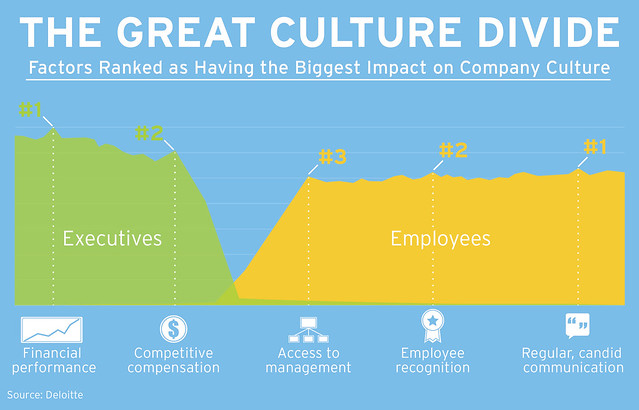
Positive Leadership: The Great Culture Divide

A culture is idealistically a force that drives and unites people with a common focus, but........


Share/Save/Bookmark

Wednesday, October 03, 2012

Positive Leadership: Behaviours Loyal Employees Trust


Here are 5 behaviours for leaders to adopt when struggling to keep employees happy and loyal:

1) Tell the truth. Not everyone is a star. Pick out those with leadership or other valued talent potential and nurture them. This will come back to the business as these individuals, in turn, nurture other workers.

2) Communicate roles and responsibilities. Provide a path to success not only for those with leadership promise but for all employees. Sometimes this will mean difficult changes, but remember the most important skill of a leader: never surprise an employee with bad news. Have a development plan for all, and a get-well plan for those whose performance lags. Make sure everyone knows the plan.

3) Create a workplace culture that values real people relationships. For many employees, workgroup relationships and relationships between managers and workers drive engagement and loyalty more effectively than wearing the corporate branded shirt.

4) Be fair and open. This does not mean treat everyone equally – it means have transparent processes for managing and leading. Employees are more likely to respond positively to change when the process used to manage change is fair.

5) Model the behaviours you seek. Accept your responsibility as a leader and act with engagement, commitment and responsibility. Do this every day.

Each of us possesses skills, strengths, talents and flaws. Each of us seeks to belong, to be engaged, to relate to those around us. Loyalty is built on relationships, shared understanding and trust. Engagement and commitment require loyalty, shared goals and fair treatment. Don’t take loyalty and engagement for granted – create a remarkable culture where there are possible and rewarding outcomes of the workplace.

We are only human after all – Every one of us. Every leader. Every brand. Every workplace. Every person.

Share/Save/Bookmark

Wednesday, August 29, 2012

Positive Leadership: Team Turnarounds


In today’s uncertain economic environment, teams are asked to do more with less. With resources stretched thin, turning around a struggling team has never been harder, and managers must work to identify and maximise whatever potential strengths a team already has. As sports fans already know, behind every great underdog story is a leader who roots out the competitive advantage that will propel the team to victory. In their excellent book, Team Turnarounds, Joe Frontiera and Dan Leidl share how this fine art of the turnaround really works, from how to inspire the team to the actual tools for change.

Share/Save/Bookmark

Thursday, August 23, 2012

Positive Leadership: The Lost Culture of the Financial Services Industry


Culture is everything when it comes to responsible, long-term business success. 

Culture is what exists before any given leader shows up, and it is what exists after any given leader moves on. Culture is in the DNA of an organisation. It is not something that a leader necessarily goes out and creates. A leader’s job is to discover, communicate and reinforce culture. If you don’t get culture right, nothing else matters.

Many of the financial services organisations that have gone astray recently have done so because they lost touch with their culture. They lost touch with their stewardship mission, purpose, values and responsibilities; core elements of the historic culture of the financial services industry.

What we need to do today is not so much invent or create a new culture for the industry but find the way back to the culture that should have been there all along.

Most financial services firms have a culture that at some point, somewhere, was about serving the needs of their clients. It was not just about making money. It was about helping clients achieve their objectives, promoting economic growth and performing a social good. Chances are the people at the firm came to the firm because of the chance to make a positive difference in the world. That ethic is used to be embedded in most financial institutions. Unfortunately we have just lost touch with it in too many cases recently.

As Sir Mervyn King, Governor of the Bank of England, said recently: "Motivation does not come from financial incentives alone. Again, the financial sector has done us all a disservice in promoting the belief that massive financial compensation is necessary to motivate individuals".

Restoring the culture of financial institutions to what it ought to be is the number one leadership challenge right now in the financial services industry. Regulatory reform is not enough. If we are going to keep future financial crises from happening, we have to address cultural failings at the heart of the financial services industry.

Whether or not we get it right will be a case study in leadership for years to come.

Share/Save/Bookmark

Tuesday, August 07, 2012

Positive Leadership: Honesty is the Best Policy

Good leadership springs from a willingness to recognize uncomfortable truths and to be honest and forthright in tackling them, writes former Tesco CEO Terry Leahy. A keen sense of right and wrong underpins every successful business strategy and helps inspire workers during trying times. "Simple though it may sound, the truth is the best compass to guide one through the storm," Leahy writes.

For more, see: http://online.wsj.com/article/SB10001424052702304870304577488572183024742.html

 
Share/Save/Bookmark

Wednesday, July 04, 2012

Positive Leadership: Leadership Lessons from the Barclays Scandal


In advance of today’s UK Treasury Select Committee hearing and the expected further fall-out from the Barclays scandal, we believe there is value in stepping back and thinking about the key leadership lessons emerging so far.

According to the Financial Times, Bob Diamond (ex Barclays CEO) gave a lecture last year in which he stressed the importance of culture in establishing an ethos of trust and integrity. “Culture is difficult to define,” he explained, “but for me the evidence of culture is how people behave when no one is watching.”

In our view, recent events highlight three significant leadership lessons, which have broad impact:

•             As well as developing good leaders, Boards need to focus on stopping, or at least slowing down, bad leaders.
•             Stakeholders should beware of the superstar CEO. Often, he gets a great deal of press attention, he writes a book, his remuneration goes up, but the performance of his company ultimately goes down.
•             It is important to focus on a leader’s character attributes when hiring and understand how he copes when faced with high-stress situations.

The framework provided by our Values of Positive Leadership™ offers a solution to these challenges.  Such an approach enables business strategy and corporate transactions to be executed successfully, thereby delivering optimum results in situations of high pressure. 

www.positiveleadership.co.uk
Share/Save/Bookmark

Friday, May 11, 2012

Positive Leadership: It's Culture That Drives Results


Stephen I. Sadove, chairman and chief executive of Saks Inc., explains that it is culture that drives results:

'It starts with leadership at the top, which drives a culture. Culture drives innovation and whatever else you’re trying to drive within a company — innovation, execution, whatever it’s going to be. And that then drives results.

When I talk to Wall Street, people really want to know your results, what are your strategies, what are the issues, what it is that you’re doing to drive your business. They’re focused on the bottom line. Never do you get people asking about the culture, about leadership, about the people in the organization. Yet, it’s the reverse, because it’s the people, the leadership, the culture and the ideas that are ultimately driving the numbers and the results.'

Share/Save/Bookmark

Friday, March 30, 2012

Positive Leadership: The Secret of Enduring Companies


While it's fun to be the flavour of the week, eBay's top executive, John Donahoe looks up to companies that manage through the tough times as well. 


‘Enduring companies do the "basics" really well: They listen to their customers, have strong cultures with a clear sense of purpose and well-defined values, and have highly engaged employees. But I think great enduring companies also have organizational "character" -- and exhibit this by not being afraid to face up to adversity and embrace difficult change……… But how companies win matters, too. Enduring companies are great because of their purpose, values, culture and leadership.’

Share/Save/Bookmark

Wednesday, March 21, 2012

Positive Leadership: The Importance of 'Organisational Socialisation'


Share/Save/Bookmark

Sunday, August 28, 2011

Positive Leadership: Culture v Strategy


Building great corporate culture is more than just metaphors; it's what motivates a winning team. Most people at corporations in the US are unhappy, says Silicon Valley Bank CEO Ken Wilcox. But the organisation can craft a pleasant and productive environment by hiring diverse and intelligent people and keeping them on-board. Knowing how to work together under an organisation's guiding principles is critical. Past experience in commercial banking is not.


Share/Save/Bookmark

Sunday, June 26, 2011

Positive Leadership: Moving Towards a Values-based Culture in Your Organisation

The journey toward values-based cultures — are you on the way?

Culture, values and leadership are critical priorities for business leaders. No matter how many resources your company deploys, how many experts you retain and no matter how many programmes you run, little matters if you’re not reaching your global workforce at heart, mind and gut level.

Companies are grasping this and embracing values-based corporate cultures, governance and leadership as new sources of advantage. In the USA, Southwest Airlines, Zappos and Google are leading the way, demonstrating the benefits of values-based behaviour.

What are some ways your company can advance its ethical journey?

Treat culture as a strategy: An ethical culture is not created by accident. It is deliberately crafted at many levels of the organisation under the guidance of leaders who hard-wire it into the processes and practices by which business gets done.

To make ethical considerations truly central to operations, ethics and compliance must expand beyond education and communications and encompass the wide variety of corporate practices, including performance appraisals, promotion and recruiting practices.

Seek better alignment and purpose: Ethics and compliance programmes serve a distinct purpose, but they cannot adequately fulfil that role unless they help reinforce corporate priorities. They fall short if they operate in isolation from rapidly shifting business needs and conditions.

Seek partners beyond your traditional domain: Ethics and compliance leaders can extend their influence and better fulfil their mandate by building deeper partnerships with business units, human resources, corporate communications, and environmental and social responsibility departments. Isolated compliance and ethics functions will never reach the hearts and minds of employees.

Culture as a strategy, fuelled by values that are translated into tangible behaviours and embedded in the gears of a business, can create a sustained competitive advantage in the marketplace. Ethical cultures are not created overnight. But ultimately, tomorrow’s winners will be those who invest in systems inspired by values-based culture.

Share/Save/Bookmark

Tuesday, May 03, 2011

Positive Leadership: Defining Corporate Culture

Andy Friere, Co-founder and CEO of Axialent, argues that what leaders do--not what they say--defines the organisation's culture. Friere suggests that most leaders are not actually aware of how what they do is perceived and shapes culture. However, shaping a strong culture is one of the most important activities for any entrepreneur because it determines, in part, whether the company goes on to success after the founder leaves or whether it fails.


Share/Save/Bookmark