Positive Leadership has also been recognised as a Top 50 Leadership Expert to Follow on Twitter.

Follow us on Twitter @posleadership


LEADERSHIP IS A PROCESS OF SOCIAL INFLUENCE, WHICH MAXIMISES THE EFFORTS OF OTHERS TOWARDS THE ACHIEVEMENT OF A SHARED GOAL.

Thursday, January 07, 2010

Driving Positive Leadership


Bob Kidder is the newly appointed chairman of Chrysler.

Here are his thoughts on what drives positive leadership:

Think big picture

“You need to think big picture. Ask yourself: what is the greater organisational objective? A good leader needs to have the ability to think like a generalist, to broaden the lens beyond the current scope.”

Hire top talent

Kidder sees people at the core of any organisation’s success. “Starting with my days at McKinsey, it is tremendously powerful to work in a high density of smart people, it is absolutely infectious and drives peak performance.”

Cultivate team spirit

“People in an organisation need to feel like they are part of something special. Similar to my experience at McKinsey where, once joined, people embrace a lifetime fraternal bond, it is key for an organisation’s success to nurture these connections.” Starting with the board, Kidder led his group of new directors through a 3-day intense orientation program. Interestingly, for the first day, the board did nothing but drive every model that Chrysler makes, with engineers in the passenger seats who would explain the details.

Focus on opportunities

Human energy plays a central role in a positive change agenda. Focusing on strengths, optimism and opportunities, Kidder confirms: “Sergio Marchionne’s (the ceo of Fiat and Chrysler) mantra is: ‘everything is up for change’. I personally support his notion that nobody is supposed to be locked in, lifting artificial constraints put on people.”

Effectively listen

He applauds Sergio Marchionne’s ability to deeply listen to concerns and ideas that subordinates and stakeholders share with him. In line with this, as chairman, Kidder regularly sets out to speak with decision-makers in the firm to see what changes need to be made and checks whether there are any strategic disconnects or red flags: “I am an additional pair of ears, here to support Sergio in his role.”

Clearly communicate

Kidder emphasises the importance of having open communication between an organisation’s leadership and its employees and stakeholders: “We need to let our people know what our vision is, where our priorities are and what we strive to achieve.”

Empower people and hold them accountable

When Kidder became CEO of Borden, then a very bureaucratic and highly diversified structure, one of his first decisions was to decentralise the firm. Kidder gave individual CEOs decision-making power, encouraged them to take risks, to succeed and also to fail. Also new to the firm, these business leaders were held accountable for their results, which drove a cultural change and ultimately had a positive effect on bottom line.

Engage leaders who possess ‘the guts to make a decision’

A proponent of participative leadership, Kidder is strongly opposed to the concept of shared governance, a model under which all constituents need not only be heard but also have to agree on next steps before action can be taken: “This, to me, is really the absence of leadership. Such an approach lacks clarity and it slows down decision-making unnecessarily.”

So why does a 64 year old executive who has accomplished everything prefer helping Detroit to kicking back in the vineyards of southern California? Because – for him – the rewards of positive leadership make it a journey worth pursuing.

Share/Save/Bookmark

Wednesday, January 06, 2010

Avoiding the Unforced Error

The Unforced Error

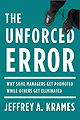
We all make them. Ethics breaches and scandals and performance-related turnover are increasingly found in today’s headlines. As in tennis, the unforced error is made by someone with the ability to keep the ball in play but who makes a mistake, resulting in the loss of a point. To improve your game you need to develop the habits that will help you keep the ball in play. It is your performance over time—a steady game—that will get you where you want to go. That’s what The Unforced Error: Why Some Managers Get Promoted While Others Get Eliminated by Jeffrey Krames aims to help you do.

The most dangerous errors—and the one discussed in this book—are “the ones we don’t recognise, so we can’t fix them before the damage is done.” Krames divides unforced errors into two groups: the unforced operating error (the ones we all make in the course of doing our job; a bad call) and the unforced nonoperating error (errors not directly related to the conducting of business, but can shatter a career nonetheless - errors of character). Krames writes, “There are seldom excuses for unforced nonoperating errors. You have to have the awareness, self-control, and maturity to avoid them.” The focus of this book is the former kind, the unforced operating error.

There is a key to avoiding unforced errors. Not surprisingly, the key is humility. “That’s because humility—one of the most underrated of all leadership qualities—is essential to developing the strength and consistency to avoid unforced errors.” It’s the kind of humility that comes from having the self-confidence to admit mistakes, blind spots and then move on to correct the mistake. Rarely would you be told that you were fired due to a lack of humility, but it is the trigger for so many unforced errors. Krames successfully helps you to recognise an unforced error when you see it. In each chapter that covers a specific unforced error, he offers sensible and pragmatic advice on how to avoid these “career killers.” His advice includes:
  • Never say the ball was out by a mile. Face reality at all times.
  • Nothing is as important as people decisions. Get the right people.
  • When you do make a people mistake, fix it as quickly as possible.
  • Don’t overlook the wild card. Develop the next generation of leaders.
  • Keep your game inbounds. Living and leading by the rules.
  • Step up to the net. Take ownership of your part of the court.
  • Watch the whole court. Find out who the real line judge is in your game and make sure they know how you’re doing.
Krames is very readable as always. The tennis metaphor works well to demonstrate the importance of these ideas. If you take the time to study the advice Kramer has gathered together, you could save yourself from committing these errors. In the words of Billie Jean King, “Self-awareness is probably the most important thing towards being a champion.” 
Share/Save/Bookmark

Leadership Lessons for the New Year


Always focus on the mission.

To be a great leader, you have to be intensely focused on the core mission of your organisation: know it, understand it, and live it. Make sure everyone in your organisation can answer these questions: Who are we? What do we do? Whom do we serve? At the end of the day, the mission is the true North Star that guides every action you take.
Share/Save/Bookmark

Tuesday, January 05, 2010

Leadership Lessons for the New Year


Act with integrity.

The actions of great leaders are consistent with their words. Saying the right thing doesn’t mean much. Doing the right thing means everything when you want people to follow you passionately.
Share/Save/Bookmark

Treating People with Respect


In this New York Times interview, Gordon M. Bethune, the former chief executive of Continental Airlines, says that “being good at your job is predicated pretty much on how the people working for you feel.” :

'Q. What are the most important leadership lessons you’ve learned?

A. I was a mechanic in the Navy. And mechanics in the Navy are like mechanics in airlines. You may have more stripes than I do, but you don’t know how to fix the airplane. You want me to fix it? You know how much faster I could fix the airplane when I wanted to, than when I didn’t want to? So I’ve always felt that if you treat me with respect, I’ll do more for you.
As I went up the ladder in the Navy, I never forgot what it’s like to be down the ladder, and that being good at your job is predicated pretty much on how the people working for you feel.

Here’s my theory: Let’s say we’re all midlevel managers, and one V.P. slot is going to open up. I’ve got 10 guys working for me, and for the last five years, every time I got any recognition, I said, “Bring them on the stage with me.” Who do you think is going to get the job? I’m going to get the job.

Q. How did you put together the team back in the early 1990s to turn around Continental Airlines?

A. I hired the best people. The sickest patients need the best doctors, so you can’t skimp on this stuff. I took the 20 top guys and I said: “I’ll create a bonus plan so that if we hit these numbers, I get paid and you get paid. And either all of us are going to get paid, or nobody’s getting paid.” And I never missed.'

For the full interview, see - http://www.nytimes.com/2010/01/03/business/03corner.html?ref=business
Share/Save/Bookmark

Monday, January 04, 2010

Discovering Your Strengths


What are the best ways for people to discover their strengths?

It’s ironic that your strengths can be so easy to overlook, because they’re clamoring for your attention in the most basic way: Using them makes you feel strong. All you have to do is teach yourself to pay attention. Try to be conscious of yourself and how you feel as you’re completing your day-to-day tasks. Most of the time, we’re so focused on getting our work done that we don’t really have time to notice how we feel about it. At the end of the day, we go home and tell our loved ones that it was a good day or a bad day, but we haven’t made the effort to notice why the day feels good or bad as it happens.

When you make the conscious effort to notice yourself at work (or at play, for that matter), you will find that you experience what are called “strong-moments” throughout your day—times when you feel invigorated, inquisitive, successful. Those moments are the best clues as to what your strengths are.

There’s also a simple acronym to help you recognise the signs of strength: SIGN.

•S - Success: Do you feel a sense of accomplishment about finishing a task?
•I - Instinct: Do you instinctively look forward to this task?
•G - Growth: Are your synapses firing? Are you mentally focused?
•N - Needs: Does this task fulfill one of your needs?

If you notice yourself feeling any of those feelings while doing a task, chances are that activity is one of your strengths.
Share/Save/Bookmark

Sunday, January 03, 2010

Who Would You Rather Follow?


Admired for her beauty, Jennie Jerome (Winston Churchill's mother) glided through the loftiest social circles. Once, on consecutive nights, she dined with Britain's premier politicians: Prime Minister Benjamin Disraeli and his chief rival, William Gladstone. When questioned about her impressions of the two men, Ms. Jerome made the following observation:

"When I left the dining room after sitting next to Gladstone, I thought he was the cleverest man in England. But when I sat next to Disraeli I left feeling that I was the cleverest woman."

Perhaps you know leaders like Gladstone—confident individuals who exude wit, intelligence, and charisma. Whenever you're around them, you cannot help but notice their charm…because they make every effort to parade their brilliance in front of you. However, you would most likely prefer to follow someone like Disraeli, a leader who would rather draw out the best in you than strut his or her personal greatness.

In relationships, be impressed with others instead of trying to make an impression. Throttle back on the urge to make your presence felt, and instead look for ways to esteem those around you. By expressing genuine interest in the people in your life, you'll win friends and gain favour.
Share/Save/Bookmark

Saturday, January 02, 2010

Characteristics of Greatness


Sixteen Consistent Characteristics of Greatness, courtesy of Don Yaeger (http://www.donyaeger.com/):

How great athletes think:


1. It’s personal

They hate to lose more than they love to win. People that aspire to greatness know that defeat just isn’t an option.

2. Rubbing elbows

They understand the value of association. We become the people that surround us. Those of us who are aspiring to greatness, it is our job to rub elbows with the right people and to learn what makes them successful and what keeps them going. In turn, it is up to them to help us better ourselves. And if you can’t change the people around you, then choose different people to be around. Think about it.

3. Believe

They have faith in a higher power. It is proven that a strong spiritual commitment, and a strong belief in faith is linked to a positive outcome. In our current economic state, always remember the power of a positive mind-set and the importance of belief in beating the impossible.

4. Contagious enthusiasm

They are positive thinkers… They are enthusiastic… and that enthusiasm rubs off. When you’re trying to work through your challenge-professional or personal – do so with the belief that the best is yet to come. Stay positive.

How they prepare:

5. Hope for the best but…

They prepare for all possibilities before they step on the field. Even if you are an eternal optimist, you also need to be a realist. So contingency-plan.

6. What off-season?

They are always working towards the next game… The goal is what’s ahead, and there’s always something ahead. if you visualise where you want to be and work backwards from there, you can always be moving the ball forward.

7. Visualise victory

They see victory before the game begins. Positive visualisation is a proven ingredient of a successful outcome.

8. Inner fire

They use adversity as fuel.One thing in life is certain… none of us gets through without adversity. What matters is that we find the strength to work through it. When we are knocked down, it may take hours, days, weeks, or months, but we need to get back up.

How they work:

9. Ice in their veins

They are risk-takers and don’t fear making a mistake. Failure is one of our greatest teachers.

“I’ve missed more than 9,000 shots in my career,” NBA legend Michael Jordan, who was known for his late-game heroics in addition to six national titles, once said. “I’ve lost almost 300 games – 26 times, I’ve been trusted to take the game winning shot and missed. I’ve failed over and over and over again in my life, and that is why I succeed.”

10. When all else fails

They know how – and when – to adjust their game plan. Flexibility and adaptability is essential to survival.

11. Ultimate teammate

They will assume whatever role is necessary for the team to win. Individual accomplishments are important, but the sum is always greater in value than the individual parts. How much do you step up to help those around you? When others around you thrive, you thrive as well.

12. Not just about the cash

They don’t play just for the money. It’s never about the money. And if it is, it’s about the wrong thing. The money will come if you follow your passion… if you become a part of something bigger than yourself.

How they live:

13. Do unto others

They know character is defined by how they treat those who cannot help them. One of the greatest sources of satisfaction is helping others, from a truly altruistic standpoint. We all have something to give… our time, our experiences, our compassion.

14. When no one is watching

They are comfortable in the mirror… they live their life with integrity. “What matters is not what you do when everyone is watching. What matters is what you do when no one is watching.” Your ultimate accountability has to be to yourself.

15. When everyone is watching

They embrace the idea of being a role model. As leaders, we have an obligation to promote positive leadership, and demonstrate the positive influence we can have on others. Our actions shape those coming behind us.

16. Records are made to be broken

They know their legacy isn’t what they did on the field. They are well-rounded. A legacy isn’t what you took from this world. A legacy is what you leave behind.
Share/Save/Bookmark

Friday, January 01, 2010


Share/Save/Bookmark

Thursday, December 31, 2009

Moving from 'Survive to Thrive' in 2010


Here in December many organisations are closing out a challenging year.

While the stock market has bounced back off its low for the year, economic and organisational growth is still hard to come by. Speaking with business leaders across a wide spectrum of industries one major question seems to resonate broadly: Now that we’ve survived in this tough environment, how do we return our focus to thriving?

Leaders and mangers have learned a lifetime worth of lessons about how to do more with less; leaders and organisational members have learned how to maintain competitive and financial positioning during adversity.

Setting goals on survival was necessary, but it will not suffice going forward from here. Business leaders who don’t begin to focus on how to thrive in the new economic reality simply won’t. Worse, survival strategies get shakier the longer the need to engage in them.

So as you complete your annual organisational goal-setting practice, how should you recalibrate your focus? How do you create a way up and onward, and motivate your team or organisation to get there? Here is a short list of practices that will help you set goals that align with a new, more positive and thriving-focused organisation.

Frame your goals positively.

Your team or organisation will focus on what you put in front of them. Create goal statements which include positive phrases rather than negative ones. For example, if an organisation had 100 new sales contracts last year, and this year will be tougher, your team may work harder to close 95 new sales contracts than to keep sales within 5-10 percent of last year’s production.

Always create a goal structure which emphasises what you do want, rather than limiting what you don’t.

Maintain a present and future outlook.

As a rule of thumb, comparison goals are difficult to use to motivate team members when faced with such an environment. Goals which relate to a percentage of growth or decline over a previous year keep the team focused on what happened last year, rather than what will happen this year.

Create goal statements that orient your team on the present and what is to come in the future.

Goals need to be specific and measurable.

Broadly defined goals tend to become abstract in the execution. Think about what the outcome of each goal will achieve and how specifically progress can be measured during the year. Whenever your team reaches a milestone metric, recognise and celebrate the progress.

Over-communicate goals and progress.

Once you have a goal statement that is positive, present and future oriented, specific and measurable, you have a great leadership opportunity. Remember the statement that teams and organisations focus on what is in front of them. Keep your goals in front of your organisational members.

If the goal is presented in this positive manner, over communicating it is a good thing. It emphasises where you are going - not where you have been.

Leaders who excel in this type of goal setting don’t end their work when the goal statement is written. These statements become the language of leadership in the coming year. Help your team understand how their individual roles relate to the organisational goals. Help them see how the tasks that they are assigned support the team in realising those goals.

Create an organisational focus on thriving in 2010 rather than surviving. Doing so will require some new thinking, innovation, and committed persistence. Having learned how to do more with less, use these creative building blocks to continue to enhance your team’s efficiency.

Positively framed goals and clear, consistent communication of these efforts will help you to lead your workgroup or organisation toward improvement and success in the coming year.

You have survived. Now take the opportunity to thrive. Engaging in a positive, purposeful leadership style will assist you in motivating your team and creating a resilient and focused organisation this coming year.
Share/Save/Bookmark

Leadership Resolutions for 2010


As we approach the end of the year, we all think about New Year’s resolutions. Here is a 12 point checklist on leadership:

Motivating yourself:

1.Keep a positive outlook. When you experience challenges, you’ll find optimism works wonders.

2.Believe in yourself. Guess what – there’s no-one else in the world like you!

3.Set yourself meaningful and achievable goals – keep measuring your success.

4.Develop and follow an action plan.

5.Find ways to enjoy what you’re doing.

6.Keep your enthusiasm levels high. Celebrate your successes / achievements.

7.Be kind to yourself. Self-criticism will lead you nowhere.

8.Move on from your mistakes. Learn from them and grow.

9.Avoid negative people. Know when to cut lose and move away. Surround yourself with successful, positive people.

10.Never stop learning.

11.Know that you will succeed!

12.Set yourself new challenges.


Motivating others / motivating your team:

1.Let your positive outlook be infectious. Spread it around.

2.Tell and show your team you believe in them.

3.Work to set meaningful, measurable and achievable goals.

4.Develop an action plan with them and help them stick to it.

5.Keep it fun for them.

6.Acknowledge and recognise their achievements, privately and publicly.

7.Never criticise. Instead, commend their achievements, make recommendations and lead by example.

8.Don’t worry about their mistakes. They need to make them. Your role is to help them learn by doing.

9.Overcome any negativity with action plans, tips, training and new ideas.

10.Show them, by example, how to duplicate themselves.

11.Keep dreams alive by constantly reinforcing the big picture.

12.Encourage them to keep setting challenges for themselves.
Share/Save/Bookmark

Wednesday, December 30, 2009

Focus on Leadership in 2010


2009 has definitely been a tough year. We suggest that 2010 is the year you focus on leadership.

Solid business results that stand the test of time do so for one reason and one reason only: consistently excellent leadership. Products and services change with the demands of the market. Individual leaders come and go. The key is to create an organisational culture that ensures great leadership today and tomorrow.

We recommend that you institute proven across-the-board behaviours that don’t depend on particular individuals. These five leadership tactics will help you see significant changes by the end of 2010:

1. Move low performers. Despite the layoff ax so many companies have wielded during the past year, low performers still work inside many organisations and they are causing big problems. Turning a blind eye to these individuals in your organisation squelches profitability. Why? Because middle performers get pulled down to the low-performer level, while high performers either a) disengage or b) leave.

2. Accentuate the positive. The next time you’re having lunch in a restaurant, listen in on the conversations at nearby tables. Chances are, you’ll hear people griping about their workloads, difficult clients, annoying colleagues, or the ridiculousness of corporate policy. Everyone does it, but if they realised how harmful it is to their company, perhaps they’d think twice. The solution is to hone the fine art of managing up.

3. Make a real connection with employees. Think of a doctor making her daily rounds to check on patients. Well, 'rounding' helps you communicate openly with your employees, allowing you to regularly find out what is going well and what isn’t going well for them at the company. But remember it’s not just empty “face time”—it’s rounding for outcomes, which means the process has a serious purpose.

4. Say thanks. In fact, put it in writing.  Send thank you notes to employees who do an excellent job. But that doesn’t mean just sending the occasional note when someone goes far above the call of duty. It means literally mandating a specific number of thank you notes for leaders to send to the people they supervise. People love receiving thank you notes. They cherish them.

5. Don’t just recruit great employees. Re-recruit them. If you plan to hire in 2010—and as the recovery (hopefully) picks up steam, many will—here’s a relatively easy step you can take that will pay off in a big way. We all know employee turnover is expensive. But did you know that more than 25% of employees who leave positions do so in the first 90 days of employment? To retain a new team member, the leader needs to build a relationship. Scheduling two one-on-one meetings, the first at 30 days and the second at 90 days, has an enormous impact on retention that directly turns into savings for your organisation.

Once you start implementing these tactics, results quickly follow. Your employees will see that you care about them, which boosts morale, improves performance, leads to happier customers and higher profits. Creating satisfied employees is of critical importance, especially right now.
Share/Save/Bookmark

From the Court to the Boardroom


When asked for his advice on business, Coach John Wooden guides entrepreneurs to the top of the pyramid, where "patience" and "faith" flank the top block -"competitive greatness." Wooden explains, "As an entrepreneur or small business owner, you must have patience, and you must believe. But, you must also have skills, and you have to realise you're going to have to work at whatever it is you're hoping to attain."

Judging from his relationships with former players, perhaps the greatest business lesson to be learned from Wooden is how leaders should treat the people around them. "Make those under your supervision understand that you really care for them, not just for what they're doing in the corporation but that you really care for them," Wooden says. "I think anyone in a supervisor position has to do that." For him, that meant letting his players know they weren't playing for him, but with him as they worked toward a common goal. "My success was largely dependent on the type of youngsters I had under my supervision," he adds.

The mark of a great leader is someone who's successful over time, and that's just what Coach Wooden has proven to be.
Share/Save/Bookmark

Coaching: How the Best Leaders Teach


Its not easy to teach people how to think, yet this skill is a must for effective leadership. It requires patience and foresight...and time. Yet if we don't teach others how to think on their own, we waste time in the long run because our team will be forever dependent upon our knowledge base for answers. 

A leader who doesn't teach stunts his own personal growth and destines himself to the "same old, same old". This type of leader "teaches" people how to be forever followers.
Often, the best leaders teach people to think by following a coaching model, whether they realise it or not. Coaching and leadership go hand in hand. Interestingly enough, coaching is a learning model.
The primary competencies of professional coaching, grouped into the four main categories of listening, creating awareness, planning and managing progress mirror the skills necessary for leaders to get things done through people.  Let's take a look at how each core area enhances a leader's ability to teach.
  1. Listening  - Through the gift of listening, leaders demonstrate humility and respect.  Additionally, new ideas often emerge when people process out loud.
  2. Creating Awareness - Great questions create learning because they encourage thinking. The process of answering a question creates more learning than a "lecture".
  3. Planning and Goal Setting - A good action plan teaches us to stretch beyond what we might ordinarily think possible.
  4. Managing progress and accountability - Done well, accountability teaches us to celebrate our success and to reflect and course correct if necessary.
When we teach others to think through a coaching model, we free ourselves up to blaze new trails and we build trust in those we lead in the process. As leaders, teaching the way a coach teaches is a win-win for everyone concerned!

Share/Save/Bookmark

Tuesday, December 29, 2009

The Impact of Positive Leaders Within an Organisation


The litmus test of a Positive Leader is the esprit de corps he creates with his troops. Positive Leaders deliberately increase the flow of positive emotions within their organisation. They choose to do this not just because it is a "nice" thing to do for the sake of improving morale, but because it leads to a measurable increase in performance.

Studies show that organisational leaders who share positive emotions have workgroups with:

•a more positive mood

•enhanced job satisfaction

•greater engagement

•improved performance

What differentiates Positive Leaders from the rest? Instead of being concerned with what they can get out of their employees, Positive Leaders search for opportunities to invest in everyone who works for them. They view each interaction with another person as an opportunity to increase his or her positive emotions.
Share/Save/Bookmark

Leadership Tactics Which Impact the Bottom Line


Leaders matter, especially in business.  To get ahead, to stay ahead, you must lead.  These four tactics can be used by any business leader, and have been scientifically shown to increase a business’ bottom line.
1. Charisma – the leader sees what is really important and instills a sense of mission, pride and respect in employees.  Money is not enough, employees need to see why their work is important.
2. Individualised Consideration – the leader gives projects to his team in order to promote learning and growth. The leader also provides coaching and teaching.  You can’t keep giving your most important projects to your best people; it is vital that all your team all grow and learn.
3. Intellectual Stimulation – the leader pushes colleagues to think in new ways and to use reason and creative problem solving.  You must push your team to go past what has worked before, because it may not work tomorrow.
4. Contingent Reward – the leader provides rewards when colleagues follow expected actions and contracts.  While money is not enough, it is important.  Staff need to know that you can get them the rewards that they want.
Together the first three tactics constitute a theory of leadership known as “Transformational leadership”, and the fourth tactic is half of what is called “Transactional leadership”.
The other half of transactional leadership is “Management by exception”, where the leader has staff follow the established rules and patterns as long as they are meeting performance goals.  Management by exception does not help a business’ bottom line, it is the opposite of transformational leadership and allows your competition to catch up and surpass you.
In the study linked to above, the researchers discovered a few more things about these tactics.
  • They are more useful in public rather than private businesses. This may be because publicly held businesses are more bureaucratic and so need more people who can push new ideas.
  • They are just as effective when used by leaders low on the org chart as when used by those at the top.  This is very important.  It means that no matter where you are in the company you can be a great leader and have a real impact on the business.
  • They are more effective at making staff feel like things are going well, rather than affecting objective performance (like revenue). This is most pronounced with contingent rewards – the transformational tactics affect both employee sentiment and company performance quite a lot.
What all does this tell us?
  1. Just doing what has worked, and is working, isn’t enough.  Other managers in other companies are trying new things, and eventually your old ways won’t be good enough any more.
  2. You need to give a sense of mission to your employees.
  3. You need to inspire them to come up with new ideas, and to give them opportunities to learn, try new things, and grow.
  4. Inspiration is not enough.  Your team also need to see real rewards.

Share/Save/Bookmark

Monday, December 28, 2009

Leadership is About Behaviour


Military experience can illuminate the identification, development and practice of leadership.

In the corporate world, potential leaders are identified because they excel in a technical area and are then taught leadership skills. Sometimes it is assumed functional excellence implies leadership effectiveness so new leaders are left to sink or swim.

The military provides a contrast. For example, if you join the RAF you probably want to fly a plane. But you have to wait six months to get to that point: for the first six months you are immersed in issues of brand, leadership and followership.

People see the military as inflexible: as having a set hierarchy, a way of doing things. Of course you learn certain things ‘by the book’ so you can free up your brain to make crucial judgements. But if you are flying a night mission over Kosovo, there is no time for a request to go up the chain of command and the decision to come back down. Everyone is involved in leadership. Mission decision-making is fluid and flexible.

In military operations, leadership has little to do with seniority. Operational teams are complex matrix structures. Once goals are set you decide who is best placed to fulfil each role. Since everyone has a grounding in leadership, anyone can take up that role. The key is to decide who is best to lead the project, to push decision making as far down the chain as it will go and then to support the people you’ve delegated to. If you do that right it solves the disengagement problem.

A mission without debriefing is unfinished. Debriefing is a constantly iterated cycle of 360° feedback and performance appraisal. Just as in execution, debriefing sidelines seniority. Leaders’ performance is critiqued and praised so they in turn learn. How leaders react to this – defensively or openly – is critical to the loyalty and motivation of their team. So debriefing, carried out in this way, sites leaders within the team: not as someone who ‘has all the answers’ but as someone learning, improving and responding to upward insights. It pulls together everything: leadership; motivation; engagement and an upward performance trajectory.

A lot of business thinkers and business schools have taken the passion out of leadership by overcomplicating it. Leadership is underpinned by process but, in the end, it's about behaviour.
Share/Save/Bookmark

Why Command and Control Leadership Does Not Work in Business Today


This New York Times interview with Joseph J. Plumeri, chairman and chief executive of Willis Group Holdings, the insurance brokerage, sheds light on why 'command and control' leadership does not work in business today:

'Q. How has your leadership style evolved?

A. I was once a command-and-control guy, but the environment’s different today. I think now it’s a question of making people feel they’re making a contribution, and they’re part of the process. In the end, you’re still directing the process, but you’re allowing for the collaboration and debate to take place, which in a command-and-control environment doesn’t happen.

A command-and-control environment is where you have a meeting and you say, “This is what I think; what do you think?” The good news about that was there was no question about where we were going, and what we were going to do. And if it works, that’s terrific. The problem is when it doesn’t work, and people start to grow and feel like they’ve got more to contribute, it wears out. I think that’s what happened to that whole command-and-control approach.

Q. What surprised you the most about getting the top job, running your own show?

A. You can’t do it yourself. You have to build up a group of people around you. In a lot of ways the C.E.O. of a company as large as this one is more like a baseball manager. I have a lot to do with what happens before they go on the field. I have a lot to do with where I put them on the field. I have a lot to do with the preparation for what they’re supposed to do when they’re on the field. But once the game starts, I have nothing whatsoever to do with what they do when something happens.

So I’m different from a football manager who calls every play. I can’t call every play. I can’t be a basketball coach, because I can’t slow down or increase the flow of the game. So I have to be putting the right people in the right spots and make sure that they know what we want to achieve. And you’ve got to make them feel that their own stats are important, but the company doing well because of their contribution is really what’s important.

Q. What else surprised you?

A. I never fully appreciated that there are people who choose certain things in life where they can’t have a bad day. I can’t have a bad day. If I walk into a meeting, and I’m grumpy — not good. I don’t think you fully appreciate that until you’re actually in a position like this, that you can’t have a bad day. My doctor can’t have a bad day. And I think anybody in a leadership position, where people depend upon you, you simply can’t have that one off day that’s bad, because you’re going to affect a lot of people.'

For more, see - http://www.nytimes.com/2009/12/06/business/06corner.html?pagewanted=1&ref=business
Share/Save/Bookmark

Sunday, December 27, 2009

Winners Never Quit – Or Do They?


You can look back at many of your past successes knowing that because of your persistence, you were able to ride through the tough times and succeed. But is persistence always a good thing?

In the recent book, The Dip: A Little Book That Teaches You When to Quit (and When to Stick) author Seth Godin points out that to succeed in most endeavours we must first survive "the dip"—that period of time when the biggest barriers come up, or when it looks like we are not going to make it. Great leaders do not back down from his or her high expectations simply because the going gets tough.

But haven't you also persisted with some things that just never worked out? Maybe an employee you believed you could get to be a good performer who just didn't want to be one? Or that marketing plan that just isn't working but you believe it should?

In "The Dip" Godin says that the real winners are those who also know when to quit—they know when they are in a "dead end". Accepting setbacks graciously or admitting that you are wrong is not an easy thing to do, but there are steps you can learn which will help you decide whether it is a "dip" or a "dead end".

Listen to your gut feelings. In many situations logic is not available because you have not been in this situation before. So listen to you instincts. Does forging ahead feel like the right thing to do?

Get advice. Who are the people in your life whose opinions you value, that you can bounce your thoughts and feelings off?

Think about the consequences of success and failure. Can you recover from the consequences if it doesn't work out? Is it worth it?

Then make the decision and move ahead.

Remember, there are no mistakes, only learning experiences. If there is such a thing as a mistake, it is not learning from what we do. Persistence works very well, especially when you learn to trust your gut instincts and quit when you are in a "dead end".
Share/Save/Bookmark

Learning from the Past


No matter how your present circumstances may be, the light of your loving will show you a way to improve some aspect of your life. You can accept yourself, and forgive any shortcomings. You can love yourself through your challenges. Learn from the past and let go of it. You may see yourself for the goodness you truly are. Celebrate your inner strengths and qualities. You can choose a new start. You need never limit your ability to love.

Love cannot be bought by the coin in your purse. Love grows from the inside out.


Share/Save/Bookmark

Saturday, December 26, 2009

Making Memories this Christmas


Can you remember your all time favourite Christmas gift? Do you remember the love and the music that filled the air during Christmas?

Of course, the Christmas season is not defined by the material gifts we give and receive but by the gift of love we share and the memories that we create together. Through the years presents are lost and become outdated but special memories are something that last forever. So this Christmas holiday season we encourage you to become Memory Makers:

1. Make Memories for Yourself - During this Christmas season say to yourself, "When I look back what do I want to remember about this time? Do I want to remember myself as a stressed out, unhappy, angry person or do I want to remember the joy I felt, the connections I made, the gifts of the heart I have given and the special moments I have shared."

2. Make Memories for Your Children - If you have children and you are feeling stressed about all the things you have to do, stop for a moment and ask yourself, "20 years from now what do I want my children to remember? What memories do I want to define their childhood?" Then create them. It's not about the presents.

3. Start a Tradition - It's never too late to start a new tradition. Traditions connect one generation to the next and they make life more meaningful. Tell a story, read a specific book, go to church, go Christmas caroling, make a certain meal, bake a specific dessert, volunteer, sponsor a family in need. Start a tradition and let it create memories every year.

4. Give Meaningful Gifts - In a world of so much stuff and maxed out credit cards... buy less this year, yet give more. Give more by giving gifts that have meaning. So whether it's a special book, a picture, a poem, a painting, or a symbol of your love, give a gift with meaning and it will create a memory forever.

5. ________________How do you make memories?
Share/Save/Bookmark

Leadership by Example


Alan Deutschman is a journalist, which is fortunate for us, the readers, because not only does he write fluently and vividly, but he tells stories, which is what all good journalists do.

Walk the Walk: The #1 Rule for Real Leaders is a compendium of stories taken from the interviews he has conducted with leaders over the past 20 years, most of them in business but some, equally relevant and revealing, from the worlds of sports and politics. Deutschman’s subjects range from Jeff Bezos of Amazon.com to Barack Obama in the first week of his presidency, from FedEx to the Florida Gators, Nelson Mandela, and the Greensboro Four, whose lunchtime sit-ins in 1960 helped to jump-start the desegregation movement in the United States.

The stories make for compelling reading, particularly because they are not all paeans to the individuals profiled. Deutschman is critical of quite a few leaders, including California Governor Arnold Schwarzenegger for talking the talk about energy and the environment but continuing to own a fleet of five Hummers. The fact that, in response to criticism, Schwarzenegger got General Motors to retrofit one of the vehicles to run on hydrogen and another on biofuel was not helpful, suggests Deutschman, because neither fuel is readily available to his constituents. Obama, too, comes in for some mild criticism for not leading enough by example in the very early days, although he is praised for many of his initiatives.

Deutschman uses his stories to make a point, or several points. He starts with the statement that “the most crucial role of a leader is establishing and instilling the one or two values that will be most important for an organisation or a movement or a community.” There are always a multitude of values that are important — the hard part is making the trade-offs between them in order to focus on one or two. He castigates Coca-Cola for its list of six goals and seven values, many of which are potentially contradictory: Were “people” more important than “profit,” and where did “integrity” come in the pecking order?

It is, Deutschman says, only when you walk the walk that you reveal the ranking of your values. He describes the response of Martin Luther King Jr. when he was attacked by Roy James, a Nazi sympathiser, in Birmingham, Ala., in 1962. King staggered back under a rain of blows, but dropped his hands and refused to fight back. He turned the other cheek. He walked his walk, lived his teaching, and so demonstrated that others, too, could live by his principles. Deutschman contrasts King’s behaviour with stories of corporations and chief executives that have ignored their declared values and principles when it suited them to do so or when they went along with the prevailing customs of their industry, most flagrantly in the case of the airline companies. Deutschman labels them lemmings, those who follow the herd rather than setting their own standards.

Deutschman distills his long list of stories into a series of principles. Although these are obvious, like so much in the literature of leadership, it is the stories that bring them to life. Our recommendation would be to read the stories and make a note of the ones that resonated most with your own situation, underline the simple message that they contain, and then resolve to act on it or, as Deutschman would say, to walk your walk.
Share/Save/Bookmark

Friday, December 25, 2009

No Excuses!


This is the time of year that we often take stock of ourselves, and reflect on what we’ve achieved over the last year.

How did we do on our goals, resolutions, or development plans from last year?

Did we achieve what we set out to do? If not, why not?

Before you answer that question, take a look at this one minute video from Nike:


This video should inspire you to not let excuses and challenges get in your way as you start the New Year.

We wish all of you a very Merry Christmas and a prosperous New Year!!
Share/Save/Bookmark

Without vision the people go astray (Proverbs 29:18)


We wish all followers of the Positive Leadership blog a very Happy Christmas.

At this time of reflection and special time with family, we are reminded of the words of Norwegian Air Force Brigadier General Arnvid Brage Løvbukten:

'Integrity

Jesus Christ is the same today, yesterday and forever. He never changes. He has perfect integrity. As a leader he is truly my frontfigure.

Laws/rules/regulations will be broken in a crisis or when times are getting rough (budget cuts etc). So who is setting the standard? We are.

We are drawing the lines. Everybody will be looking at us, and the units will immediately adapt to new rules as soon as we make up new unwritten ones.

It is tempting and convenient not to inform my authorities about my dispositions because the money flows easily in times of crises. So there are numerous opportunities to show my integrity or lack of it during a crisis. My leadership will in the long run be strengthened or weakened by it.

In an extended crisis, the morale will fall if we don't work on it. Then our own integrity will inevitably be looked at by our own people to find any excuse to break rules, laws, use of alcohol, etc. Credibility is a very important possession of a leader.

I always say that I am never perfect, but I should be working on myself constantly. I believe that when I'm through improving, I'm through. I also discovered that there are traps around success as well. When everything in the crisis is going well, it is not the time to relax. Ability may get me to the top - but it takes character to keep me there.'


Share/Save/Bookmark