Positive Leadership has also been recognised as a Top 50 Leadership Expert to Follow on Twitter.

Follow us on Twitter @posleadership


LEADERSHIP IS A PROCESS OF SOCIAL INFLUENCE, WHICH MAXIMISES THE EFFORTS OF OTHERS TOWARDS THE ACHIEVEMENT OF A SHARED GOAL.

Tuesday, May 07, 2013

Positive Leadership: It's Possible

'PAIN IS TEMPORARY!

It may last for a minute, or an hour, or a day, or even a year. But eventually it will subside and something else will take its place. If I quit however, it will last forever. I dare you to take a little pain. I dare you. I dare you not to go home. Somebody said "I feel bad, I'm gonna go home." Go through it. You’re not going to die!

At the end of pain is success. You’re not going to die because you're feeling a little pain. I'm not eating like I eat at home. That's why you're going to go to the next level, because if you ate like you ate at home, you're going to remain a boy or a girl. It’s time to become men and women. But I'm exactly where I want to be because I got to commit my entire being to this thing. I got to breath it, sleep it, eat it.

Until you get there, you'll never be successful in life. But once you get there, I guarantee you the world is yours. So work hard and you can have whatever it is that you want.'

 
Share/Save/Bookmark

Monday, May 06, 2013

Positive Leadership: Advice for #Entreprenuers in Building a #VC Friendly Business Model

This excellent discussion with Stanford University Professor Haim Mendelson explores the best approach for putting together a business model and how to use it for new business development opportunities.

Learn why the business model is a blueprint for planning, and then building, new businesses that include startups or a new line of business within an established company.


Share/Save/Bookmark

Friday, May 03, 2013

Positive Leadership: The Role of Sport in Facilitating Social Change


"Sport is one of the best tools for social change because it is a large part of cultures around the world and reaches into every socioeconomic class of society. If laws are put in place, the benefits will be beyond measure. Sport helps develop self-esteem and confidence; improve physical and mental well-being, serve as a medium of communication and empower women to improve themselves and their communities."

Nawal El Moutawakel, 1984 Olympic gold medallist, Morocco 


Share/Save/Bookmark

Thursday, May 02, 2013

Positive Leadership: Good Leadership and Good Performance - The Financial Facts


There is unequivocal evidence in every sector that there is a strong relationship between leadership capability and performance. 

Good leadership leads to a good organisational climate and good organisational climates lead, via improved staff satisfaction and loyalty, to sustainable, high performing organisations.

The impact of good leadership on organisational performance as measured by the business and commercial success is extremely well evidenced:
  • A study in the Harvard Business Review (Bassi and McMurrer 2007) provides a strong link between leadership skills and the bottom line.
  • The Institute for Strategic Change reports that the stock price of companies perceived to be well-led grew 900 per cent over 10 years versus 74 per cent for companies perceived to lack good leadership (2008).
  • The Corporate Leadership Council estimates that employees working for good leaders put in 57 per cent more effort and are 87 per cent less likely to leave than those with poor leaders.
  • The Hay Group study of 2012 demonstrated that the top 20 companies for leadership had a 36 times better shareholder return over a 5 year period than the companies with the poorest leadership.
  • Murray Dalziel, Director of Liverpool Business School summarises: “There is incontrovertible evidence from the academic literature that leadership makes a difference. Across a wide range of industries about 15 per cent of the variance in performance can be directly attributed to CEO performance. This figure has been constant for over 25 years.”


Share/Save/Bookmark

Wednesday, May 01, 2013

Positive Leadership: Winning Entrepreneurs


What are the most important characteristics of winning entrepreneurs?

They must have a strong desire to compete and win, an intuitive understanding of marketplaces and how to serve them, and a deep understanding of technology and how it can be used to serve marketplaces. Those three things are fundamental. A fourth is high integrity and decent behavior. If you don’t have that you will have a short run at success but you won’t make it long term. Also, we have never met a successful entrepreneur who didn't have zeal.

Share/Save/Bookmark

Tuesday, April 30, 2013

Positive Leadership: Making Sound Decisions Under Pressure


Here are a solid set of principles for making sound decisions under pressure:

1. Remove the rose-coloured glasses: A good cost-benefit appraisal can be trickier than you think. Why? Because most of us tend to underestimate costs and overestimate benefits – and to be generally optimistic about our ability to make things happen. Our analyses inevitably bend toward the outcomes we’re hoping for. Good decision-makers are wary of wishful thinking. Get a second or third opinion from sceptics you trust — the advisers who'll push back and make you defend your assessments.

2. Wield the red pen ruthlessly: When it comes to picking ideas, separate the elephants from the ants. Cross off everything but the top few priorities, and make sure you haven’t fallen in love with pet projects and ‘hobbies’ whose time may have passed. When it’s clear a pet project is ailing, hurry up and get out the rifle (so to speak). A few, clear, simple goals are more likely to yield results than complex “perfect decisions” that can bog down an organisation.

3. Don’t fall in love with percentages: Everyone likes a tenfold return, but you’re not going to be noticed by the Financial Times for turning £10,000 into £100,000. A mere doubling of £500 million into £1 billion, however, could be worth spilling some ink over. In many business decisions, it’s the long-term return that matters, and the highest absolute benefit wins over the highest percentage benefit.

4. Don’t delay the decision: Time is rarely on your side. When did you last hear an executive say he made a tough call too soon. The same goes for making personnel decisions: if you’re not looking for ways to promote or keep current team members, it may be time to think about replacing them.

5. Feel the fear and do it anyway: Be careful about letting your feelings warp your perception of the situation. Fear can make you freeze up; but in almost every case, it’s better to make a call and deal with consequences than to leave things in limbo. Look the circumstances squarely in the face. As Sir Winston Churchill said, "courage is the first of human qualities because it is the quality which guarantees all others.”

6. What would Kant do? It should go without saying that you want your decision to be an ethical one. So if your ethical compass needs a bit more calibrating, remember Emmanuel Kant. His “categorical imperative” is a useful thought experiment to help you decide if you’re doing the right thing. It’s a bit like “The Golden Rule” on steroids: what if everyone in the world, in your shoes, always made the same choice you’re about to make? If that's a world you’d want to live in, you’re okay in Kant’s book.

7. But can you execute it? Good decisions can become great ones if you execute them well. So for every one of your options, think about whether it’ll be easy to explain to your team and your organisation, or if it’s likely to be lost in translation. Will people be enthusiastic about making it happen? If not, maybe the idea's not as good as it looked on paper.

8. Think forward: Don’t relive past decisions – good or bad. Circumstances change, people change, and you change. Dwelling on past glories or failures is dangerous and unproductive.

9. Borrow wisdom: You’re probably not the first person to face a given predicament, so seek out anyone who might have been there before. Mentors have seen a lot of things – find a good one if you can. And make a habit of reading about how past leaders made momentous choices. Many of us have come to rely on our instincts to cut through the jungle of choices we face every day. Be careful, though: good intuition is not the same as good decision-making. In business, intuition works, but only in conjunction with calculation. Like a chess master, you should pick your move after weighing the outcomes. Then make it, implement it, and start thinking about the next one.

Share/Save/Bookmark

Monday, April 29, 2013

Positive Leadership: The Body Language of Power


When people want to make an impression, most think a lot about what they want to say. 

Stanford University Business Professor Deborah Gruenfeld cautions you to think twice about that approach. 

The factors influencing how people see you are surprising: Words account for 7% of what they take away, while body language counts for 55%. There is a body language of power. 

In this video, Gruenfeld introduces the body languages of authority and being approachable. Becoming fluent in matching body language to each situation can be a source of power and influence. Gruenfeld also shares leading social science research on the ways in which body language affects your psychology, in addition to influencing how others perceive you.


Share/Save/Bookmark

Friday, April 26, 2013

Positive Leadership: Inspiration


Share/Save/Bookmark

Thursday, April 25, 2013

Positive #Leadership: Imagine


Share/Save/Bookmark

Wednesday, April 24, 2013

Positive Leadership: Success


Share/Save/Bookmark

Tuesday, April 23, 2013

Positive Leadership: Resilience


Share/Save/Bookmark

Monday, April 22, 2013

Positive Leadership: Making the Big Choices in Life


Share/Save/Bookmark

Friday, April 19, 2013

Positive Leadership: Never Give Up


Share/Save/Bookmark

Thursday, April 18, 2013

Positive Leadership: How Much Do You Want To Succeed?


Share/Save/Bookmark

Wednesday, April 17, 2013

Positive Leadership: The Virtues of a Leader

‘Leadership is a matter of intelligence, trustworthiness, humaneness, courage, and discipline . . . Reliance on intelligence alone results in rebelliousness. Exercise of humaneness alone results in weakness. Fixation on trust results in folly. Dependence on the strength of courage results in violence. Excessive discipline and sternness in command result in cruelty. When one has all five virtues together, each appropriate to its function, then one can be a leader.’ 

Sun Tzu

Share/Save/Bookmark

Tuesday, April 16, 2013

Positive Leadership: The Athena Doctrine

At the BRITE '13 conference, John Gerzema, author of the new book "The Athena Doctrine: How Women (and the Men Who Think Like Them)Will Rule the Future" talked about his two-year research effort which found that feminine values are ascending all around the world. 

His data shows that countries that think in a more feminine way have a higher per capital GDP and people who think in a more feminine way are nearly twice as optimistic about their future.

For more info on "The Athena Doctrine" visit: http://www.johngerzema.com/

The BRITE conference on brands, innovation and technology is hosted by the Centre on Global Brand Leadership at Columbia Business School. http://briteconference.com and http://globalbrands.org


Share/Save/Bookmark

Monday, April 15, 2013

Positive Leadership: Getting Results


Share/Save/Bookmark

Friday, April 12, 2013

Positive Leadership: Three Keys to Acquiring and Turning Around a Poorly Performing Business


Which distressed firms are worth trying to turn around?

Focus on those companies with an iconic brand name, one that people remember even if the company is down and out; a credible product, or at least the prospect of a credible product; and finally, talent or the prospect that a talented team can be hired. Talent is the key.


How do you motivate talent?

Down-and-out companies don’t have much money to spend. This means you have to build a team of people who are willing to work for the end game. You need people who have the passion, the perseverance and the courage to really walk in the darkness every day, one foot in front of the other, until they see the light.

How do you determine whether people stay?

If something is deeply distressed, the chances are there is some fault with the people on the ground. Sometimes it’s the culture, further crippled by an exogenous force. You never want to eradicate all history and prior knowledge, so at least give people a chance. But if they are not capable of self-reflection, if they can’t take any responsibility for where they are, they will never be the team to succeed. The one thing about this world is that truth is cold and hard, but it’s the first point on the path to hope and salvation: If you don’t want to hear the truth, then there is no future for you in the company.

Share/Save/Bookmark

Thursday, April 11, 2013

Positive Leadership: The Attributes of an Inspirational Leader


Seven attributes needed to be an inspirational leader:
  1. Passion
  2. Purpose
  3. Loyalty
  4. Caring
  5. Understanding
  6. Patience
  7. Communication
  8. Integrity


Share/Save/Bookmark

Wednesday, April 10, 2013

Positive Leadership: The World's Most Reputable Companies


Leaders ought to be more concerned with character than with reputation. "Character is like a tree, reputation is like a shadow. The shadow is only what we think it is, the tree is what it really is" Abraham Lincoln


Share/Save/Bookmark

Tuesday, April 09, 2013

Positive Leadership: Greatness


Share/Save/Bookmark

Positive Leadership: Baroness Thatcher, a Great British Leader


Speaking about the late Baroness Thatcher yesterday, David Cameron, the British Prime Minister, said: “We've lost a great prime minister, a great leader, a great Briton. She didn't just lead our country, she saved our country, and I believe she'll go down as the greatest British peacetime prime minister.”

Here are a few favourite ‘Thatcherisms’:

“Consensus: “The process of abandoning all beliefs, principles, values, and policies in search of something in which no one believes, but to which no one objects; the process of avoiding the very issues that have to be solved, merely because you cannot get agreement on the way ahead. What great cause would have been fought and won under the banner: ‘I stand for consensus?”

“Watch your thoughts for they become words.
Watch your words for they become actions.
Watch your actions for they become habits.
Watch your habits for they become your character.
And watch your character for it becomes your destiny.
What we think, we become.
My father always said that... and I think I am fine.”

“Look at a day when you are supremely satisfied at the end. It's not a day when you lounge around doing nothing; it's a day you've had everything to do and you've done it.”

“Don't follow the crowd, let the crowd follow you.”

Share/Save/Bookmark

Monday, April 08, 2013

Positive Leadership: The Difference Between Winning and Succeeding

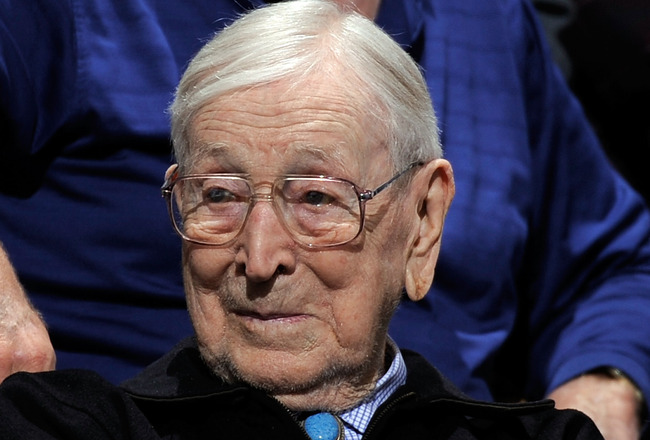
With profound simplicity, Coach John Wooden redefines success and urges us all to pursue the best in ourselves. 

In this inspiring talk he shares the advice he gave his players at UCLA, quotes poetry and remembers his father's wisdom.

 John Wooden, affectionately known as Coach, led UCLA to record wins that are still unmatched in the world of basketball.

Throughout his long life, he shared the values and life lessons he passed to his players, emphasising success that’s about much more than winning.


Share/Save/Bookmark

Friday, April 05, 2013

Positive Leadership: The Changing Face of Leadership Development


Leadership Development needs to move -

From:
To:
Case studies
Real-time challenges
Intellectual, cerebral learning: new insights and good intentions
Behavioural transformation: new actions in the workplace
Individual, leader development
Relational, leadership development
Competency based – for success in the past
Involving real stakeholder perspectives – for success in the future
No attention being paid to dropping old habits that are no longer relevant
The inclusion of unlearning, addressing of limiting assumptions, mind-sets, habitual patterns


Share/Save/Bookmark