Positive Leadership has also been recognised as a Top 50 Leadership Expert to Follow on Twitter.

Follow us on Twitter @posleadership


LEADERSHIP IS A PROCESS OF SOCIAL INFLUENCE, WHICH MAXIMISES THE EFFORTS OF OTHERS TOWARDS THE ACHIEVEMENT OF A SHARED GOAL.

Saturday, January 16, 2010

Encouraging a 'Check-Six' Culture in Business


US Air Force fighter pilot Rob “Waldo” Waldman learned how to overcome fear, anxiety, and self-doubt to fly combat missions that pushed him to his limits by disciplined training and the help of his wingmen. Wingmen are people with different backgrounds, skills, and experiences unified under one agreement—to never think or act alone.

A wingman watches your back. In Never Fly Solo: Lead with Courage, Build Trusting Partnerships, and Reach New Heights in Business, Waldo threads real world experiences to encourage the development of a check-six culture. Check-six refers to the six o’clock position where the jet is most vulnerable—the pilot’s blind spot.

Waldo says, “There is a limit to how much you can learn on your own. A good wingman will give you mission-critical feedback, catch your errors, ask questions, and propose challenging scenarios to push you to grow in your skills and mental discipline.” Encouraging others to look out for our blind spots requires a great deal of mutual trust. “These trusted partners, male or female, are your wingmen.”

Of course, this means first, not being afraid to acknowledge that you need help and then being able to ask for it. This is all the more difficult if you haven’t built trust in yourself and invested the time to build trusting relationships with others. You’ve got to “walk the flight line.” Get out and build relationships with those people you work with—treating each other as people first and coworkers second. “It’s the relationships we build and the people whom we trust that give us the courage to take risks and make ourselves better.”

By being willing to say, “I don’t know,” or “I messed up,” we create a transparency that will attract others to us and “create the type of environment where people won’t be afraid to make mistakes. They will also be more likely to check your six as well.”

Additionally, we have to keep our “radar sweeping for a wingman, coworker, or peer who may be experiencing a challenging time in her life. Don’t let her get isolated.” Be supportive and find her some help if necessary.” It is the worker that keeps to themselves—trying to fly solo—that check out, become unmotivated, complacent and careless. “Never feeling invested in the company’s mission, they do the minimum, and everyone suffers.”

In today’s environment, communication, feedback, and mutual support are critical Waldo says because:

•Human beings make mistakes.

•We each have a limited perspective.

•We operate in stressful environments that lead to tunnel vision and task saturation.

•Most professionals undervalue communication and teamwork.

•Faulty communication can kill a mission as well as a relationship.

•Errors increase when there is no definable set of teamwork standards and skills.

“An effective check-six environment frees up communication and removes barriers to growth, so that all members of the team feel empowered to speak up and ask questions.” It also builds team confidence.

We all need wingmen and the best way to find a wingman is to be one!
Share/Save/Bookmark

Leading Is Not Easy


'And did you get what you wanted from this life, even so?
I did.
And what did you want?
To call myself beloved, to feel myself beloved on the earth.'
Raymond Carver, American short story writer and poet (1938 - 1988)
Share/Save/Bookmark

Friday, January 15, 2010

The Test of a Positive Leader


Experts suggest that the litmus test of a Positive Leader is the kind of reputation one creates with followers.

Positive Leaders deliberately increase the flow of positive emotions within their organisations. They choose to do this not just because it is a nice thing to do for the sake of improving morale, but also because it leads to a measurable increase in performance.

Research indicates that organisational leaders who share positive emotions have workgroups with a more positive mood, enhanced job satisfaction, greater engagement, and improved performance.

For more information, please contact: graham.watson@positiveleadership.co.uk
Share/Save/Bookmark

Thursday, January 14, 2010

CEO Changes


Here is an interesting article from yesterday's Los Angeles Times:

'The nation’s companies reported that 1,227 chief executives vacated their posts during 2009, the lowest level in five years, according to a survey today.


Last year’s total was 17% less than the record 1,482 departures of 2008 and the smallest annual number since the 663 chief executives who left in 2004, according to Chicago outplacement firm Challenger, Gray & Christmas Inc.

The year featured several notable departures, such as Bank of America’s Ken Lewis, who retired. General Motors’ Rick Wagoner, who was ousted in March, was followed out shortly thereafter by his successor, government-appointed Fritz Henderson, in December.

Challenger Chief Executive John Challenger noted that the decline in departures could be a result of companies trying to maintain a stable upper management until the economy settles down and begins growing.

“If and when it appears that the expansion is finally underway, there could be a surge in leadership changes, with companies opting for growth-oriented risk-takers over the ‘just-keep-the-ship-afloat’ leaders they favored in the latter half of the recession,” he said.

Last month, 105 chief executives left their positions, up from the 94 who vacated in November but less than the 123 who left in December 2008. The 78 chief executives who left in May was the lowest monthly total since December 2004, when 56 departed.

The healthcare industry recorded the highest turnover for the fifth consecutive year, with 203 departures, down from 285 in 2008, Challenger said.

The government and nonprofit sector was next, with 163 departures, followed by the 123 in the financial industry.

As for their reasons for leaving, 355 chief executives cited resignation, while 251 retired. Only 15 were fired by their companies, and seven were removed due to underperformance.

And 231 chief executives, such as Morgan Stanley’s John Mack, said they left their posts but stayed with the company as a member or chairman or in some other senior executive post. But 144 left after being enticed by new positions in other firms.

The typical chief executive departing last month was 58 years old and had served for just over 8 years.'
Share/Save/Bookmark

The New Breed of CEO


In May 2009, PepsiCo CEO Indra Nooyi made a profound speech about the new breed of CEO's we now need and their responsibility to society:

'I think we need to embed a culture of long-term thinking. If that is right, then the job of the CEO is going to be very different in the future from the way in which the job has developed over the past 2 or 3 decades. The CEO we have tended to admire has been the one who could take the costs out, the one who could get the biggest return in the shortest possible time. That was what the idea of the company as an engine of short-term value required. But that kind of hard-edged leader delivering a return on capital no matter what the emotional social cost, I believe, is yesterday’s leader....

....So we need a new breed of CEO better equipped for the job they will now do than the job they did years ago....perhaps the most important thing is that the new CEO has to create sustainable value.'

For the full speech, see - http://www.pepsico.com/Download/IKN_Economic_Club.pdf
Share/Save/Bookmark

Wednesday, January 13, 2010

Mistakes a Leader Can Make


Some interesting results from a recent survey which came across the Positive Leadership desk:


Of these 4 leadership sins, what's the worst one a CEO can commit?

Failing to listen. 62.01%

Failing to set goals intelligently. 14.09%

Unwillingness to try new things. 13.87%

Failing to delegate effectively. 10.03%
Share/Save/Bookmark

Staying Cool Under Pressure


Almost everyone is required at one time or another to perform under pressure at work. The very fact that you have a job means that you are expected to perform tasks, produce results, and adhere to policies and standards. When a team has a really good year, the organisation doesn't say: "thank you—you can relax a bit next year." The expectation is that the team will perform even better. This means more pressure!

Have you noticed that some people really thrive under pressure while others just cave under it? They can't cope. Coping with pressure and stress is not an innate personality trait that you do or do not have—it is in fact a skill that anyone can learn.

Dr. David H. Olson, Professor Emeritus of the University of Minnesota, concluded after extensive research that there are four coping skills needed to effectively deal with pressure or stress:

Problem Solving: the ability to face up to problems and deal with them when they arise, rather than avoiding them or procrastinating about dealing with them, or looking for someone or something to blame.

Communication: the ability to openly discuss problems or situations that are causing pressure or stress, rather than keeping it all to yourself.

Closeness: the ability to build relationships based on mutual trust so you have people you can talk to about the pressure you are experiencing and explore potential solutions.

Flexibility: the ability to effectively deal with unstructured or unpredictable situations, or unplanned change.

Leaders are typically under more pressure than individual performers—they have the added pressure of getting their team to produce the results expected of them, and they also have personnel problems to deal with. The more effective you are at each of these four coping skills, the more effective you will be as a leader.
Share/Save/Bookmark

Tuesday, January 12, 2010

Harvard Wins Fans for Advanced Leadership Course


While the UK restricts funding for the courses older people like to do, at Harvard they have big ideas: don't retire, retrain for a new career. Where the Harvard initiative diverges from other models of "ongoing education" – and the reason advocates for older people in the UK are showing an interest – is because of the ambitious and positive message it sends about older people to wider society.

For more, see - http://www.guardian.co.uk/education/2010/jan/12/advanced-courses-retirement-harvard
Share/Save/Bookmark

Driving Bold Change


We have talked before on the Positive Leadership blog of what business leaders can bring to education:
http://positiveleadershiplimited.blogspot.com/2009/10/what-business-leaders-can-bring-to.html

Here is a fascinating interview with the Chancellor of the New York City public schools, Joel Klein. Klein is a product of the schools he now runs. He attended New York City public schools for 12 years, then went to Columbia University and Harvard Law School. He clerked for Supreme Court Justice Lewis Powell and eventually became the Justice Department's antitrust chief under President Clinton.

The video interview is instructive for business and education leaders in the UK also: http://www.washingtonpost.com/wp-dyn/content/video/2009/12/16/VI2009121600664.html#
Share/Save/Bookmark

Leadership Coaching


At times, leaders and managers can benefit from individual confidential mentoring or coaching sessions with our highly experienced consultants. This can be arranged at a mutually convenient venue for an intensive session that can save time and achieve highly effective results. For more information, please contact graham.watson@positiveleadership.co.uk
Share/Save/Bookmark

Monday, January 11, 2010

M&A Skills Honed as Athletes


Kraft Foods Inc. Chief Executive Officer Irene Rosenfeld and Cadbury Plc CEO Todd Stitzer disagree on the merits of merging their companies. They’ll both need to prove themselves if the deal falls through.

Stitzer has engineered more than 40 transactions since joining Cadbury Plc as a Columbia-trained mergers and acquisitions lawyer. In 2003, the Pennsylvania-raised CEO outbid Nestle SA for chewing-gum maker Adams Inc., making Cadbury the world’s biggest confectioner. The U.K. company held that rank until it was displaced by Mars Inc.’s $22.6 billion purchase of Wm Wrigley Jr. Co. in 2008.
 
Rosenfeld has spent more than 25 years at Kraft, with a two- year interruption in 2004 to run PepsiCo Inc.’s Frito-Lay snack- food unit. Last year, Forbes magazine ranked her No. 6 on its list of the world’s most powerful women, three behind PepsiCo CEO Indra Nooyi.

Both CEOs have honed their competitive skills as athletes. Rosenfeld, who is also Kraft’s chairman, played four varsity sports in high school and chose Cornell University as her alma mater partly because of the women’s athletic program. Stitzer, who has dual U.S. and U.K. citizenship, paid for law school at Columbia University by playing professional tennis.
Share/Save/Bookmark

A Test of Character


J F Roxburgh, the first headmaster of Stowe School, said he wanted to turn out young men who would be "acceptable at a dance and invaluable in a shipwreck". Perhaps the examples need a little updating, but Roxburgh's goal perfectly captures the ingredients of good character: moral courage, civility and an ability to put the needs of others before your own.

Questions of character are being posed again today, after decades of neglect. This character revival is occurring as politicians and policy-makers in the UK realise that many of their most cherished goals – for social mobility, co-operation, social responsibility – cannot be met through either the machinery of the state or the magic of the market. Character is an old-fashioned term for a set of pressing contemporary problems.

For more, see - http://www.telegraph.co.uk/news/newstopics/politics/david-cameron/6965133/David-Cameron-A-test-of-character.html
Share/Save/Bookmark

Dealing with Tough Days


Even the most dedicated and experienced of leaders will admit that there are more than a few days when they wonder whether it might not be a lot less stressful to hang up their leadership boots in favour of an individual contributor role. There are many days when you will drive home from work wondering whether you truly accomplished anything, and others when you will feel like you just took a few steps in the wrong direction.

Here are some ideas for dealing with these tough days:

1. Every problem or crisis is an opportunity to build your leadership skills along with your confidence and credibility.

2. Problems create teachable opportunities. Don’t waste these opportunities.

3. It’s the challenges that you and your team conquered that you will remember. Make some memories!

4. Remember that you don’t have to carry the weight of the world on your shoulders. If you’ve done your job and earned respect, your team members are there to help ease the burden. Ask for help.

5. People aren’t programmed to act and respond in ways that always fit your plans. Losing a great employee is painful, but if it has to happen, ensure that the relationship transitions to one of valued and always welcome friend.

6. Be thankful for feedback that says that you can improve. At least someone cares.

7. Leaders earn dividends over the long term. Your payoff comes a decade from now when the people that you are leading today are rising to new heights in their careers. They did the work but perhaps you played a small role along the way. Take pride in their accomplishments.
Share/Save/Bookmark

Sunday, January 10, 2010

How do You Define “Ethical Leadership”?


The Positive Leadership definition of 'ethical leadership' has three elements:

(1) Perspective- Working hard to see reality clearly

Many of us view reality as things being just the way they are (at face value), while others understand that our view of reality is based on our beliefs, and that our beliefs are based on our past experiences.

(2) Courage - Doing what is required to get the job done

Failure in leadership is not due to the lack of ideas, but due to the decisions we make after we feel the “tight gut.” It is the ability to be uncomfortable and do the right thing anyway.

(3) Integrity- Doing what is required without violating personal integrity

Integrity is simply obedience to the unenforceable. It is doing the right thing when no one is looking and you wouldn’t get caught doing otherwise.

An individual, a company or even a society’s “brand” is defined to a great extent on ethics. On an individual level, we have to have the courage to be virtuous and do the right thing even when we feel like not doing it. We grow our “virtue muscle” each time we get through the thirty seconds of discomfort – that “tight gut.” We have to work hard not to retreat into cynicism as a protection against feeling bad. One of the best ways to enhance this trait is by working with someone who has higher integrity than us – thereby raising our level of integrity by the association.

On an organisational level, the extremes are from total bureaucracy to total anarchy. In total bureaucracy, lines of integrity are never crossed due to the rules in place, yet individuals are miserable and the company cannot adapt quickly. In total anarchy, the absence of boundaries causes the atmosphere to be chaotic and the company to experience unnecessary loss. The goal in the organisation is to be in the middle of these two extremes and experience “obedience to the unenforceable.” What companies need are employees that will do the right thing in alignment with the direction of the company even when no one is watching.

On a societal level, there are more controls on people’s integrity than ever before. These laws while urging compliance can create cynicism. The more individuals show a commitment to being a value-based society, the more everyone moves toward compassion. The more time we spend in shaping other’s integrity, the more our fabric has been strengthened as a society.
Share/Save/Bookmark

Saturday, January 09, 2010

Why Integrity and Values Matter in Business


Rosabeth Moss Kanter is a professor at Harvard Business School, where she specialises in strategy, innovation, and leadership for change. Here are her interesting views on the recent troubles of Tiger Woods:

'Golf champion Tiger Woods no longer represents global consulting and technology services firm Accenture, as of December 13. Accenture is the first of Woods' corporate sponsors to pull out of the relationship completely. A day earlier, Gillette announced a suspension of Woods' marketing appearances for an unspecified period.

For anyone missing two weeks of headlines, here's a recap. Golf champion Woods crashed his car near his Florida home after what appeared to be a major league (oops, wrong sport) fight with his wife over alleged infidelities. At first Woods denied any marital misconduct, using the first line of defense of many public figures caught in a sand trap, which was to lie about it. Then other women surfaced with firm evidence of Woods' affairs, for a total of 13, and Woods told the world that he had made mistakes. On December 11, he announced he is taking a mega-mulligan — a leave of absence from golf to repair his marriage.

Though Accenture doesn't sell anything to consumers, it put itself in the public eye with its "Go ahead, be a Tiger" ad campaign. Working for Accenture since 2004, Woods seemed a plausible long-term choice. His consistently stellar athletic achievements and mixed racial heritage symbolize the best of a global economy. Now his departure could mark a seismic shift in corporate branding and marketing approaches.

Some analysts see Accenture's announcement as purely pragmatic, not moral or ethical. Woods' indefinite leave of absence from golf would introduce too many uncertainties into Accenture's ad campaigns, one commentator told AP. Moreover, Woods is rapidly losing cachet. A poll reported by Bloomberg found that Woods has already dropped from 6th to 24th in popularity among consumers.

But I see the values dimension front and center. Accenture has made a strong commitment to values-based corporate citizenship. Its aspirations require disengagement from a tainted celebrity.

During the past decade, ethical misconduct of many kinds has caused the decline of the cult of the celebrity CEO and the fall of many a celebrity politician. Now we are watching thedecline and fall of the just plain celebrity. This is not just about the type of indiscretion — at least, some sports fans would say, Woods didn't take steroids. Instead, the significance of the Woods affair is the challenge it poses to a major marketing convention: use of celebrities to sell products and services instead of featuring the product or service's value for users (and the values that guide its production).

In Accenture's case, I know about its outstanding reputation and work for clients from former or future Accenture employees passing through my classrooms. (I recently gave a lecture to an Accenture group.) But I was puzzled about the little knowledge gleaned about that good work from ads in which Tiger Woods stands alone swinging a golf club. For one thing, Accenture professionals practice in teams, not as individuals, and promote teamwork in the organizations they serve.

Unlike Accenture, Nike makes a product that Woods and other athletes actually use — shoes. Green-values-oriented Nike is sticking with Woods for the moment, appearing to be rehabilitation-minded and comeback-oriented in other instances too. This fall, Apple, Excelon, and other companies dropped their memberships in the U.S. Chamber of Commerce in disagreement with what they saw as the Chamber's foot-dragging on climate change policy. Nike kept its membership while resigning from the Chamber board in order to work for change from within, executives said. But the Chamber incident, too, is evidence that companies increasingly see that their values must be reflected consistently in every decision they make, every marketing campaign they run, and every partnership they form.

I have no insider information about what Gillette will do next, just a guess. From my in-depth research on its corporate parent Procter & Gamble (P&G) and conversations with chairman and CEO Bob McDonald, I predict that Tiger Woods will not reappear. P&G takes its values very seriously. McDonald has said publicly that representing the company extends to ethical private conduct off the job, not just compliance during work hours.

P&G brand guardians should be glad P&G invented Mr. Clean. A cartoon spokesperson doesn't have a personal life involving ethical dilemmas. Mr. Clean eliminates messes rather than getting into them. And Mr. Clean speaks to consumers about what his product does for them, rather than how many tournaments he wins. That kind of communication about value and values could be the post-Tiger tiger to catch.'


Share/Save/Bookmark

New Leadership Styles Emerging from the Economic Crisis


Since September 2008, the leadership and management practices of financial institutions have been widely discredited. This has precipitated new thinking about organisations and leadership within financial-services — and in business in general. The new leadership styles that prevail, and associated changes in management and governance structures, will shape the development of business institutions generally. It isn’t yet clear what norms and values the new industry leaders will champion, but the pressures on them are evident, and the history of managerial culture suggests that we will see some major transitions, and some unexpected ones.

Popular conceptions of what constitutes good business leadership will extensively influence this new style. Between the early 1980s and 2001, the “leader as hero” was a celebrated model. Exemplars like Jack Welch at General Electric Company and Sir John Browne of BP shook up old organisations that were weighed down by processes and committees, and, shining clear light from the top, transformed their performance. But after 2001, the dot-com bust and other factors pushed this individualistic model of leadership off the pedestal. That downturn revealed the flaws, failures, and even disgraceful conduct of some noteworthy individualistic leaders, including those of Enron, WorldCom, Tyco, and Parmalat.

The “leader as hero” model was superseded by enthusiasm for the concept of “leadership teams.” Better performance, the theory ran, came from combining a variety of management talents and styles into a single cohesive and mutually supportive group. Life at the top became more touchy-feely. The team-based model was well suited to a generation of CEOs who were less hierarchical, less schooled in the military, and more collaborative by inclination than those who preceded them.

Now we face another transition. The economic crisis and the entanglement of so many trusted financial-services firms have once again shaken our confidence in the prevailing leadership style. With apologies to Winston Churchill, never in the field of commercial business has so much been damaged for so many by so few. The failure of expectations has been widespread, severe, and rapid. That discredits past leadership practices — but what will replace them?

The quickest impact on business leadership in business will probably be felt at the board of directors level. Driven by fear of the risks that have been exposed, board leaders will start by changing their own behaviours. Directors want more visibility into corporate practices and risks, and more data to directly verify more dimensions of corporate performance. They feel their positions are much more on the line, and they are starting to ask for the staff and capabilities to do more checking up, probing more deeply even in areas historically left to management.

Boards will revise formal governance structures, adjust team composition, and reconsider the personality and skills of the people placed in top positions. As always, they will respond to prevailing interpretations of recent history. In seeking a new form of leadership, boards will start with the oldest truths: Those in authority must have foresight, and they must lead by example. They must motivate and inspire on a moral basis, through aspiration as well as rewards and punishments. It is precisely this calm, considered, and ethical leadership, required to lead large numbers of people when the economy is tough, that seems to have been in such short supply recently.

Guided by their boards, many institutions will recommit to public responsibility. Trust and simplicity, cornerstones of the Positive Leadership model, will become major selling points. Enterprises in banking or in business in general industry that can command greater trust or offer closer connections with their customers will enjoy substantial opportunities. There could be a renaissance of institutions with a tradition grounded in cooperatives or member-owned organisations, of which there are many in Europe (including some, like Rabobank Group in the Netherlands, that have weathered the storm in financial services reasonably well). Inevitably, a broader scope of alternatives to the shareholder-centric corporate model will be tested, and some will win favour.

Many companies will also need to find structures and processes, both formal and informal, that challenge thinking and retain productive dissent. The leadership team form will be left intact, but its potential will be tapped in new ways. Teams will be populated with more diverse personalities, whose challenge will be to work together to set some new directions and renew moral leadership while paying closer attention to day-to-day execution.

These leadership team members will have to learn to recognise the power of the unknowable. We have found out the hard way that conceptual financial models, which seemed for a time to provide a new means of rapid growth, can actually obscure the underlying realities of the economic system. We now have some catching up to do as we recognise the failure of these models to comprehend and control the complexity and interdependence of our world. Leaders in financial services might do better if they understood that we human beings are all limited, that our best course is to accept that we are intrinsically prone to get things wrong, that we need to keep our wits about us, and that to succeed in the arcane world of finance, we need most of all to stay grounded in day-to-day reality.

We must promote leaders for whom doubt and uncertainty are simply a part of the human condition, not the enemy of action or a sign of weakness. They must tolerate questioning and doubt within their own organisations, and apply it productively themselves. We must make it an organizational habit to regularly challenge even what seems to be most obviously true, to remain open to different types of data, especially including direct experiential and “feet on the street” observations. One wonders what would have happened if the boards of the banks had visited the neighborhoods whose homes they were financing.

The makeup and management of executive teams may have to change. The evidence is clear that the most productive teams contain diverse people. Teams composed of people from a range of backgrounds, including prosaic ones, outperform teams composed entirely of the so-called best and brightest, for example. The dynamics of team interaction often make it hard to preserve diversity, even though it is diversity that makes the team productive. The bright guys want to hire more bright guys, for example. Moreover, in a typical leadership team, the variety of personality types tends to make the team itself short-lived. People who want to get things done (and there are a lot of them in business) drive out those who want to stop and debate or who value perspective and understanding as much as action. As those latter individuals go, so goes the ability to challenge. And those who shrink from conflict or believe that only harmonious teams can be effective will also disapprove of the kind of open dissent that encourages better leadership and decision making. That is a different definition of productive teamwork than has been applied in the past.

If people recognise this, we should see improvements in the organisation and management of executive teams and boards. In composing teams, boards will tend to favour a diversity of characteristics, and they should guard against the drift toward homogenisation. Further, power and control will be separated more actively and structurally. There may be a segregated, internal governance structure in some organisations — beyond the CEO’s control, but reaching down into the company — whose role will be to audit and hold to account those with primary decision-making authority. Rather than accepting conventional wisdom and existing policies, they will need to look for disconfirming facts and contrary evidence.

This type of governance structure is made even more necessary by the fact that only 25 percent of new CEOs today come from outside the company. Consequently, the outsider’s perspective is not coming from top executives. Many corporate leaders will thus need organisational innovations that provide visibility and challenge to management at quite detailed levels. The financial control function at most companies is an excellent and well-established example; this oversight arrangement can be extended to other corporate functions.

We see this already in a few companies. It has helped some institutions avoid or mitigate the effects of the crisis. Central corporate leadership at the financial-services firm Barclays PLC is entirely devoted to governance, leaving day-to-day and even month-to-month management to the divisions. The centre has a strong risk control function, but also governance roles across many other areas of the business. And despite Barclays’ extensive involvement in the debt market and other troubled markets, it has avoided many of the problems facing other banks.
Of course, there is a risk that such governance models will simply re-create the old bureaucratic staff structures that hobbled companies in the 1960s and 1970s.

What we will need is tightly limited roles and processes, a separate voice and perspective, and a smaller number of resources and processes. This spare, collective, and relatively informal approach will require leaders who are unusually holistic, integrative, and dispassionate in their character and thinking. This is not a time for leaders who will be waylaid by details, nor for those who are convinced they see the future clearly and want their organisations to fall in line. Rather, they must see the general patterns, and see them better than others, while recognising, not suppressing, the risk and uncertainties.

The most successful leaders of these newly transformed organisations will do one more thing distinctively well. They will set the overall purpose and mission of the organisation, not just its strategy. Indeed, they will often concentrate on corporate purpose or mission, leaving strategies to the executive team. We already know that companies with an articulated purpose that goes beyond simply the expediency of “making more money” have fared much better in the downturn. They will also fare better in the recovery. But this will depend on the temperament of leadership.

If we are fortunate, the leaders who emerge this time will be honest, robust, and farsighted enough that their prevailing style will last for some time.


Share/Save/Bookmark

Building Your Own Business


Building a business involves a lot of strategic planning, financial planning, and goal setting if you are going to be successful. What a lot of aspiring entrepreneurs do not realise is that it is also important to maintain certain mental attributes and leadership skills that will help to motivate planning strategies and goals.

There are certain attributes that entrepreneurs possess that determine how successful they will be as a business owner. These are success principles that entrepreneurs live by which ensure that they will overcome obstacles and achieve success.

Take Control of Your Life

Making the decision to transition into entrepreneurship means that you have decided to take control of your life. This means that you must maintain a mental attitude of being in control instead of blaming everything on other factors. Not taking control and placing the blame elsewhere does not get you where you want to go as an entrepreneur and holds you back from moving forward with your business.

Persistence

Successful entrepreneurs realise that persistence is one of the attributes that will ensure your success. If you maintain a winning attitude, the obstacles that are bound to crop up will only be seen as temporary setbacks and part of the journey to reaching your goals.

Planning With an End Goal in Mind

Part of good leadership skills is the ability to plan with an end goal in mind. Successful entrepreneurs know how to look at the big picture and then set measurable goals that will ensure that they reach the end goal. Without the ability to set goals, you are navigating the high seas without a compass and ensuring that your business will fail.

Involvement

Successful entrepreneurs are strong leaders because they are willing to take the bull by the horns and get involved with their success. While others are waiting for what they want to come to them, entrepreneurs are going out and getting it.

Fear

Instead of allowing fear to paralyse their actions, successful entrepreneurs recognise fear as a natural part of the process and forge ahead anyway. If you let fear overcome you, the chances of achieving success with your business will be reduced.

Risk Tolerance

Successful entrepreneurs and leaders already know that failure is part of achieving their goals and are willing to take the calculated risks anyway. If you take calculated risks wisely you will help your business to forge ahead as well as learn from your failures.

Self-Confidence

Successful entrepreneurs get to where they are going because they maintain a positive mental attitude and believe in their abilities to achieve their goals.

Hard Work

Successful entrepreneurs are willing to work hard and do not give up as soon as something is difficult. Instead they realise that to get to their dreams they also have to endure the hardships and obstacles that are a natural part of the journey.

These are a few of the attributes that are important to becoming successful with your own business. Without these attributes it does not matter how well you have planned your business. It will not succeed if the person behind the planning is not motivated and goal-oriented.

If you do not have all of these attributes you can always work on developing them by surrounding yourself with people that have an entrepreneurial mindset. If you have already decided to take the leap, you have already taken an important step toward becoming a successful entrepreneur.
Share/Save/Bookmark

Friday, January 08, 2010

Leadership Traits


In 2006, the Minneapolis Police Department undertook some research looking at Leadership Traits in their officers. This data was analysed and rated by frequency of mention by other officers. The top 15 positive and negative mentioned are listed below.


Top Positive Leadership Traits

1.Fair – No favouritism, evaluations (appraisals & reviews)

2.Knowledge – Of job, smart, on policy & procedure, what’s expected of them

3.Honesty

4.Communication – Open, Effective, Know when to speak, Good interpersonal skills

5.Decisions – Make one, quick, good, tough, does right thing,

6.Involve Troops (people), standing behind decisions, shares it

7.Consistency

8.Experience – street minimum 5-10 years, earned their way

9.Support – growth, officers, personal & professional develop

10.Trust – Believe in officers, is trustworthy themselves

11.Integrity

12.Common Sense

13.Flexibility

14.Respect – Treats officers (teams/ people) with, earns it themselves

15.Approachability


Top Negative Leadership Traits

1.Micro Manage – Does

2.Favouritism – Friendship first, plays them

3.Selfish – Self centred, self serving, self promoting

4.Indecisive – Second guessing

5.Inconsistent – Shift priorities

6.Knowledge – Pretend to know everything, never wrong, not of job, know-it-all

7.Decisions – Not making any, emotional, inability to make any

8.Vindictive

9.Communication – Poor, non communicator, dishonest

10.Hypocritical – “Do as I say, not as I do”

11.Close Minded – Not open to suggestions, won’t change mind

12.Dishonest

13.Discipline – Selective, more concerned with, group vs. individual, double standards, name calling, not recognition, heavy handed

14.Inexperience

15.Responsibility – Not taking, shirks it

Taking the time to ask our people what traits they like and dislike in their leaders can be a valuable first step in any leadership development programme.
Share/Save/Bookmark

Leadership Challenges Facing the Military


Facing a rising number of suicides in its ranks, the U.S. Army recently published new guidance for improving the mental health of soldiers and for preventing or responding to suicide attempts.

"The key to the prevention of suicide is positive leadership and deep concern by supervisors of military personnel and [Army] civilian employees who are at increased risk of suicide," the new publication explained.

Factors contributing to suicide are said to include loneliness ("an emotional state in which a person experiences powerful feelings of emptiness and spiritual isolation"), worthlessness ("an emotional state in which an individual lacks any feelings of being valued by others"), hopelessness ("a strong sense of futility, due to the belief that the future holds no escape from current negative circumstances"), helplessness, and guilt ("a strong sense of shame associated with actions they believe are wrong").
The Army directed its commanders to carry out a series of efforts to promote soldiers' health, to reduce the stigma associated with addressing mental health issues, and to "manage at-risk soldiers, to include processing for separation as appropriate in a timely manner."

The New York Times recently described the rise of military suicide as a "near epidemic," and reported that 133 active-duty U.S. Army soldiers committed suicide this year through the end of October, making it likely that last year's record of 140 will be surpassed. ("Families of Military Suicides Seek White House Condolences" by James Dao, November 26.)

In its new publication, the Army said it is not always possible to detect or predict suicidal intent, and that eliminating suicide altogether was not a realistic objective. "Some suicides may be expected even in units with the best leadership climate and most efficient crisis intervention and suicide prevention programs. Therefore, it is important to redefine the goal of suicide prevention as being suicide risk reduction [which] consists of reasonable steps taken to lower the probability that an individual will engage in acts of self-destructive behavior."
 
See "Health Promotion, Risk Reduction, and Suicide Prevention," Department of the Army Pamphlet 600-24, November 24, 2009.
Share/Save/Bookmark

Thursday, January 07, 2010

Driving Positive Leadership


Bob Kidder is the newly appointed chairman of Chrysler.

Here are his thoughts on what drives positive leadership:

Think big picture

“You need to think big picture. Ask yourself: what is the greater organisational objective? A good leader needs to have the ability to think like a generalist, to broaden the lens beyond the current scope.”

Hire top talent

Kidder sees people at the core of any organisation’s success. “Starting with my days at McKinsey, it is tremendously powerful to work in a high density of smart people, it is absolutely infectious and drives peak performance.”

Cultivate team spirit

“People in an organisation need to feel like they are part of something special. Similar to my experience at McKinsey where, once joined, people embrace a lifetime fraternal bond, it is key for an organisation’s success to nurture these connections.” Starting with the board, Kidder led his group of new directors through a 3-day intense orientation program. Interestingly, for the first day, the board did nothing but drive every model that Chrysler makes, with engineers in the passenger seats who would explain the details.

Focus on opportunities

Human energy plays a central role in a positive change agenda. Focusing on strengths, optimism and opportunities, Kidder confirms: “Sergio Marchionne’s (the ceo of Fiat and Chrysler) mantra is: ‘everything is up for change’. I personally support his notion that nobody is supposed to be locked in, lifting artificial constraints put on people.”

Effectively listen

He applauds Sergio Marchionne’s ability to deeply listen to concerns and ideas that subordinates and stakeholders share with him. In line with this, as chairman, Kidder regularly sets out to speak with decision-makers in the firm to see what changes need to be made and checks whether there are any strategic disconnects or red flags: “I am an additional pair of ears, here to support Sergio in his role.”

Clearly communicate

Kidder emphasises the importance of having open communication between an organisation’s leadership and its employees and stakeholders: “We need to let our people know what our vision is, where our priorities are and what we strive to achieve.”

Empower people and hold them accountable

When Kidder became CEO of Borden, then a very bureaucratic and highly diversified structure, one of his first decisions was to decentralise the firm. Kidder gave individual CEOs decision-making power, encouraged them to take risks, to succeed and also to fail. Also new to the firm, these business leaders were held accountable for their results, which drove a cultural change and ultimately had a positive effect on bottom line.

Engage leaders who possess ‘the guts to make a decision’

A proponent of participative leadership, Kidder is strongly opposed to the concept of shared governance, a model under which all constituents need not only be heard but also have to agree on next steps before action can be taken: “This, to me, is really the absence of leadership. Such an approach lacks clarity and it slows down decision-making unnecessarily.”

So why does a 64 year old executive who has accomplished everything prefer helping Detroit to kicking back in the vineyards of southern California? Because – for him – the rewards of positive leadership make it a journey worth pursuing.
Share/Save/Bookmark

Wednesday, January 06, 2010

Avoiding the Unforced Error

The Unforced Error

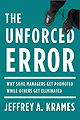
We all make them. Ethics breaches and scandals and performance-related turnover are increasingly found in today’s headlines. As in tennis, the unforced error is made by someone with the ability to keep the ball in play but who makes a mistake, resulting in the loss of a point. To improve your game you need to develop the habits that will help you keep the ball in play. It is your performance over time—a steady game—that will get you where you want to go. That’s what The Unforced Error: Why Some Managers Get Promoted While Others Get Eliminated by Jeffrey Krames aims to help you do.

The most dangerous errors—and the one discussed in this book—are “the ones we don’t recognise, so we can’t fix them before the damage is done.” Krames divides unforced errors into two groups: the unforced operating error (the ones we all make in the course of doing our job; a bad call) and the unforced nonoperating error (errors not directly related to the conducting of business, but can shatter a career nonetheless - errors of character). Krames writes, “There are seldom excuses for unforced nonoperating errors. You have to have the awareness, self-control, and maturity to avoid them.” The focus of this book is the former kind, the unforced operating error.

There is a key to avoiding unforced errors. Not surprisingly, the key is humility. “That’s because humility—one of the most underrated of all leadership qualities—is essential to developing the strength and consistency to avoid unforced errors.” It’s the kind of humility that comes from having the self-confidence to admit mistakes, blind spots and then move on to correct the mistake. Rarely would you be told that you were fired due to a lack of humility, but it is the trigger for so many unforced errors. Krames successfully helps you to recognise an unforced error when you see it. In each chapter that covers a specific unforced error, he offers sensible and pragmatic advice on how to avoid these “career killers.” His advice includes:
  • Never say the ball was out by a mile. Face reality at all times.
  • Nothing is as important as people decisions. Get the right people.
  • When you do make a people mistake, fix it as quickly as possible.
  • Don’t overlook the wild card. Develop the next generation of leaders.
  • Keep your game inbounds. Living and leading by the rules.
  • Step up to the net. Take ownership of your part of the court.
  • Watch the whole court. Find out who the real line judge is in your game and make sure they know how you’re doing.
Krames is very readable as always. The tennis metaphor works well to demonstrate the importance of these ideas. If you take the time to study the advice Kramer has gathered together, you could save yourself from committing these errors. In the words of Billie Jean King, “Self-awareness is probably the most important thing towards being a champion.” 
Share/Save/Bookmark

Leadership Lessons for the New Year


Always focus on the mission.

To be a great leader, you have to be intensely focused on the core mission of your organisation: know it, understand it, and live it. Make sure everyone in your organisation can answer these questions: Who are we? What do we do? Whom do we serve? At the end of the day, the mission is the true North Star that guides every action you take.
Share/Save/Bookmark

Tuesday, January 05, 2010

Leadership Lessons for the New Year


Act with integrity.

The actions of great leaders are consistent with their words. Saying the right thing doesn’t mean much. Doing the right thing means everything when you want people to follow you passionately.
Share/Save/Bookmark

Treating People with Respect


In this New York Times interview, Gordon M. Bethune, the former chief executive of Continental Airlines, says that “being good at your job is predicated pretty much on how the people working for you feel.” :

'Q. What are the most important leadership lessons you’ve learned?

A. I was a mechanic in the Navy. And mechanics in the Navy are like mechanics in airlines. You may have more stripes than I do, but you don’t know how to fix the airplane. You want me to fix it? You know how much faster I could fix the airplane when I wanted to, than when I didn’t want to? So I’ve always felt that if you treat me with respect, I’ll do more for you.
As I went up the ladder in the Navy, I never forgot what it’s like to be down the ladder, and that being good at your job is predicated pretty much on how the people working for you feel.

Here’s my theory: Let’s say we’re all midlevel managers, and one V.P. slot is going to open up. I’ve got 10 guys working for me, and for the last five years, every time I got any recognition, I said, “Bring them on the stage with me.” Who do you think is going to get the job? I’m going to get the job.

Q. How did you put together the team back in the early 1990s to turn around Continental Airlines?

A. I hired the best people. The sickest patients need the best doctors, so you can’t skimp on this stuff. I took the 20 top guys and I said: “I’ll create a bonus plan so that if we hit these numbers, I get paid and you get paid. And either all of us are going to get paid, or nobody’s getting paid.” And I never missed.'

For the full interview, see - http://www.nytimes.com/2010/01/03/business/03corner.html?ref=business
Share/Save/Bookmark