Positive Leadership has also been recognised as a Top 50 Leadership Expert to Follow on Twitter.

Follow us on Twitter @posleadership


LEADERSHIP IS A PROCESS OF SOCIAL INFLUENCE, WHICH MAXIMISES THE EFFORTS OF OTHERS TOWARDS THE ACHIEVEMENT OF A SHARED GOAL.

Thursday, October 13, 2011

Positive Leadership: Masters of the Universe


It isn't easy being an alpha male. Getting to the top and staying there takes a physical toll.

The latest evidence comes from wild baboons in Kenya's Amboseli basin. Researchers from Princeton and Duke universities studied 125 males in five groups over nine years and found that while the alpha males got the best food and the most mates, they experienced far more stress than the beta males just beneath them in the hierarchy, based on the levels of cortisol, a stress hormone, in fecal samples.

The beta males had almost as many mates and got just as much grooming from others, but they didn't have to spend as much time fighting or following females around to keep other males away.

"Being an alpha is exhausting. I'd rather be a beta," says Laurence Gesquiere, lead author of the study that appeared in the journal Science in July. 


In the work world, alpha males are ambitious, assertive, confident and competitive. Here's a quiz that helps define who's an alpha male:

Alpha Strengths
1. No matter what, I don't give up until I reach my end goal.
2. I always say exactly what I think.
3. I have no problem challenging people.
4. I make the decision I believe is correct, even when I know other people don't agree.
5. I seldom have any doubts about my ability to deliver.

Alpha Risks
6. I believe that my value is defined by the results I achieve.
7. I don't care if my actions hurt people's feelings, if that's what's required to produce results.
8. When people disagree with me, I often treat it as a challenge or an affront.
9. If I have a good idea and I'm asked to hold off and listen to inferior ideas, I can quickly become visibly annoyed.
10. People say I become curt, brusque, or frustrated when I have to repeat myself.

Scoring:
If all or nearly all of your responses to statements 1 to 5 were "yes," you are probably an alpha with many of the strengths that make alphas such dynamic and influential leaders.
If all or nearly all of your responses to items 6 to 10 were "yes," you mostly likely have some alpha risks that deserve your attention.
Don't be confused if you scored high in both categories. Because alpha liabilities are mainly alpha assets taken too far or applied inappropriately, that is to be expected. (The exceptions to the rule are healthy alphas who have worked hard to reduce their negative tendencies.)

Source: Kate Ludeman: Adapted from the 'Alpha Assessment' at www.WorthEthic.com

Share/Save/Bookmark

Wednesday, October 12, 2011

Positive Leadership: Performing with a Purpose


People perform amazing feats when they have a purpose.

Here are the five higher benefits of having a quest:

1. Focus
Every person—those who conceive, design, build, buy and talk—have the same focus. People at every level are able to decide what works because everyone knows where we're going and why we're going there.

2. Peak performance
On a quest, we're either in 100%, or we're not. On a quest, we sort who's good at what. People who are in 100% are valued and their strengths are matched to the cause. People who are valued invest more, do more, and go further for the work we love.

3. Energy and tolerance
We have more patience, time and energy for problem-solving when we directly reap the benefits. What leads people to achieve greatness isn't money. In fact, Peter Drucker proved that money is a disincentive…it has the most effect when it’s not there or too small. Greatness is found in the payoffs that a loyal community offers: acknowledgment, sense of purpose, support, feedback.

4. Compelling value
What’s more appealing than working with someone who’s not only good but also loves his or her job? Bringing logic and emotion together in a business outdistances the world view of logic alone. Competence and great execution are expected. A loyal engaged community builds in added value in how they tell the story, how they treat the product and the customers who buy it, and how they talk about the company as a value in their lives.

5. Total differentiation
A thinking culture of passionate leaders who love their job attracts others who share those values. The respect of a loyal community shows in everything it does. The values become both brand and barrier to entry. Community builds authority. We value what we earn and what we love. That value telegraphs itself. It’s contagious. Customers, vendors and partners pick it up as well.

Nothing beats the 360 degree investment of brains, money and dreams all in the same direction. Every company that wants to grow should have some of that. The value of a thinking, job-loving employee community shouts ROI and makes solid business sense.

Share/Save/Bookmark

Tuesday, October 11, 2011

Positive Leadership: Fix the Problem and Not Just the Symptoms


This interview with Joseph Jimenez, chief executive of Novartis, the pharmaceutical company, was conducted by the New York Times:

‘Q. What are the most important leadership lessons you’ve learned?

A. One occurred when I was a division president of another company. I was sent in to turn the division around after four years of underperformance.  It was a declining business.  And when I got there, I completely misdiagnosed the problem.  I said: “Look.  We’re missing our forecast every month.  What’s wrong?”  I brought in a consulting firm, and we looked at what was wrong.  And the answer was that we had a bad sales and operations planning process, where salespeople, marketing people and operations people were supposed to come together and plan out the next 18 months and then forecast off of that.  So I said: “O.K.  We’re going to fix this.  We’re going to have the consulting team come in and help us make that a better, more robust process, with more analytics.”

And it turned out it wasn’t at all about analytics.  Because once we did that, and we put that new process in place, we still continued to miss forecasts.  So I thought, “Something’s really wrong here.”  I brought in a behavioural psychologist, and I said: “Look, either I’m misdiagnosing the problem or something’s fundamentally wrong in this organisation.  Come and help me figure it out.”  She came in with her team and about four weeks later came back and said: “This isn’t about skills or about process.  You have a fundamental behavioural issue in the organisation.  People aren’t telling the truth. So at all levels of the organisation, they’ll come together, and they’ll say, ‘Here’s our forecast for the month.’  And they won’t believe it.  They know they’re not going to hit it when they’re saying it.” The thing she taught me — and this sounds obvious — is that behaviour is a function of consequence.  We had to change the behaviour in the organisation so that people felt safe to bring bad news. And I looked in the mirror, and I realised I was part of the problem.  I didn’t want to hear the bad news, either. So I had to change how I behaved, and start to thank people for bringing me bad news.

Q. That doesn’t mean letting them off the hook, though.

A. Right. It’s more a chance to say: “Hey, thank you for bringing me that news.  Because you know what?  There are nine months left in the year.  Now we have time to do something about it.  Let’s roll up our sleeves, and let’s figure out how we’re going to make it.”  It was a total shift from where we had been previously.  So after that experience, I always ask all of my people, and I always think to myself: “Are we really fixing the root cause of this problem, if there’s any problem?  Or are we fixing the symptoms?”


Share/Save/Bookmark

Saturday, October 08, 2011

Positive Leadership: Learning From Steve Jobs


Share/Save/Bookmark

Positive Leadership: Commitment To Excellence

Commitment To Excellence
Share/Save/Bookmark

Friday, October 07, 2011

Positive Leadership: Some Thoughts on Leadership


  • “It begins with people.  Life is people.”
  • “If we get the right ‘whos’ on the bus, we get the right outcomes.”“
  • Try to change every ‘what’ to a ‘who’”
  • “It is not about personality, it is about humility.”
  • “Humility is burning ambition channelled to do good outside yourself.”
  • “Hubris is outrageous arrogance that inflicts suffering on the innocent.”
  • “Bad decisions with good intentions are still bad decisions.”
  • “True innovation comes from empirical creativity.”
  • “The only mistakes you learn from are ones you survive.”
  • “The signature of mediocrity is chronic inconsistency.”


Share/Save/Bookmark

Thursday, October 06, 2011

Positive Leadership: Be a Yardstick of Quality


Share/Save/Bookmark

Wednesday, October 05, 2011

Positive Leadership: Accept the Facts

Accept The Facts from Nick Bollettieri on Vimeo.


Share/Save/Bookmark

Positive Leadership: Playing to Win

Play to Win from Nick Bollettieri on Vimeo.


Share/Save/Bookmark

Tuesday, October 04, 2011

Positive Leadership: Creating Harmony


When a leader tunes his or her instrument first and ensures that each instrument in the orchestra is tuned, harmony is created and people are drawn to see and hear what the organisation has to offer.

Share/Save/Bookmark

Wednesday, September 28, 2011

Positive Leadership: Sharing Accountability


Uncertainty necessitates the need for finding more wisdom within our organisations. This can only be accomplished by creating a leadership mindset throughout the entire organisation. It is shared accountability. Any leader that thinks that they can do it alone is indulging their own ego.

Do not assume that no one else on the premises can match our own ambition, competence, and vision. We have to accept the fact that there are many points of wisdom within our organisations and a wise leader will engage them. Too many leaders are not accustomed to accepting input from junior members no matter how valuable it is. This creates a lack of trust and openness. The currency of leadership is relationships and a wise leader would do well to encourage input from as many sources as possible and especially not from the usual suspects.

The concept of distributed leadership will keep you in touch with the environment. If you want to prepare people for this environment, you have to get leadership further down the organisation. We generally tend to drive managing down the organisation, but not leadership. However, in order to maximise the opportunity for success, we have to prepare for acts of leadership further down the organisation – even if it feels like an unnatural act to people sitting at the top.

Leadership needs to be the expected norm at all levels. 

Share/Save/Bookmark

Tuesday, September 27, 2011

Positive Leadership: Building a Positive Work Environment


16 ways to build positive work environments:
  • Develop people.
  • Know what they do best and leverage it.
  • Clearly define expectations.
  • Trust them to act.
  • Support them when they fail.
  • Always give credit and take blame. No one likes seeing a blamer.
  • Believe in them – you’re on their team.
  • See opportunities more than problems.
  • Help find solutions.
  • Keep out of the way.
  • Encourage, enable, and inspire.
  • Protect from bureaucracy.
  • Value them as individuals.
  • Don’t talk about yourself, too much. Let people know you, however.
  • Don’t talk on and on ….
  • Make people feel listened to by asking more than stating.

Bonus: Give others what you wish others would give you.

Share/Save/Bookmark

Monday, September 26, 2011

Positive Leadership: Would You Want to Report to Yourself?


This is an extract from a New York Times interview with David Barger, president and chief executive of JetBlue.

Q. How do you talk about leadership within the company? 

A. We teach principles of leadership on a regular basis, to supervisors and above. The module I teach is, “Inspiring Greatness in Others,” and we talk a lot about how we each have a silhouette that comes to life. And, as the silhouette comes to life, it’s as much about what you’re doing, the body language, as what you’re saying. There’s a lot of lessons to be learned by watching others make a mistake. And I’ve certainly seen that, in the past. It could be leaders coming in and the next thing you know they’re not visiting the cockpit, they’re not saying hi in the galley, they’re not going to the baggage service office, they’re not stopping by the ticket counter. It doesn’t take a lot. People know you’re there. Go see them. Be present.

Q. What are some other takeaways from your session?

 A. There are several, but here’s a few more: Be mindful that there is incredible leadership all around you. Go find it. Go tap it. Go mine it. And here’s a key question: would you want to report to yourself? It’s little things, too. When you say hi to somebody, do you mean it, or is it just a casual comment?

Q. Any leadership insights you’ve gained in the last couple of years?

 A. We have executive coaches we’ve used over the last couple of years. The message was, enough consensus building. When it’s time to make a decision and your team’s not making the decision, make the decision. I don’t think I ever was reticent in terms of making a decision. But, as I look back, there were plenty of examples where the team was looking at an issue but not getting a final decision. I think it’s probably the most formative feedback I’ve been given — that it’s fine to be the consensus builder, and I know that’s where I lean in terms of my leadership DNA, but now I am more comfortable saying, “This is what we’re going to do. Next topic.”


Share/Save/Bookmark

Friday, September 23, 2011

Positive Leadership: Encouraged vs Discouraged


Events do not cause what we feel, but what we tell ourselves about these events does cause what we feel. 

Many people may seem to be unmotivated but they are really discouraged.  Perhaps they have come to believe that, no matter what they do, the results will not be there, so what is the use?  They should remember that discouragement is more a result of what they are telling themselves as opposed to being about the event itself.

Discouragement is a style of thinking which focuses on end results and a self-counselling of our fears. Encouragement is a style of thinking that focuses more on the process and on possibilities.

Try and avoid talking to yourself about results and fears (again, never counsel your fears) as opposed to process and strengths.  Develop a "go to script" for pressure situations: "Trust," "Read and React," "No judgment. With these phrases you are having audible, observable thoughts that encourage yourself. 

How do you talk to you?  Do you discourage you?  Do you say that this undertaking cannot be done?  Do you say, "I have to win?"  Or do you encourage yourself step by step?  Do you talk yourself through the process?

Here are two of the best encouragement phrases:
  • ‘The bamboo encouragement principle’ - If you water bamboo one, two, three years, you get nothing.  But then the fourth year, the bamboo grows nine feet in six weeks.
  • 'Keep planting grass; don’t pull weeds'  - Paying attention to the weeds is counselling your fears.  Planting grass is encouraging your strengths.

Your greatest enemy when under pressure is mental fatigue and discouragement.  But if you can keep from growing weary, in doing well in due season, you will reap if you faint not.  Keep on fighting weary until finding renewed energy.  Talk to you, out loud if you have to, saying, "Keep planting grass; don’t pull weeds."  Or "Keep watering the bamboo."  Or maybe "I am just too stubborn to give up, so weary I hear you knocking, but you can’t come in."   Whatever you do, just keep on keeping on.

Share/Save/Bookmark

Wednesday, September 21, 2011

Positive Leadership: Achieving Greatness


What is the difference between mediocrity and greatness? Possibly not as much as you think.

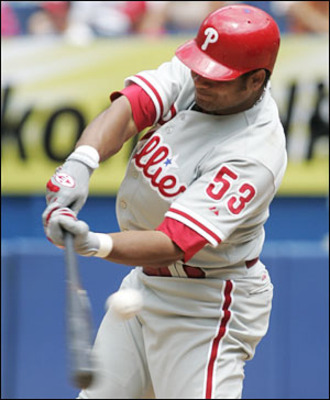
You know, it really takes very little to make a big difference in our lives and in the world. In professional baseball in the USA for example, most batters hit for an average of about .250, which means that they get one hit for every four times at bat. Anyone who hits .300, three hits out of ten, is considered a star. By the end of the season, there are only about a dozen players out of hundreds in the leagues who have maintained a .300 average, and these are the ones who get the big contracts, the acclaim, and the TV commercials.

In other words, the difference between the great players and the ordinary players is only one hit out of twenty! This slim margin of greatness in baseball symbolises the dynamics of greatness in life, because when we use just a tiny bit more of our potential, we become outstanding human beings.

Now, the purpose of being outstanding is not to win acclaim or glory, but to be more of what we can be. If you accept the idea that most of your present limitations are not based on any unchangeable reality but are rather the result of beliefs you hold about your reality, then the next step is to deliberately and systematically change those beliefs.

It’s called possibility thinking, and it’s a skill you can learn quite easily. 

Share/Save/Bookmark

Friday, September 16, 2011

Positive Leadership: What Makes A Leader

'What Makes A Leader?' was the title of the 1998 article Daniel Goleman wrote in the Harvard Business Review that the review calls one of its ten “must-read” articles of all time. He wrote about three abilities that distinguish the best leaders from average: self-awareness, which both lets you know your strengths and limits, and strengthens your inner ethical radar; self-management, which lets you lead yourself effectively; and empathy, which lets you read other people accurately. You put all those together in every act of leadership.

For more, see: http://www.forbes.com/sites/danschawbel/2011/09/15/daniel-goleman-on-leadership-and-the-power-of-emotional-intelligence/

Share/Save/Bookmark

Tuesday, September 13, 2011

Positive Leadership: The Importance of 'You'!


A "Crash Course" on LEADERSHIP

The 10 most important words:
“What can I do to help you be more successful?”

The 9 most important words:
“I need you to do this, and here’s why…”

The 8 most important words:
“That’s my mistake and I will fix it.”

The 7 most important words:
“My door is always open to you.”

The 6 most important words:
“Let’s focus on solving the problem.”

The 5 most important words:
“You did a great job!”

The 4 most important words:
“What do YOU think?”

The 3 most important words:
“Follow my lead.”

The 2 most important words:
“Thank You.”

The MOST important word:
“YOU”

Share/Save/Bookmark

Monday, September 12, 2011

Positive Leadership: Inspirational leadership secures #WalkerCup


If north-east Scotland had not been buffeted by strong winds and rain squalls at the week-end, might the US have won the Walker Cup again? The question is relevant following Great Britain and Ireland’s narrow victory in a thrilling match at the stunning Royal Aberdeen golf club because winds gusting up to 30mph and intense rain squalls were certainly less familiar to the visitors than to the home team.

The answer to the question though is that Great Britain and Ireland confounded all known form, including the current world amateur golf rankings not to mention almost all the pre-match predictions and were so ably led by Nigel Edwards that they won this biennial contest for only the eighth time. They probably would have won under calmer conditions. But it is also true that luck favoured Edwards. Had the wind dropped on Sunday morning so that the second day could have been played in a calm, when the Americans improved, then matters might have been different. In fact, perhaps it was Edwards’s performance that tipped it for Britain and Ireland. The third Welshman to captain Great Britain and Ireland, Edwards, 43, became the second to win, after Clive Brown’s victorious captaincy at Royal Porthcawl in 1995.

Edwards stands comparison with Colin Montgomerie in last year’s Ryder Cup in the way he coaxed and cajoled his men to victory. Just as Montgomerie looked into every detail, even the smallest and least significant, so Edwards did much of the same. His self assurance, his eye for detail, his elaborate preparation and his knowledge of the competition as well as his passion for it, simply overwhelmed Jim Holtgrieve, the eminent American golfer. Holtgrieve is a sturdy man from the mid West, a superb and successful amateur and a less successful professional who returned to the amateur ranks. But he is 63 and his rather casual style of captaincy and the age gap between him and the rest of his team made him look out of touch at times. His captaincy also highlighted an obvious question: why is the United States Golf Association in the business of giving captaincy of this competition to former players as a reward?

The 43rd Walker Cup was rather like an old Ryder Cup. Holtgrieve gave the impression of leaving much of it to his players, believing he had the best amateurs in the world who were sufficiently experienced to be able to look after themselves. Edwards, by contrast, could not do enough for his men, from taking them twice to Aberdeen for practice week-ends, to showing motivational films and continually making sure that he was in the right place when he needed to be. Most of all, he was able to speak from the experience of winning and losing in Walker Cups because he had played in two winning teams as well as two that narrowly lost. In this he was rather reminiscent of Bernhard Langer at Oakland Hills in the 2004 Ryder Cup. While Hal Sutton progressed around while wearing a cowboy hat that, frankly, made him look rather silly, Langer concentrated on popping up on the tee of every short hole, always ready to give advice and pass on information.

Edwards looked as though he knew precisely what he was doing at all time; Holtgrieve didn’t. Edwards looked on top of his job; Holtgrieve didn’t. Edwards is certain to be asked to captain GB and I at the National Golf Links on Long Island, New York in two years. Holtgrieve probably will be asked because the convention among American teams is that captains are given a home and an away match, but he may not actually deserve it.

You make your own luck. “Prepare properly and you get your just rewards” Edwards said. He did and he and his team won. Holtgrieve didn’t and so he and his team lost.

Posted by John Hopkins

Share/Save/Bookmark

Positive Leadership: Crisis Leadership

On September 11, 2001 we witnessed both the destructive power of evil leadership and the resilient power of heroic leadership by FDNY, NYPD, and countless others.

One figure who stood tall as an example of effective leadership during the crisis is former New York mayor, Rudy Giuliani.

Regardless of your political leanings, Guiliani's leadership during the 9/11 tragedy is something leaders from all walks of life can learn from.

In his book titled Leadership, Giuliani writes, "It is in times of crisis that good leaders emerge."
Giuliani demonstrated that during times of crisis, leaders must do four critical things: be highly visible, composed, vocal, and resilient.

1. BE VISIBLE

Giuliani writes, "While mayor, I made it my policy to see with my own eyes the scene of every crisis so I could evaluate it firsthand."

During a crisis, leaders must be out front rather than running or hiding from the ordeal. They must go to the scene of disaster and stand front and centre - to accurately assess the situation as well as show their concern, while also demonstrating confidence that the group will persevere.

Business author Tom Peters writes of Guiliani's courage to be visible: "Rudy 'showed up' - when it really mattered, on 9/11. As one wag put it, he went from being a lameduck, philandering husband to being Time magazine's 'Man of the Year' in 111 days. How? Not through any 'strategy,' well-thought-out or otherwise. But by showing his face. By standing as the embodiment of Manhattan's Indomitable Spirit."

As a leader, be sure you don't retreat when faced with a crisis. Rather than hide from the chaos and confusion, be sure to step in to sort things out and find a solution.

Again, political preferences aside, the importance of being visible during a crisis can also be learned from George W. Bush's presidency. Like Giuliani, Americans rallied around President Bush when he went to Ground Zero and grabbed a bullhorn amid the rubble to reassure the nation.
Contrast that with President Bush's lack of a timely response to Hurricane Katrina. Bush was noticeably absent during the first few days of the crisis and his poll numbers took a big hit.

Bottom Line: Step up during a crisis to survey the scene and be there for your people.

2. BE COMPOSED

Guiliani writes: "Leaders have to control their emotions under pressure. Much of your ability to get people to do what they have to do is going to depend on what they perceive when they look at you and listen to you. They need to see someone who is stronger than they are, but human, too."
No matter how difficult things may seem, you must maintain your poise under pressure. People will look at your face as well as tune into the tone of your voice to determine whether they should panic or remain calm; to give in or maintain hope.

As Duke men's basketball coach Mike Krzyzewski reminds us in his book Leading with the Heart, "A leader must show the face his team needs to see."

Bottom Line: Be sure to show your team that you are calm and in control, even though you may not exactly feel that way at the time. Your calm demeanour will go a long way toward helping your team think clearly and react appropriately during the crisis.

3. BE VOCAL

Giuliani writes, "I had to communicate with the public, to do whatever I could to calm people down and contribute to a orderly and safe evacuation [of lower Manhattan.]"

In addition to being visible and composed, leaders must step up in an effort to calm people down and communicate with them.

Bottom Line: You must speak up and take charge of what people are thinking and feeling at the time. You must reassure them and give them a simple yet specific plan that will get people through the crisis. Outline important action steps that they can take immediately to help themselves and the team.

4. BE RESILIENT

As difficult as the crisis can seem, remind people that there is hope.

Giuliani writes: "I am an optimist by nature. I think things will get better, that the good people of America and New York City will overcome any challenge thrown our way. So in the face of this overwhelming disaster, standing amid sixteen acres of smouldering ruins, I felt a mixture of disbelief and confidence... that Americans would rise to this challenge."

While your athletic challenges pale in comparison to 9/11, they can still discourage, distract, and debilitate those on your team.

Bottom Line: Give your team a sense of hope. Let them know that they have the ability to make it through the crisis.

9/11 was undoubtedly a horrendous day in the USA’s history. Yet, in the course of this tragedy, countless leaders emerged to help the nation through.

Share/Save/Bookmark

Tuesday, September 06, 2011

Positive Leadership: Talent is Not Everything


Do you know people who talk about children who can learn and ones who can’t? Or, children who can be helped and ones who can’t? Well, they are wrong, and we will tell you why.

Some 30-odd years ago, the great Japanese teacher, Dr. Suzuki, who taught over 20,000 children to understand and play the violin like virtuosi, had some words of wisdom to share with us. He said, “People today are like gardeners who look sadly at ruined saplings and shake their heads, saying the seeds must have been bad to start with – not realising that the seed was all right, and that it was their method of cultivation that was wrong. They go on their mistaken way, ruining plant after plant. It is imperative that the human race escape from this vicious circle.” These words have value even today.

You see, Dr. Suzuki did not believe that some children were gifted while others were not. He believed that every child could be superior, and that every child could be educated. Talent, he believed, was no accident of birth, but a purposeful effort, a powerful creation.

Let’s teach our children to understand that when they see someone of ability, they see a person who has been carefully taught, and who has worked hard to realise their unlimited potential. Let’s teach them that they have the same unlimited potential. And let’s teach them to believe in sustained effort, self-discipline and self-determination.

We have the opportunity and the ability to raise an entire generation of superstars every day. Why would we settle for less?

Share/Save/Bookmark

Monday, September 05, 2011

Positive Leadership: Helping Your Employees Find Their Voice


There is a difference between employees not speaking up at work because they don’t have anything to say about a specific issue and not speaking up because they fear the consequences of expressing their ideas. Managerial behaviour can signal employees that it is unwise to speak up. But even when managers hold positive beliefs about the value of employee voice that manifest in encouraging behaviour towards employees, some employees will still be reticent to share information they believe is risky.

The Academy of Management Journal recently published an extremely well done study by James Detert and Amy Edmondson (full citation below) that examined employee taken-for-granted beliefs about when and why speaking up at work is risky or inappropriate.  The authors found that “sometimes unwillingness to speak up is not experienced as intense, discrete fear but rather as a sense of inappropriateness; voice seems risky because it seems wrong or out of place.” (p. 481).

Through a series of four separate studies, they identified the following five beliefs employees can hold about authority figures that can cause them to exhibit self-protective silence:

1.     Negative career consequences of voice: e.g. if you want advancement opportunities in today’s world, you have to be careful about pointing out needs for improvement to those in charge.

2.     Don’t embarrass the boss in public: e.g. you should always pass your ideas for improvement by the boss in private first, before you speak up publicly at work.

3.     Don’t bypass the boss upward: e.g. loyalty to your boss means you don’t speak up about problems in front of his or her boss.

4.     Need solid data or solutions (to speak up): e.g. unless you have clear solutions, you shouldn’t speak up about problems.

5.     Presumed target identification: e.g. it is not good to question the way things are done because those who have developed the routines are likely to take it personally.

This research is important because it shows that the boss is not always to blame for organisational silence. Individuals arrive at work with a set of implicit theories about work and authority figures that they learned via past direct and vicarious experiences. The authors conclude “managers appear saddled not only by their own actual behaviours inhibiting voice but also by subordinate beliefs about managers.” (p. 484).

If you want employee voice to become an operational priority, you are going to have to make changes to your selection, training, evaluation, reward, and promotion systems. Our advice is to make employee voice an expected, measured, and rewarded behaviour. Hire employees that can demonstrate a proven record of coming forward with specific suggestions and solutions at their previous jobs. Never promote to a position of management an employee that in addition to mastering the performance expectations of their assigned job did not also attempt to partner with managers to improve that job.

If you discover you have a manager that stifles employee voice, help them with training but don’t promote them again until they demonstrate that they understand how to encourage employee voice. If you discover you’ve hired an employee with strong self-protective beliefs about the safety of silence, help them engage in behaviour at work that directly and specifically challenges those beliefs; otherwise, “it is unlikely that they will revise, set aside, or develop new implicit theories related to speaking up.” (p. 465).

Full citation: Detert, J.R. & Edmondson, A.C. (2011). Implicit Voice Theories: Taken-For-Granted Rules of Self-Censorship at Work. Academy of Management Journal, 54 (3): 461-488.

Share/Save/Bookmark

Sunday, September 04, 2011

Positive Leadership: Making the Call


This New York Times interview with Enrique Salem, president and C.E.O. of Symantec, the computer security company is worth reading in full.

‘Q. What were some important leadership lessons for you?

A. I played high school football — I was a linebacker — and then I played at Dartmouth. When you play football, you really understand it is a team effort. When you play organizesd sports, especially team sports, it’s not about individuals. I think organised sports are a way to learn a lot about things that will be helpful in business.

Q. Other lessons you learned playing sports?

A. I was captain of the varsity football team my senior year of high school. We called the plays the coach would signal in to us from the sideline. I used to be very much a student of the game. I would watch the game films myself and get ideas of what we should do, what we should think about.
One time the coach called a defensive play and I changed it, and after having some success with that I said, “Oh, this isn’t so hard.” But then another player runs on the field and replaces me, and I run to the bench and the coach says, “When you want to call what I’m calling, you can go back in the game.” So I sat on the bench for a play or two and then went over and said: “O.K., Coach. I got it. I’m sorry.” And he put me back in the game. I really learned this notion that whoever’s making the calls, you’ve got to listen to that person. And he pulled me aside after the game and we talked about it, and he said: “I know you love the game. I know you study the game. But you’ve got to realise that when I make calls, I’m setting something up. I’m looking at something that’s happening, and you can’t be out there second-guessing me on this.” I still remember that story. In business, somebody has to make the call. I learned that pretty early on.

Q. And do you find yourself ever having to explain to somebody the point that the coach made to you?

A. Absolutely. You run into situations where there’s a bigger picture sometimes that an individual who’s working on a project may not be able to see, and can’t understand all the implications of any decision you make.’


Share/Save/Bookmark

Friday, September 02, 2011

Positive Leadership: What is Your Leadership Mindset?


Everyone gets stuck in a rut. We might have days, weeks, or even months, where we feel like we’ve lost our focus, take longer than necessary to achieve goals, or simply become disconnected from our work.

It’s not a bad thing to admit you’re in a rut. However, it can become detrimental to your career if you don’t take action to dig yourself out of it, and make some sort of change.

So, how do you go about making such a change?  First off – strive to change your leadership mindset. Specifically, aim to adjust your mindset from a ‘fixed’ to ‘growth’ mindset, as presented by Stanford professor Carol Dweck in her book, Mindset: The New Psychology of Success.

In the book, she discusses how those with a fixed theory of intelligence believe they are born with a certain set of skills and their success is based on innate abilities. Plainly speaking, those people believe they either have a particular talent or they don’t. In essence, if someone has a fixed mindset, they are not open to self-improvement. Instead of finding ways to keep learning and evolving as a leader, they simply remain the same. Anything new is avoided because it may show weakness, and they are apprehensive to failure because it will mean a negative statement on their abilities. As a result, these individuals don’t reach their full potential. When they get stuck in a rut, good luck to them because they will be there for a long time.

Now on the opposite end of the spectrum, those with a growth mindset view success as being based on hard work and learning. These individuals believe they can always get better at what they do and have untapped potential. They are willing to stretch their comfort zone, and look at criticism and failure as opportunities to grow.

Dweck actually argues a growth mindset allows one to live a more successful life. And for those with a fixed mindset you’re in luck because one’s mindset, of course, can be altered.

One definition of mindset is a set of beliefs or a way of thinking that determines one’s behaviour, outlook, and mental attitude.

Recognising that we can choose whether or not to engage in certain behaviours is the first step toward changing your leadership mindset.

The key to getting out of a rut is committing to a change in mindset. 

Share/Save/Bookmark

Tuesday, August 30, 2011

Positive Leadership: What is 'True Leadership'?


Rajeev Peshawaria is the CEO of the ICLIF Leadership & Governance Centre and the author of 'Too Many Bosses, Too Few Leaders'. He has previously served as chief learning officer at Morgan Stanley and Coca-Cola and is one of the founding members of the Pine Street Group leadership development programme at Goldman Sachs. In this article, he talks about why there is a lack of strong leadership and what can be done about it.


‘There is a ton of leadership advice out there, yet, as you point out in the book, on average people say they have worked for between zero and two good leaders. Why aren’t traditional techniques working?

First, we spend a huge amount of time and money trying to teach something that cannot be taught.  True leadership is about having the lasting energy to create a better future — that’s not something you can learn in a classroom or training module.

Further, not only are we trying to teach the unteachable, we are also using methods that don’t work. Let’s walk through a few of the most widely used techniques. First, most leadership training is based on competency models. These capture what made someone successful in the past, and argue that if one repeats those same behaviours, one will be successful in the future. But today, when the world is changing faster than ever before, past behaviour is no predictor of future success.

Another popular tool to teach leadership is psychometric testing — this is meant to determine if someone has a personality suited for leadership.  But a quick look at successful leadership through the ages will reveal that good leadership comes in all personality types and styles, and that here is no correlation whatsoever between a certain personality and effective leadership.

The third popular technique is one used by every business school — the case method. But if we could become great leaders by discussing cases with strangers in a classroom, we would all be leaders by now.

Then we have copycat role plays based on the notion of “best practice.” Leadership experts tell stories of great leaders (like Jack Welch) and translate their greatness into three-step formulas. The truth is that there is no such thing as a three-step formula to good leadership.  And last I checked the dictionary, copying someone else’s behaviour was an act of followership, not leadership.

Leadership is not about competency models, two-by-two matrices or best practice role plays.  Leadership is about finding and maintaining the energy to create a better future.  To become a leader, one must feel deeply about the inadequacies of current reality AND decide to do something about it — and these things come from within.

What does a good leader actually spend his or her time on?

The first step for any leader is to discover their personal source of energy. In order to do this, she must develop laser sharp clarity about two things — her purpose (the results she wants to create) and her values (the principles that will guide her when tested). Clarity of purpose and values are the only sources of long-lasting leadership energy.

After a leader has uncovered her own energy by clarifying her purpose and values, she must spend most of her time aligning the energy of others towards shared purpose.  There are three pillars that a leader must proactively shape to make this happen, particularly in large organisations: the brains, bones and nerves of the organisation.

The brain of an organisation is its vision and strategy. The bones are the organisational architecture, which means having the right people, processes and structure.  Finally, the nerves refer to the organisation’s culture. We have found that those leaders who proactively and regularly pay attention to these three pillars drive sustainable success.

You define a company’s culture as “what your people do when no one is looking.” What makes for a positive culture, and what is a leader’s role in bringing it about?

A leader must first define what the culture stands for in terms of clearly recognisable behaviours.  Unless there is a clear definition of expected behaviour, there is no common culture.  Once defined, the leader must socialies the culture by communicating expected behaviours regularly.  While verbal and written communication is good, the most powerful communication is walking the talk — a leader’s actions speak much louder than her words.

Finally, the leader must reinforce the culture by aligning reward and recognition systems to the desired cultural behaviours. When I was at American Express many years ago, 50% of my bonus depended on my leadership behaviours. I had no doubt in my mind that they were important.

Your book talks about the importance of communicating company goals and strategy. What can leaders, especially those who oversee large numbers of employees, do to make sure their communication efforts are successful?

The key is to make the communication both simple and powerful at the same time.  I have seen many brilliant minds fail because they could not communicate brilliant ideas simply enough.  And while making things simple, one must not make them simplistic. Vision and strategy must be communicated in a way that is simple to understand but powerful enough to motivate people to action.  If leaders can ensure everyone in their organisation has a common understanding of the vision and strategy, and are inspired by it, they will unleash the energy of a large number of people towards shared purpose.  This is easier said than done, and the only way to become good at it is to consciously try.’

Share/Save/Bookmark