Positive Leadership has also been recognised as a Top 50 Leadership Expert to Follow on Twitter.

Follow us on Twitter @posleadership


LEADERSHIP IS A PROCESS OF SOCIAL INFLUENCE, WHICH MAXIMISES THE EFFORTS OF OTHERS TOWARDS THE ACHIEVEMENT OF A SHARED GOAL.

Sunday, December 06, 2009

4 Leadership Lessons From Carolina Coach Roy Williams


Here are four powerful Leadership Lessons from Coach Williams book Hard Work: My Life on and Off the Courtthat can be used by all leaders to build and maintain an elite programme - in sport or in business:

1. Character Counts

Coach Williams: When I decide that a kid has the talent I am looking for, then I try to find out about his character. I once had an elementary school principal in Wichita, Kansas tell me, "Coach, I wish you'd say academics is the second priority."

"No ma'am," I said. "because if he's a great player and a 4.0 student but he's going to be a pain in the rear end, I want it to be somebody else's rear end."

Too many coaches (and athletic directors) lower their programme's standards and take talented players (and coaches) with questionable or poor character. They knowingly accept talented people who have a history of not doing the right thing. It's a big gamble that sometimes pays off in the short-term, but usually has negative consequences in the long-term.

Just as Coach Williams heavily weighs character in the recruiting process, so too should you consider character when selecting your team. Having people of character makes it much easier to build and maintain a team that is focused on a common goal, not their own selfish desires. Coach Williams writes, "If you have one guy looking out for himself, you're in big trouble. If you have more than one, you have no chance."

2. Choose to work hard every day.

Coach Williams: I tell every prospect I recruit that I'm going to try to outwork every other coach... I like to ask prospects, "Who is recruiting you the hardest?" If they don't say me, I'm mad and I'll go back to my staff and tell them we've got to do more.

The more I learn from highly successful coaches and athletes, the more I am convinced that having a compelled work ethic is one of the biggest keys to success. Look at most anyone who is consistently at the top of their profession and you will see an individual and a team that is absolutely committed to being the best. They are highly passionate about what they do, invest themselves fully, and willingly put in the necessary hard work.

The great thing about hard work and commitment is that it is a choice. You get to choose at what level you bring it every day. The tough thing about hard work and commitment is that it is also a choice - you must consistently choose to bring it at a high level each and every day - despite distractions, disappointments, and human nature telling you to give up and give in.

3. Be a Fierce Competitor

Coach Williams: I love playing road games. I love that atmosphere. I encourage my players to treat games away from home as a wonderful challenge. I like to tell my team, "Let's go into their living room and steal their brownies." It's all about having the confidence and attitude that I can beat your butt anytime, anywhere, anyplace, anyhow... The bottom line is that I want my players to understand that at some point in every game, somebody's going to give in, and I don't ever want it to be us. We want to be the last team standing.

Underneath Coach Williams folksy and cordial outward demeanour beats the heart of a fierce competitor. He is driven to be the best and enjoys the continual challenge of taking every opponent's best shot - whether at home or on the road. He relates several stories in the book about how his competitiveness has been an edge throughout his career.

If you want to compete with the big boys and girls, you too are going to need to become a fierce competitor. More importantly, you will need to instill your own competitive will in your team as you develop them into competitors. Highly successful programmes look to dictate the tempo of the competition and impose their will on their opponents. They force opponents to react to them rather than the other way around. You too can get to this level. But you must remember that having a competitive team is a big key - and it begins with you modeling it, developing it, demanding it, and rewarding it as leader.

4. Win on and off the court.

Coach Williams: Winning still drives me. But I also enjoy putting a team together. Every year presents a different challenge for me. What I will miss the most is building relationships with players. Those bonds are always going to be there and they are personal. They are not based on wins and losses but on something you gave them, something you tried to do for them, something you tried to establish in those kids that would affect their lives.

Even though Coach Williams is highly committed to winning on the court, he also cares about his players' futures off the court. He is just as demanding of his guys when it comes to their performance in the classroom and in the community. He sees himself as a mentor who is privileged to prepare young men for the game of life - whether they are future NBA Superstars or productive members of society.

Share/Save/Bookmark

Hard Work Pays Off!


With two national championships over the past five years, seven trips to the Final Four, and a Hall of Fame induction, University of North Carolina Tar Heels' Basketball Coach Roy Williams is truly one of the top coaches in US college sport today.

While he is at the top of his profession now, Williams began his coaching career posting a losing 2-19 record his first season as a high school coach. Along the way he has swept the floors, been a PE teacher, sold calendars across the state just to put food on the table, and made only $2,700 a year as Dean Smith's part-time assistant coach at UNC.

Coach Williams' new book is aptly titled Hard Work: My Life on and Off the Court. He put in decades of hard work as an aspiring coach to reach the pinnacle of the coaching profession and continues to put in the hard work to maintain his programme's elite status by consistently out-recruiting and out-coaching many of his peers.

Coach Williams says, "We put our hands in and chant something my teams have been saying since I was North Carolina's junior varsity coach: Hard work! It's something I've believed in since I was a kid shoveling snow off the basketball court so I could practice or selling calendars or going right back out on the recruiting trail after winning a national title. The phrase is a reminder that nobody is going to outwork us. I think it pulls our guys together and gives them strength. It is what the players chant when they huddle for any timeout or any deadball. It's a constant reminder: Hard work!"

Coach Williams and the Tar Heels success are due to some key things that anyone can use in building a successful programme - in sport or in business:

1. Coach Williams is a tireless worker on the recruiting trail.

2. He recruits great talent but also ensures that his guys are people of strong character.

3. Coach Williams is extremely competitive and instills his will in his players.

4. He cares about his players beyond the basketball court.
Share/Save/Bookmark

Saturday, December 05, 2009

What History Tells Us About Effective Leadership


What do we actually know about effective leadership? One hundred years of research on the topic has led to some clear answers.

First, are leaders born or made? The answer is both, but more made than born. Leadership is a complex and sophisticated social role. Although certain qualities do predispose some people to attain leadership positions and be better at leading, effective leaders actually hone their skills through experience, conscious self-development, education, and training.

Second, does leadership training work? Relatively recent analyses of over 100 years of leadership training and development efforts suggests that most programsme do indeed lead to some positive change. Is the change dramatic? Sometimes. Certain crucible, or trigger, events can lead to substantial improvement in leadership ability. For the most part, however, leadership development is a long-term and incremental process.

Third, are there certain elements that all (or most) great leaders share?

We are quite sure that the theory of transformational leadership represents the very best elements of leadership. Effective leaders tend to be inspirational, visionary, and serve as positive role models for their followers. But the very best leaders also care sincerely about their followers, their well-being and their personal development. Great leaders also empower followers and encourage them to be creative and to take initiative.

Fourth, is leadership situation specific? In other words, if you are a successful leader in one area, such as at work, will you also be a successful leader in the community, or in a different company? Although this question has not been thoroughly researched, it is likely that the same transformational qualities and skills will transfer to other settings. The limitation, of course, is that knowledge of the particular setting, and understanding of its “culture” is required. So, a period of adjustment and learning is needed to allow the leader to use transformational abilities in the new environment.

Finally, how early in life does leadership begin to develop? This is a fascinating question, and one that current research is exploring. There has been little longitudinal research on the early “roots” of leadership, but initial results suggest that the foundation of leadership begins at a very early age. Encouragement from parents and teachers likely plays a very important part, as well as early exposure to a variety of social situations, and novel experiences.

What are the implications for personal leadership development? Leadership is complex, but it can be developed. We know the building blocks of leadership success, and it is clear that devoting time and energy to your personal development pays off.
Share/Save/Bookmark

Success and Failure Begin and End in What the Mind Believes is Possible


The story of Roger Bannister is an inspirational one.

For many years it was widely believed to be impossible for a human to run a mile (1609 meters) in under four minutes. In fact, for many years, it was believed that the four minute mile was a physical barrier that no man could break without causing significant damage to the runner's health. The achievement of a four minute mile seemed beyond human possibility, like climbing Mount Everest or walking on the moon.

It was a windy spring day, on the 6th of May 1954, during an athletic meeting between the British AAA and Oxford University, that Roger Bannister ran a mile in 3 minutes, 59.4 seconds, breaking through the “four munite mile” psychological barrier. John Landy, a great runner of that day, had never run faster than within 1.5 seconds of the four minute barrier. Then 56 days after Roger Bannister's breakthrough, John Landy ran the mile in 3 minutes and 57.9 seconds in Finland. Later, Bannister and Landy raced in the 'Mile of the Century', where Bannister won in 3 minutes and 58.8 seconds.

The breaking of the four minute mile was so significant that is was named by Forbes as one of the greatest athletic achievements. What made this event so significant is that once the four minute barrier was broken by Roger Bannister, within three years, by the end of 1957, 16 other runners also cracked the four minute mile.

Describing the psychological impact of the four minute barrier in an interview with Forbes, Sir Roger Bannister, who was knighted in 1975, related that:

'The world record then was four minutes, 1.4 seconds, held by Sweden’s Gunder Haegg. It had been stuck there for nine years, since 1945. It didn’t seem logical to me, as a physiologist/doctor, that if you could run a mile in four minutes, one and a bit seconds, you couldn’t break four minutes. But it had become a psychological as well as a physical barrier. In fact the Australian, John Landy, having run four minutes, two seconds, three times, is reported to have commented, “It’s like a wall.” I couldn’t see the psychological side.'

So what happened to the physical barrier that prevented humans from running the four minute mile? Was there a sudden leap in human evolution? No. It was the change in thinking that made the difference, Bannister had shown that breaking the four minute mile was possible. Often the barriers we perceive are only barriers in our own minds. Previous runners had been held back by their beliefs and mindsets. When the barrier was broken, other runners saw that is was possible and then 16 runners went on to do the same.

Our beliefs and mindsets limit or expand our world. Beliefs have power over us because we treat them as though they’re true. Beliefs influence what you attempt or choose not to attempt in life. They determine what you pay attention to, how you react to difficult situations and ultimately your attitude. Success and failure begin and end in what the mind believes is possible.

The first step a leader can take in influencing the world around them is to change how they think about it. If Roger Bannister accepted that the four minute mile was a physical limitation, he would never have tried to break it. Just like the runners of time past, many of the barriers that hold us back today exist only in our minds.

What are the 'four minute miles' that are holding you back in your personal and professional life?

Are their any role models who are challenging existing limits that you can learn from?
Share/Save/Bookmark

Friday, December 04, 2009

Optimism Leads to Academic, Athletic, Military, Occupational and Political Success


President John Quincy Adams' quote, "If your actions inspire others to dream more, learn more, do more and become more, you are a leader" sets a tone that has been followed for more than 200 years in the USA.

More recently, information from over ten years of research in the areas of Positive Psychology and Positive Organisational Psychology are being used in businesses and organisations to create Strategic Optimism.

Strategic Optimism means having a positive expectation for the future that contributes to flourishing and well-being. Human flourishing is described as the sum of positive emotions, positive actions and positive meaning.

Here are four strategies that directly contribute to flourishing and Strategic Optimism:

- Positive Climate
- Positive Communication
- Positive Relationships
- Positive Meaning.

Optimism is part of Emotional Intelligence which can be learned. It helps you be more effective in your career and have a more fulfilling personal life. Research shows the benefits of optimism to be linked to:

- Perseverance
- Good morale and popularity
- Effective problem solving
- Academic, athletic, military, occupational and political success
- Positive mood
- Good health and a long life.

You may be wondering what role negativity or pessimism has. Research indicates that it can lead to:

- Depression
- Passivity
- Failure
- Social estrangement.

Strategic Optimism sets high expectations that actively let you avoid thinking much about negative things that might happen. This allows you to take action on your goals. If strategic optimists set lower expectations or play through possible outcomes too much, their anxiety increases, and their performance decreases.

Moods and emotions are contagious. They impact leadership, job performance, decision making, creativity, turnover, teamwork and negotiations. The kind of optimism that is most beneficial for leaders is referred to as Strategic Optimism. It works best when anxiety is low or not present. Leaders need to be positive when the future can be changed by being Strategically Optimistic.
Share/Save/Bookmark

Thursday, December 03, 2009

Let People Do Things


Judith Jamison is about to begin her 20th year as artistic director of Alvin Ailey American Dance Theater. Here she answers some questions on leadership in a recent article which appeared in the New York Times:

'Q. What’s the most important leadership lesson you’ve learned?

A. Let people do things. If they do it better than you, let them do it. You have to recognise that in order for this plane to fly, I need co-pilots, I need engineers, I need passengers.

Q. How did you learn that?

A. There’s no formula. It’s kind of the natural thing to do. I’ve been in a competitive situation almost all my life. I’ve been having a competition with myself and trying to be the best I could be. I did a lot of praying. I did a lot of preparation. But then, I also learned how to release, how to let go. That’s a constant learning process — how to let go and let somebody else do it who knows how to do it better than you do it. If it keeps the plane in the air, fine.

Q. What else have you learned?

A. I want to know who you are as a person, and then I want you to develop as a whole human being. One thing I cannot stand is when people say, “Hi, how are you?” and they don’t wait to hear how I am. They’re just going through the motions. I say to people: “Keep it human. Keep it alive. Don’t turn into a robot.” You have to hear what the other person is saying clearly. You have to listen, and really care, because we’re all the same under the skin. I’ve danced all over the world, and people are people. We cannot cut off from each other in life. In order to lead, you can’t do that. '

For more, see - http://www.nytimes.com/2009/11/29/business/29corner.html?_r=1&ref=business
Share/Save/Bookmark

Leadership Lessons From Peter Drucker


In his new book, Drucker on Leadership: New Lessons from the Father of Modern Management , Bill Cohen, a student and colleague of Peter Drucker, extracts the leadership lessons that he learned from this great thought leader.

Here are the lessons that Cohen uncovered:

1. Strategic planning is the first priority of the leader. Drucker believed that the leader's job was to create the desired future for the company or the organisation. The leader needed to be intimately involved with the strategic direction.

2. Ethics and integrity are critical for leader effectiveness. Character and ethical behaviour are of central importance for the leader. According to Drucker, followers might forgive leaders for mistakes, but will not forgive a lack of integrity.

3. Model the military. Peter Drucker had great respect for how the military developed leadership, with an emphasis on character and leaders as positive role models. The military's emphasis on commitment and "taking care of your people" are examples of what Drucker admired about military leadership.

4. Motivation: Treat employees like volunteers. Drucker greatly admired nonprofit organisations, and he extracted leadership lessons from them. If a leader treats employees as if they were volunteers - free to leave at any time - the leader pays greater attention to the non-monetary needs of workers, and moves from transactional motivation to transformational motivation.

5. Leaders should be marketers. This surprising lesson really means that leaders should be focused on the customer, and be concerned about how customers view the organisation and its products or services. The leader must set the tone for how the organisation is viewed, and be its best representative.

Although little of Peter Drucker's writings focused on leadership, there are many lessons for leaders in his work. Our thanks to William Cohen for highlighting them.
Share/Save/Bookmark

Wednesday, December 02, 2009

Practice Positive Leadership


“Positive Leadership” doesn’t simply mean the absence of overt negativity. It means remaining purposeful in the face of adversity. While it’s important to acknowledge the obstacles your organisation is facing, don’t dwell on them in meetings or in individual conversations, and don’t bring up bad news before you’ve pointed out one or two things that are going well. Instead of being disappointed by where you are, optimistically focus on where you are going.

Right now, negativity and fear are probably knocking your people off balance. It’s a scientifically proven fact that the nature of our thoughts affects our lives in tangible ways. If you think your best days are behind you, they are. However, if you think your best days are ahead of you, they are. Therefore, it’s time to regroup, refocus and unite your people to create a winning mindset, culture and positive team environment. Remember, culture drives behaviour. You win in the office first. Then you win in the marketplace. With a winning team, you create strength on the inside that can withstand the negativity, naysayers and adversity on the outside.
Share/Save/Bookmark

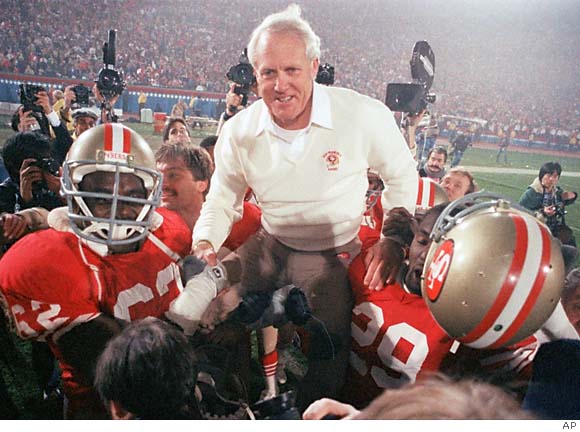
What Leadership Looks Like: Bill Walsh


When most people in the USA - sports fans, at least - think about the late Bill Walsh, they generally think about two things: (1) his creation of the "West Coast" offense, the fast-breaking, field-spreading plays that fundamentally changed football strategy on both sides of the ball; and (2) his three Super Bowl wins at the helm of the San Francisco 49ers during the 1980s.

He was a football icon, no doubt. But in the final analysis, he was really much, much more than that. He was a leader of the highest order, possessing attributes and approaches we can all learn from, regardless of vocation.

Here is an assessment of Bill Walsh and what his legacy as a model leader should encompass:

Intelligence: Without question, Bill Walsh was one of the brightest and most cerebral of NFL coaches. In fact, prior to being hired, some in NFL leadership viewed this as a negative, unsure how his brilliance as a behind-the-scenes strategist would translate into an on-the-field leader. The cynics were proved wrong and his brainpower became a priceless asset during his tenure as head coach at both Stanford and the 49ers.

Innovation: The West Coast offense was, in Clay Christensen's parlance, a "disruptive technology." In a similar vein as the forward pass, the West Coast offense caused competitors to rapidly change their schemes lest they get blown off the field by a high-percentage, fast-scoring offensive strategy. This meant re-fashioning both their offense and their defense, giving the 49ers a sizeable lead that translated into three Super Bowl titles in eight years.

Mentoring: Mr. Walsh was likely the one coach that seeded more future NFL head coaches than any other, creating a "coaching tree" that is hard to believe if you follow professional football. He was also a ground-breaker in promoting the case of minority coaches, including Super Bowl-winning coach Tony Dungy, Dennis Green and Ray Rhodes. He invested in his people and brought the best out of them, remaining involved in their professional and personal lives far beyond their tenure with his teams.

Confidence: Bill Walsh was certainly not cocky, but displayed a confidence in himself that clearly impacted his players and coaches alike. It also helped in recruiting. Who could turn down an approach from Mr. Walsh, whose intellect and on-field success built an already sizeable confidence in himself into an unstoppable force. His confidence was contagious and helped elevate those working with him to a higher level.

Respect: Bill Walsh had respect for his players, his staff, his opponents and the game itself. Notwithstanding the more aggressive techniques of other coaches, he treated his players as intelligent with men who were better motivated by teaching and guidance than by threats and intimidation. He respected the media, answering questions and not lashing out even in the face of defeat. His coaches were treated as integral parts of the system, not simply as cogs in his coaching machine.

Recruitment: He was one of the best judges of talent that ever lived. Whether it was Joe Montana, Jerry Rice, Steve Young or many others, his assessment of value and his ability to realise that value in his programme was unparalleled. But none of this would have mattered if the players weren't excited to play for him, giving their all that was critical to the success of his teams. But he had an uncanny sense of which players to field at what time, creating match-up problems that directly contributed to their historic achievement in the most important games.

Just a good guy: Players, fellow coaches, sportswriters... they all liked Bill Walsh. What wasn't there to like? He may not have been an electric guy but he was a good guy, a nice guy, a smart guy, a sometimes funny guy. He just got along with people, people from different walks of life who had their own agendas and motivations. But somehow, he almost always left a good impression that served him well at that moment and beyond.

There is nothing about the elements of Bill Walsh's success that are unique to football. They are applicable to all of us who either are or aspire to be leaders, be they of teams or entire companies.

It it sad that Bill Walsh died such a young man.
Share/Save/Bookmark

All Leaders Have a Brand


All leaders have a brand. Whether that term is used or not, leaders have an identifiable persona that is a reflection of what they do and how others perceive them. This is their leadership brand.

When it comes to cultivating a leadership brand, look no further than Oprah Winfrey, who recently announced that she would be ending her popular talk show in 2011. In a perceptive analysis, New York Times media columnist David Carr suggests that Winfrey's brand and the key to her longevity is a combination of things she didn't do as well as things that she did do. On the "don't do side," she did not over-merchandise nor take her company public; she kept control of her products and thereby her image, unlike Martha Stewart. On the "do side," she always stayed true to herself. As she told her business partner Gayle King years ago, "I don't know what the future holds but I know who holds it."

The lessons of Oprah's brand are relevant to any leader.

First and foremost, understand that brand is what you develop as well as what others perceive. The balance between reality and perception can be shaky if you are not careful, but as we have seen from Oprah, not impossible.


Here are some lessons for cultivating your own positive leadership brand.

Practice what you preach. It's easy to say, but when the going gets tough, how many supposed leaders disappear into the shadows? Those who lead by example are willing to make tough decisions and be accountable for the consequences. They are also willing to lend a hand to colleagues and direct reports. These are go-to people who work extra hard when necessary. Nothing is stronger than seeing the boss do heavy lifting alongside an employee during crunch time.

Act on principle. This applies to work, where principles determine the quality and attention you deliver, as well as to values, where principles determine behaviour. Employees who see their bosses standing up for the right way of doing things in the face of competition (from inside and outside the organisation) will believe and follow. For example, make certain that employees are compensated (either monetarily or in time off) for overtime and are receiving recognition for jobs well done.

Insist on integrity. When it comes to a leadership brand, integrity is the lever one uses to get things done the right way. That means treating people with respect, regardless of their positions. Act for the benefit of the organisation first and yourself second. Do things that honour the work you do as well as the people who work for you. Talking about integrity is one thing; insisting that you and your colleagues abide by is what matters. Integrity is not reserved for big corporate dealings; it can focus on small things. For example, in tough times, make the choice to fly economy class rather than business class.

Some who read this might be thinking, 'nonsense'! As a leader my job is to lead others not worry about my image. True, but not entirely. Your job as a leader depends upon getting others to follow your lead; they must trust you. Trust is essential to leadership, and a brand — how people perceive you — is critical to encouraging followership.

And there's one final point. Leaders make mistakes. A strong brand, just as a strong sense of self, can aid in a comeback. People will readily forgive a misstep if they believe your intentions were good. This applies not only to mistakes in business judgment but mistakes about people too. If you have done well, but make a bad call about a product or process, or even if you insult a colleague, a strong brand will give you a safety net. As long as you act quickly and make amends, you can restore trust because you have created a legacy of good will.

In short, your brand is a reflection of your credibility. Develop it wisely and nurture it carefully and it will help you create strong bonds of trust with your followers. Any doubt, just ask Oprah.
Share/Save/Bookmark

Tuesday, December 01, 2009

Charisma vs Character: Style vs Substance : What Kind of Leaders Do We Need in 2010?


The stock market seems slowly on its way to recovering from the financial crisis, but a deep scar from the recession remains.

In the USA, many Americans lack confidence in the nation's leadership to address the challenges the country currently faces. The Harvard Center for Public Leadership's 2009 National Leadership Index reveals that 69% of Americans think there is a leadership crisis in the country. 67% believe that "unless we get better leaders, the United States will decline as a nation."

At the bottom of the index's ranking of confidence in leadership are Wall Street leaders, closely followed by news media, Congressional, and business leaders. It is tempting for leaders to view these dismal results as a public relations issue emanating from the economic downturn. But this is not a PR problem: It's a leadership problem.

We opened this decade with a wave of appalling leadership failures. Ken Lay and Jeff Skilling of Enron, Bernie Ebbers of WorldCom, Joseph Nacchio of Qwest, and Dennis Kozlowski of Tyco blatantly disregarded the ethical and legal responsibilities entrusted to them by their shareholders. We are closing the decade with another wave of leadership failures. Dick Fuld of Lehman, Alan Schwartz of Bear Stearns, Angelo Mozillo of Countrywide Financial, and Chuck Prince of Citigroup (C) sacrificed financial prudence for the possibility of extraordinary short-term gains. Their decisions obliterated billions of dollars of economic wealth and almost destroyed the world's financial system.

This crisis won't be over until a new generation of leaders emerges that understands that long-term institutional stewardship and maintaining public trust are the two imperatives of 21st century leadership.

Far too many leaders fell into the trap of believing that the purpose of business is to maximise shareholder value and reap personal rewards, rather than serve customers and the society they operate in. However, those that focus primarily on maximising shareholder value—usually with a short-term focus—are more likely to wind up destroying the value they create.

Bill George is a professor of management practice at Harvard Business School, where he has taught leadership since 2004. In this speech he discusses the kind of leaders we need in 2010:


In this conversation with The Washington Post (Embed link), he explains why leaders should be "vulnerable" with followers, even at the risk of losing their jobs and why integrity ('doing the right thing') really matters in business today.

Bill George is the author of Seven Lessons for Leading in Crisis (JB Warren Bennis Series)
Share/Save/Bookmark

Integrity


In the main the issues behind the more spectacular and well known falls from grace of leaders in the public eye could be grouped under a lack of competence, a lack of support or loyalty from those they sought to lead and a lack or failure of integrity.

Of all of these the last is the most egregious, the most fatal. We so much want our leaders to be unfailingly decent, an obvious or perceived flaw in integrity can be the toxin that kills them off. All of us have a reputation, something we are known for, sometimes different from what we would like to be known for.

At the core of this is the simple but fragile heart, our integrity; always under challenge, under tests both trivial and profound every day of our lives. In business, integrity is just as important as in any of the great public offices.

It is interesting to observe that many of the modern corporate failures in leadership have come from a failure in integrity by the leaders in question or, equally serious, a failure to diligently protect the integrity of the business, on which the owners rely.

Some may argue that this is more a case of incompetence but surely one of the first and fundamental obligations of competent business leadership is above all to protect the reputation and integrity of the business; to that degree the integrity of the business is the integrity of the leader.

During the past couple of decades the business community has seen an exponential increase in compliance-based regulations. These regulations have grown from a raft of incidents where corporations and their leaders behaved poorly, leading to great losses among shareholders. While many of these regulations seem to business to be burdensome and frustrating, their imposition is certainly a logical outcome of some outlandish corporate behaviour in the past. In some ways this framework of regulation can lead to a culture of "integrity by compliance", whereby corporate leaders (boards and chief executives) can increasingly feel that if they abide by the letter of the law (or regulation) then they have behaved with integrity.

The subtle shortcoming is that no system can ever describe the limits of obligation that must be self-imposed on the behaviour of men and women of integrity. And, of course, a business culture that assumes that within the regulatory envelope, anything else goes is obviously flawed.
Share/Save/Bookmark

Make the Impossible Possible


Make the Impossible Possible: One Man's Crusade to Inspire Others to Dream Bigger and Achieve the Extraordinary

This is a very special book about a man who has lived, and continues to live, an extraordinary life.

Over the past 30 years, Bill Strickland has helped change the lives of thousands of people through the creation of Manchester Bidwell, a jobs training centre and community arts programme located in Pittsburgh. The centre works with corporations, community leaders, and schools to help give disadvantaged kids and adults the opportunities and tools they need to envision and build a better future:

“We greet them all with the same basic recipe for success: high standards, stiff challenges, a chance to develop unexplored talents, and a message that many of them haven’t heard before – that no matter how difficult the circumstances of their lives may be, no matter how many bad assumptions they’ve made about their chances in life, no matter how well they’ve been taught to rein in their dreams and narrow their aspirations, they have the right, and the potential, to expect to live rich and satisfying lives”


Share/Save/Bookmark

Monday, November 30, 2009

Why Every Leader Needs a Coach


In the world of sports there is a natural tendency to respect those who have succeeded on their own. These are the Olympians who have climbed to the summit by sheer strength of will, and raw talent. They have shown us all how to win. They have made it look easy. These are the heroes of the press, and the public. We look at a Sir Chris Hoy or a Rebecca Adlington and marvel at their success.

But, what makes Sir Chris Hoy or Rebecca Adlington so good?

Each has extraordinary talent. Each has tenacity, focus, and perseverance. Even if they did nothing more, each would be considered good athletes in their respective sport. However, each has taken an additional step, a step that has helped them achieve their well earned reputation. Each has a coach.

Why would someone as talented as these players use a coach?

The answer is actually relatively simple. In the heat of the event, neither can be an unbiased judge of how he or she is performing.

The same is true in business and government. In the heat of the boardroom, when the future is clouded by the fog of war, sagging economies, and a need to change the organisation, leaders are not always the best critics of their own performance, or the best judge of how their behaviour is affecting the organisation. A coach who can view the play from the sidelines can be an invaluable ally.

The role of coaching in the business and government world has changed over time. According to a recent article in the Harvard Business Review (HBR):

'Ten years ago, most companies engaged a coach to help fix toxic behaviour at the top. Today, most coaching is about developing the capabilities of high-potential performers.' (Harvard Business Review, January 2009, "What Coaches Can Do for You", Diane Coutu and Carol Kauffman)

In the business and government world, about half of the coaches employed today are focused on the positive side of coaching, developing high-potential talent to assure top corporate performance. Another quarter of all coaches are focusing on strategic issues and organisational dynamics.

For the potential leader or manager seeking to improve and grow, a coach can provide insight into how behaviours are affecting the organisation, an independent assessment of the extent to which change efforts are achieving the desired results, or insight into which new behaviours are or are not working.

However, as the HBR pointed out in an article in 2007, learning and growing takes a significant amount of effort:

'The development of genuine expertise requires struggle, sacrifice, and honest, often painful self-assessment. There are no shortcuts. It will take you at least a decade to achieve expertise, and you will need to invest that time wisely, by engaging in “deliberate” practice—practice that focuses on tasks beyond your current level of competence and comfort. You will need a well-informed coach not only to guide you through deliberate practice but also to help you learn how to coach yourself.' (Harvard Business Review, July-August 2007, "The Making of an Expert", K. Anders Ericsson, Michael J. Prietula, and Edward T. Cokely)

(Much of Ericsson's research is based on the world of athletic and artistic high performance - see for example, this 1994 New York Times article - http://www.nytimes.com/1994/10/11/science/peak-performance-why-records-fall.html?pagewanted=all ).

Don't expect instant success, and at the same time, expect constant progress. True mastery of of any trade or profession takes time.

Finally, you might find the following very short video of Eric Schmidt, CEO of Google, interesting. If Eric Schmidt can benefit from having a coach, so can you.


For further information on the business coaching and mentoring services provided by Positive Leadership, please contact Gavin Hastings (gavin.hastings@positiveleadership.co.uk ).
Share/Save/Bookmark

Why Connectors are the New Influencers


Here is some fascinating insight from Havard Professor, Rosabeth Moss Kanter on how social networking is changing the concept of leadership influence in the 21st century:

'In the world according to Twitter, giving away access to information rewards the giver by building followers. The more followers, the more information comes to the giver to distribute, which in turn builds more followers. The process cannot be commanded or controlled; followers opt in and out as they choose. The results are transparent and purely quantitative; network size is all that matters. Networks of this sort are self-organizing and democratic but without any collective interaction.

The significance of Twitter is yet to be determined; it is a simple, impersonal, and transient application of technology. But very real network effects are a new source of power in and around organizations.

America in the 20th century was called a "society of organizations." Formal hierarchies with clear reporting relationships gave people their position and their power. In the 21st century, America is rapidly becoming a society of networks, even within organizations. Maintenance of organizations as structures is less important than assembling resources to get results, even if the assemblage itself is loose and perishable.

Today, people with power and influence derive their power from their centrality within self-organizing networks that might or might not correspond to any plan on the part of designated leaders. Organization structure in vanguard companies involves multi-directional responsibilities, with an increasing emphasis on horizontal relationships rather than vertical reporting as the center of action that shapes daily tasks and one's portfolio of projects, in order to focus on serving customers and society. Circles of influence replace chains of command, as in the councils and boards at Cisco which draw from many levels to drive new strategies.

Distributed leadership — consisting of many ears to the ground in many places — is more effective than centralized or concentrated leadership.

Fewer people act as power-holders monopolizing information or decision-making, and more people serve as integrators using relationships and persuasion to get things done.

This changes the nature of career success. It is not enough to be technically adept or even to be interpersonally pleasant. Power goes to the "connectors": those people who actively seek relationships and then serve as bridges between and among groups. Their personal contacts are often as important as their formal assignment. In essence, "She who has the best network wins."

Connectors have always been more promotable, even in traditional hierarchies. In my early research in a rigid industrial conglomerate (that has since gone out of business), I saw that women tended to be excluded from top ranks because there were so few women already in top ranks, and being part of peer groups mattered for career advancement. Wherever teamwork across positions is desirable, natural connectors who instinctively reach across divides to form relationships get the plum jobs, on small sports teams as well as in large companies. For example, on the North Carolina women's soccer team, a perennial winner among college teams, Jordan Walker was a team leader because she was a connector who helped other players work together, even though Coach Anson Dorrance called her one of the least athletic players he had ever seen. As for big business, during the Seagate turnaround, Joan Motsinger was asked to head a technical area even though she wasn't a technical expert, because of her business card collection, which made her a network star.

Network stars have social capital — a stockpile of personal relationships with many people whom they regularly connect to one another. Though technology tools are increasingly common to help people find connections, from LinkedIn to Facebook, I find that even the most technology-savvy leaders rely on their own personal networks to find the best resources quickly. The technology is so democratic that the information is considered less reliable. The human networks are what count. In SuperCorp companies with far-flung global operations, personal networks of people that managers have met or worked with are often better sources for key assignments than data bases of resumes. One manager in a high-tech company called this "the old-fashioned way, the knowing people type thing: I know a person who might know a person..."

To be known is to be in the know. This is why connectors with big networks have so much power. They don't need to be the formal boss if they have the connections. Nick Donofrio, former IBM executive vice president, encouraged 90,000 technical people to think of themselves as working for him, even though they did not work directly for him in any formal or official way. He answered hundreds of daily emails personally, counting on this as a major bottom-up source of information about issues and opportunities.

Social capital is often, but not entirely, correlated with length of organizational experience. The other factor is whether the nature of the job encourages getting to know large numbers of people — that is, whether the job involves mobility, a portfolio of varied projects, and participation in initiatives that call for communication across groups.

In short, giving people work that spans boundaries is a way to grow the potential for more connectors, in a nice multiplier effect. But ultimately the power of connectors lies in themselves, not in the stars. It comes from their own willingness to continue making relationships, passing on information, and introducing people to one another.'
Share/Save/Bookmark

Sunday, November 29, 2009

What It Takes to Be a Remarkable Leader

If you want to uderstand the success of Silicon Valley and the leadership that Valley VC's provide to the world of technology, please watch this fascinating lecture from one of the doyens of the venture capital world, John Doerr:


Share/Save/Bookmark

How a Leader's Emotions Affect Workplace Performance


What if you could change the behaviour of your team or workgroup just by changing how you feel during the day? How about if as a leader, you could actually improve your team’s performance merely by shifting your emotions?

There is evidence that a leader’s emotions can influence others’ emotions. Now, research indicates the effect of a leader’s emotions go one step further. How you feel can impact workgroup performance, for good or ill.

A recent article in the Academy of Management Journal noted that a leader’s emotional tone interacts with the workgroup environment in specific ways which either improve or inhibit team performance.

The key to how your emotional attitudes will affect others lies in what type of environment you are working in. Angry leaders in low stress environments tend to see a positive performance result when they display anger. Workgroup members are most often able to identify the source of the anger as relating to poor performance and become motivated to work harder.

An interesting thing happens when deadlines loom, or the environment becomes stressful. Under such conditions, team members are much less likely to be able to differentiate the angry response as independent of the environment. They end up taking offense at the display of anger and become less motivated to perform for the manager’s or team’s benefit.

This is tricky stuff. Why? Because it means that managers must be able to read the environment accurately, and manage their own emotional displays intentionally - not always an easy thing to do, especially when stakes are high. When to be hard-nosed and when to be supportive become important factors influencing how well your team does.

Note that this doesn’t mean you have to display a happy attitude all the time. In fact, in situations where the stakes are low, sometimes your display of frustration will motivate folks to work harder. If you are going to display displeasure though, you need to be careful and intentional. Here are some guidelines.

Check your emotions at the door. Easier said than done, right? The first step to effectively managing your emotions is to become aware of them. Are you angry, frustrated, sad? Or are you excited and happy? The key is to identify these before the team interaction so you don’t need to act on them.

Read the environment. A key contributing factor to the performance variation regarding a leader’s emotional display is the environmental influence. Is your team having a light day and relaxing even though there is a project on the table? Or is there an immediate deadline essential to success? Is the team relaxed or stressed?

As best you can, act intentionally. Emotions can be highly influential of our behaviour. However, if you have paused to consider your own emotional state, and then taken the time to consider the environment, you can then make an intentional emotional shift. The team that is relaxing may respond to a stern lecture. The team under stress will likely respond better to a happy, supportive chat.

While this appears to be a simple three step process, it is considerably more difficult than it seems. This type of behaviour requires a high degree of emotional and social intelligence - and some good learning, training and practice.


This research isn’t condoning angry outbursts in a work setting. We need to be respectful and considerate with our colleagues. However, in our view, a positive leadership style will trump punishment and consequences over the long term in any organisation.

Knowing your own emotional state and the emotional environment of your team provide useful data you have about how your team is likely to respond and perform at different times. Teams are powerful precisely because they are interactive and interdependent, not only in their work but in their emotional and social domains as well. As a leader, you have a great opportunity - and responsibility - to guide these interactions for the benefit of your organisation.
Share/Save/Bookmark

Saturday, November 28, 2009

Why Ants Are Great Team Players


“Ants don’t worry, they operate like a fantastic team, they accept obstacles and deal with them in a positive manner, they don’t complain and remain positive. An ant doesn’t work on emotion, is proactive and always chooses the ant role.”  Dave Brailsford, Team Sky

For more on how Team Sky is building a winning team, see - http://www.timesonline.co.uk/tol/sport/more_sport/cycling/article6922458.ece
Share/Save/Bookmark

Making Tough Decisions


Leaders often need to make hard decisions.

As one client said “by the time something reaches my desk, that means it’s really hard. Because if it were easy, somebody else would have made the decision and somebody else would have solved it. So typically, if something’s in my folder, it means that you’ve got some very big, difficult, sticky, contradictory issues to be wrestled with.”

Yes, it can be lonely at the top. But it doesn’t always have to be. There are times when a leader may want to involve others in the decision making process.

There are five ways a leader can do this. None of them are “right” or “wrong” – it all depends on the degree of involvement required and how quick the decision needs to be made:

1. Tell

“I want to inform you of a decision I’ve made and give you an opportunity to ask any questions.”

2. Test

“I’m thinking of choosing option A to solve the problem – what do you think?”

3. Sell

“I’m thinking of choosing option A to solve our problem – let me convince you why I think it’s a good option.”

4. Consult

“I need to select an option, and would like your input on which to choose.”

5. Consensus

“We need to make a decision, and I’d like us to make the decision together.”

If a decision needs to be made right away – and little involvement is needed, then the “Tell” method is perfectly appropriate. Examples of when this method might be used include emergencies or trivial matters, where the leader does not want to waste everyone’s time.

Generally though, the more buy-in needed, the more time it usually takes to make a decision.

There are pros and cons for each option. Obviously, the ones requiring less involvement are faster. However, with little involvement, there is little buy-in and commitment, and a missed opportunity to incorporate multiple perspectives.

Again, each of these options has it’s time and place. The important thing is for a leader to be clear with the group which option is being used. This helps set the right expectations and informs people how they need to prepare. When a leader bounces back and forth between options and doesn’t tell the group, it confuses and frustrates the team – as well as the leader.

Consensus will provide the highest degree of involvement, collaboration, and commitment. However, if mismanaged, attempting to reach a consensus decision can turn into the meeting from hell.
Share/Save/Bookmark

Friday, November 27, 2009

Are Leaders Made or Born: Hard Work vs Talent


Share/Save/Bookmark

What do M&S and Chelsea Have in Common?


What do M&S and Chelsea have in common?


Jeff Randall gives you the answer in his piece in today's Daily Telegraph -

http://www.telegraph.co.uk/finance/comment/jeffrandall/6664637/If-Britains-got-talent-why-are-we-being-run-by-foreigners.html

Here's how he concludes his commentary on why, if Britain's got talent, we are now being run by foreigners!

'But here's a thought. If, contrary to jingoistic intuition, an influx of foreign management is really a boon to Britain, why stop there? Why not clear out the muppets who are running British politics and replace them, too, with imported talent? The Canadians have done an impressive job in cutting massive deficits, how about their poaching their leader? Just imagine – we could trade Gordon Brown for Stephen Harper. It seems like a good deal to me.'
Share/Save/Bookmark

Building a 'Leaderful' Team


Dr. Richard Ian "Ric" Charlesworth, M.D., was on the Australian hockey team for five Olympic Games, two of them as captain. He was also part of the team that won the World Cup in 1986. For more than a decade, many considered him the world's best hockey player. After his playing career ended, he went on to be head coach of the Australian women's hockey team, which under him won almost every top hockey contest in the world, including the Champion's Trophy, the World Cup, the Olympics and the Commonwealth Games.

As a coach he has been a revolutionary in his way of building winning organisations, by developing what he calls the "leaderful team," in which every player is prepared, technically and psychologically, to step up to lead--or to step back to support, as needed. The idea is to maximise the potential contribution of every team member in a way never before attempted in sport.

Forbes magazine recently interviewed Ric Charlesworth in two sessions: "How Hierarchies Do Harm" and "How You Can Develop A Leaderful Team" :

http://www.forbes.com/2009/11/16/charlesworth-hierarchy-hockey-leadership-ceonetwork-managing.html?partner=leadership_newsletter

and

http://www.forbes.com/2009/11/23/charlesworth-hierarchy-leaderful-leadership-ceonetwork-managing.html?partner=leadership_newsletter

The articles are well worth reading.
Share/Save/Bookmark

Links Between the Lack of Positive Leadership and Stress in the Workplace


A recent study (2009) into 'The Impact of Managerial Leadership on Stress and Health Amongst Employees' by Anna Nyberg of the Karolinska Institutet (Stockholm) reported that:

“… significant associations were found between Dictatorial leadership and lack of Positive leadership on the one hand, and long-lasting stress, emotional exhaustion, deteriorated SRH [self-reported general health], and the risk of leaving the workplace due to poor health or for unemployment on the other hand.”

For more, see - http://diss.kib.ki.se/2009/978-91-7409-614-9/thesis.pdf
Share/Save/Bookmark

Thursday, November 26, 2009

Thanksgiving Thank You's


In the spirit of Thanksgiving, we would like to share with you the benefits and power of two simple words. THANK YOU.

They are two words that have the power to transform our health, happiness, athletic performance and success. Research shows that grateful people are happier and more likely to maintain good friendships. A state of gratitude, according to research by the Institute of HeartMath, also improves the heart's rhythmic functioning, which helps us to reduce stress, think more clearly under pressure and heal physically. It's actually physiologically impossible to be stressed and thankful at the same time. When you are grateful you flood your body and brain with emotions and endorphins that uplift and energise you rather than the stress hormones that drain you.

Gratitude and appreciation are also essential for a healthy work environment. In fact, the number one reason why people leave their jobs is because they don't feel appreciated. A simple thank you and a show of appreciation can make all the difference.

Gratitude is like muscle. The more we do with it the stronger it gets.

In this spirit here are 4 ways to practice Thanksgiving every day of the year.

1. Take a Daily Thank You Walk - Take a simple 10-minute walk each day and say out loud what you are thankful for. This will set you up for a positive day.

2. Meal Time Thank You's - On Thanksgiving, or just at dinner with your friends and family, go around the table and have each person, including the children, say what they are thankful for.

3. Gratitude Visit - Martin Seligman, Ph.D., the father of positive psychology, suggests that we write a letter expressing our gratitude to someone. Then we visit this person and read them the letter. His research shows that people who do this are measurably happier and less depressed a month later.

4. Say Thank You at Work - Doug Conant, the CEO of Campbell Soup, has written over 16,000 thank you notes to his employees and energised the company in the process. Energise and engage your colleagues and team by letting them know you are grateful for them and their work. And don’t forget to say thank you to your clients and customers too.

Happy Thanksgiving!
Share/Save/Bookmark