

Thursday, June 20, 2013



Wednesday, June 19, 2013
Positive Leadership: Presenting Effectively
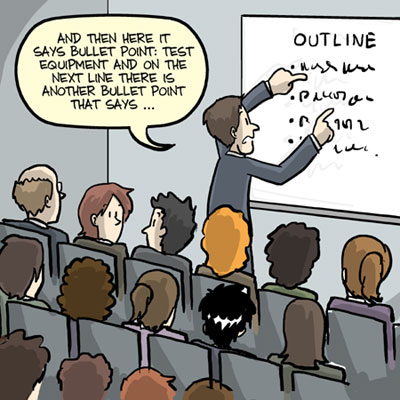
Before you start creating slides for your next talk, plan
what you’re going to say. A storyboard — a visual outline of your presentation
¬— will save you more time than it takes to create it. First, draw small
representations of your ideas on sticky notes. The small space forces you to
use simple, clear words and pictures. Limit yourself to one idea per slide:
There’s no reason to crowd them. This sketching process will help you clarify
what you want to say and how you want to say it. As you storyboard, you’ll be
able to tell immediately which concepts are clunky or overly complex (you’ll
run out of space on your sticky notes). Eliminate them, and brainstorm new ways
to communicate those messages more clearly.
Tuesday, June 18, 2013
Positive Leadership: Syndicating the Work of Leadership

In this video, Professor Gary Hamel discusses why he
believes it is vital for companies to "syndicate the work of
leadership" across the organisation.
An edited transcript of his interview with McKinsey's Simon London can be found at: http://bit.ly/McKLeadersEverywhere
An edited transcript of his interview with McKinsey's Simon London can be found at: http://bit.ly/McKLeadersEverywhere
Monday, June 17, 2013
Positive Leadership: Being Extreme in Leadership

Sunday, June 16, 2013

Friday, June 14, 2013

Thursday, June 13, 2013

Wednesday, June 12, 2013
Positive Leadership: Perspectives on Leadership

In his ‘View from the Top’ speech, Dean of the Graduate
School of Business at Stanford University, Robert Joss defines what it means to
lead: "It's any position where you take responsibility for a group with a
mission to fulfill." He told students that In order to have the organisation
you lead evolve, "you have to be the change you want to see in
others."
Tuesday, June 11, 2013
Positive Leadership: Bad Leadership

Barbara Kellerman, the James
MacGregor Burns Lecturer in Public Leadership at Harvard Kennedy School,
discusses the theme of her latest work entitled "Bad Leadership."
Monday, June 10, 2013
Positive Leadership: Integrity

When you think about the people you know who have integrity,
do you count yourself among them? What does it mean to be a person of
integrity? Well, first and foremost, integrity is about truth. And truth is the
greatest force we have for personal and planetary well-being.
No bomb, no hatred, and no prejudice can match the strength
of truth. In troubled and uncertain times, truth is our most powerful friend.
When we stand for truth, we are confident, whole and energised.
Throughout history, every great philosopher and leader has
tried to teach us the same lesson - the principle that integrity, or wholeness,
is the natural order of things. In spite of the fact that we live in separate
bodies, houses, and nations, our essential nature is one of unity.
Any separation we think we see is an illusion that we have
mistakenly learned to believe in. As long as we feel separate and isolated, we
will behave in ways that result in damage to others and ourselves. Most
religious and scientific scholars agree that our entire universe is one huge
system - integrated and whole.
To behave accordingly, then, is to have integrity - to stand
up for the truth of our inter-connectedness and our need to care for each other
if we are to survive. You see, when we have integrity, we align ourselves with
the force of the entire universe. And when we live with integrity, we become
very powerful indeed.
Friday, June 07, 2013
Positive Leadership: How Best To Pitch Your Business Plan

Focus your business pitch on yourself, not on your plan!
Potential investors and partners are often more interested
in an entrepreneur as a person than in the business plan. That document is
important, but be sure to also show these three characteristics:
Passion and purpose. Investors want to know if you’re the
right person for this idea. Make your personal connection to the business
you’re launching clear.
Resilience. The road to building a business is full of speed
bumps. Share some failure stories to show you can bounce back from challenges.
Resource magnetism. Can you attract money, people, and other
resources? This is more important than charisma. Whether or not you have a
thousand-watt smile, you need to be able to persuade people to join your cause.
Thursday, June 06, 2013
Wednesday, June 05, 2013

Tuesday, June 04, 2013

Monday, June 03, 2013
Positive Leadership: What Does Values Based Leadership Mean?

We speak a lot about values-based leadership, but what does
it mean?
Whoever we think we are or say we are, our own and others’
perceptions result largely from what we do. That is why, as leaders, it’s important to act from our
values.
Of course, we are not wholly defined by our behaviour;
sometimes our environment demands that we only express a sanctioned side of
ourselves.
We’ve probably all experienced a time when we’ve acted ‘out
of character’, for example, we may normally be supportive but on occasion lose
our temper.
But the very expression ‘out of character’ suggests that
these are anomalous events that do not reflect the way we normally behave.
It’s also important to recognise that how we behave is in
part situational. Self-aware leaders know that different times call for
different styles. We may need to be tough in driving a legal outcome but
empathetic to a colleague who is struggling or when delivering bad news.
Being able to adapt our emotional leadership style does not
mean we are being inauthentic; on the contrary, values act as an anchor that
allows us to read and respond to situational cues, and respond appropriately.
There’s a lot of talk about values-driven leadership. But
what does it mean in reality? And how can we be values-driven leaders?
If you were asked to list your top 10 values, could you reply easily?
Would yours be acceptance, assertiveness, compassion,
cooperation, encouragement, equality? Or are you about flexibility, generosity,
honesty and humility? The list of possibles is long.
And, if asked, could you show how these values play out in
your daily life, and where and how you apply them?
Say you believe in integrity. Then, no matter what the
situation, you would ask yourself: how do I respond to this with integrity? You
don’t look around to see what others consider acceptable and make a decision
relative to them; you make it relative to you.
If a culture is about the way we do things ‘around here’,
then the question becomes: how do I do things in accordance with my own values,
without being rigid or defending my need to be right?
It’s not always easy. All choices have consequences,
including those we refuse to make.
Values are not goals.
They’re a deep internal drive and ultimately a shaping statement.
Properly used, values provide a filter that helps us decide
what to do and, consequently, who we become. We should live them, not just
speak them, and be able to demonstrate our commitment to them in practical
terms.
Friday, May 31, 2013

Thursday, May 30, 2013
Positive Leadership: A Winning Mentality

As those who read this blog know, we have been interested in ‘winning’ for a long time and in particular, how the world’s top athletes and sports teams
nurture and sustain the peak performance which is necessary in order to maintain their winnings streaks.
Sport has many lessons to teach us about how to be our best. It has it all.
Highs and lows. Community, tenacity, commitment. Performing at your best under intense pressure. The crucial importance of
taking action when the right moment strikes; and what to do in the face of
failure.
So when we came across this article from blogger Geoffrey
James on getting yourself in the mental state to win, we thought it was absolutely appropriate to our thinking.
Here are some takeaways from the article:
See the moments coming: Be prepared when it counts. Don’t
run into the day blindly.
Adopt a winner’s physiology: How you look affects how you
feel. Stand up tall. Look people in the eye.
Visualise the winning outcome: Lots of runners imagine
themselves crossing the finish line. It helps them get from where they are to
where they want to be.
Mentally rehearse what you’ll say and do: Now that you’ve
seen yourself past the finish line, what are the steps you need to take to get
there?
Disconnect from goals and results: Be in the moment.
Take action: Make things happen!
Wednesday, May 29, 2013

Tuesday, May 28, 2013
Positive Leadership: Who Wants to Lead a Large Corporation?

How many young people today want to become leaders of large corporations? Too few!
Why?
Why?
Many young people simply lack trust in today’s leadership
models. Here are some of the concerns they voice:
Are leaders transparent enough in their actions?
Often times, leaders are not open enough about
how they make the big decisions that impact their organisations. This lack of
transparency makes it difficult for people to hold their leaders to account.
When the research team at the Future of Work Research Consortium asked over
3,000 corporate executives about the significance of various leadership traits,
they ranked transparency as increasingly important in the future. Yet they also
acknowledged that right now this was not a well-developed capacity and is a
high-risk trait in need of attention.
Are leaders engaging
their stakeholders effectively?
Some believe that leadership teams of large
corporations seem to be stuck in traditional management models that do not help
them build trusting relationships with stakeholders. Inside corporations they
can fail to create effective democratic processes with employees, while
externally they aren’t always demonstrating real commitment to wider social
challenges. This is a major challenge for leaders as people increasingly look
at companies’ ethical practices and the way they treat employees when deciding
whether to trust them or not. It’s clear from
the broader research that delivering consistently strong financial performance
does not guarantee a corporation the trust of its stakeholders unless
accompanied by good practice and ethical behaviour.
Do leaders do as they
say?
A recurring theme is the challenge of intent and actions. Leaders may
talk about strong corporate values, but some are all too quick to bypass them
in the interest of the bottom line. No doubt this scepticism is a response to
the wave of corporate scandals in 2012 that has increased suspicions about
corporate leaders. A global survey by consulting firm Edelman Berland, found that
less than 1 in 5 people believe business leaders will actually tell the truth
when confronted with a difficult issue.
It is clear that there is still much scepticism about
leadership intent. What we need now is deeper insight into what it takes to
restore some of the lost faith in today’s corporate leadership.
Monday, May 27, 2013
Positive Leadership: The Role of Business Education in 2013

The Wall Street Journal sounded the death-knoll for business
schools back in 1985. Applications were dropping. Mass closures were on the
cards. The same headlines have appeared periodically since. Eight years later
the New York Times headlined with “Business Schools Hit Hard Times Amid Doubt
Over Value of MBA”. Last year it was Forbes asking “Is the MBA Obsolete?”
If
you scan the latest stories on business sites and in magazines, it seems to be
in fashion to give the impression that innovation and talent trumps education.
But is it true?
What is true is that the nature of business has changed.
Lines of communication have evolved. Globalisation has opened up new markets
and competition is fierce. Innovation is now a global catch-cry and anyone with
a half-baked idea is trying to sell it. Yet we are still short of quality
business managers.
In reality, it isn’t a competition between natural talent
and formal education. We need both. What is important is that business schools
adapt their style of teaching. They must ensure our next generation of leaders
are learning techniques relevant to today. In America alone, 10,000 baby
boomers retire every day. These are the people who have been our business
leaders for the past 30 years and we are struggling to replace them.
Business schools know this. They also know the demands on
modern managers are unique in the information age. Yale rewrote its curriculum
back in 2006 and continues to regularly review it. Wharton rolled out a whole
new plan last year. We are seeing a shift to customised courses tailored for
21st century enterprise. There is a greater focus (particularly in North America) on leadership, trouble-shooting, problem
solving and communication skills.
Business isn’t just about brilliant product, it’s about
people (ideally, both brilliant). Success will come from ensuring that young
people who have chosen business as their career have the right knowledge,
skills and attitudes to lead.
Friday, May 24, 2013
Positive Leadership: The Impact of Short Term Profitability Motives on Leadership Decision Making

Thursday, May 23, 2013
Wednesday, May 22, 2013

Tuesday, May 21, 2013
Positive Leadership: Influencing Up

Stanford Professor David L. Bradford shares his top tips on how to influence
your boss and overcome power gaps in his new book "Influencing Up".
Bradford is the Eugene O'Kelly II senior lecturer in leadership (emeritus) at the Stanford Graduate School of Business. Allan R. Cohen of Babson College co-wrote the book.
Bradford is the Eugene O'Kelly II senior lecturer in leadership (emeritus) at the Stanford Graduate School of Business. Allan R. Cohen of Babson College co-wrote the book.
Subscribe to:
Posts (Atom)