Positive Leadership: Why Top Talent Leave Their Jobs
Positive Leadership Limited is a strategic leadership and corporate finance advisory firm. We use our considerable experience to provide unique perspectives and innovative solutions which help corporate leaders unlock maximum value from complex business challenges. There is no dress rehearsal for delivering answers to critical business challenges. When you are under intense pressure to succeed, we help deliver the vitally important marginal gains which let your business excel and win.
The Positive Leadership Blog has been recognised as a Top 50 Leadership Blog by the number of pages indexed by Google and as one of the Top 100 Most Socially Shared Leadership Blogs of 2013.
Positive Leadership has also been recognised as a Top 50 Leadership Expert to Follow on Twitter.
Follow us on Twitter @posleadership
LEADERSHIP IS A PROCESS OF SOCIAL INFLUENCE, WHICH MAXIMISES THE EFFORTS OF OTHERS TOWARDS THE ACHIEVEMENT OF A SHARED GOAL.
Monday, October 17, 2011
Friday, October 14, 2011
Positive Leadership: Self-Belief and Success
Have you ever looked back on something that you achieved and
wondered why you were so successful? When you look back at your successes and
the things you've achieved in your life and you look for the reasons why you
succeeded, you'll find that most often it wasn't just luck. Some, if not all,
of the following were involved:
Knowledge, Skill,
Commitment, Motivation, Energy, Confidence, Resilience, and a belief in
yourself and what you were doing.
It's not hard to see why we succeed. What is hard is
explaining why we don't succeed all the time. Quite often people will say,
"Oh, that would be too hard for me," or "That would take too
much effort." But would it really? Because the truth is that each one of
us has a wealth of abilities, energy and skills, but most of the time we only
use a fraction of this wealth. This incredible wealth of untapped resources is
called "Human Potential." How much we use of it depends, more than
anything else, on our belief system.
If we believe there is no way around a problem, we close our
minds to possible solutions. But if we believe we will find a way, then it
doesn't matter what obstacles we run into. We get very creative. We see things
we wouldn't ordinarily see, and we hang in there and get others to help us
until we do find a way.
Remember, the most
powerful thing you can do to change your life is to change your beliefs about
life and begin to act accordingly.
Positive Leadership: Self-Belief and Success
Labels:
Self-Belief,
Success,
Values of Positive Leadership
Thursday, October 13, 2011
Positive Leadership: Reducing the Cost of Workplace Stress
Stress at work is a major issue. Brain cells "talk to
each other" by means of chemical messengers. When a person is exposed to
too much stress, chemical communication in the brain begins to fail. When these
messengers fail, a person suffers from sleep disturbance, aches and pains,
depression and anxiety. Mental illness costs UK employers an estimated £26bn a
year.
One way of helping to deal with stress is to consider
magnotherapy as a way of helping to improve sleep patterns.
What is magnotherapy?
Human bodies are electromagnetic in nature and
this fact is closely allied to the chemical balance of the body which can be in
either a healthy or an unhealthy state.
It is now known scientifically that a healthy body contains
fluids that are slightly alkaline and that an unhealthy body is acidic. A poor
diet can make the body acidic and in this state all sorts of diseases will
thrive. It is also known that at damaged sites in the body, exists a positive
electrical charge which affects both the chemical balance and the electrical
balance in the area, resulting in pain. In order to effect healing, the body’s
own systems send a negative electrical charge to the area. This healing action
of the body is easily restricted by poor diet, lifestyle, alcohol, drugs etc.
There is also considerable evidence of something called “Magnetic Deficiency
Syndrome” being a major contributor to restricting the body’s ability to
respond to illness.
It is now firmly established that a negative magnetic field,
provided by a geomagnetic north pole magnetic field (the same as the Earth’s
North Pole), is the most natural way of providing much needed support for the
body’s own immune system.
Negative magnetic fields oxygenate and alkalise by aiding the body’s defences and helping to relieve pain. Further, they combat inflammation and infection and enhance deep restorative sleep. This latter point is extremely important.
In order
to combat maladies that result from the stress of our current lifestyles, the
correct amount of good quality sleep is essential.
Combine this with the
possibility of at least reducing the amount of powerful drugs taken and what
results is a completely natural complementary therapy. Given the correct choice
and placement of magnetic device, this is probably the most effective
alternative therapy available. Magnet therapy can be applied
by you whenever and wherever needed. Modern materials technology has produced
small powerful inexpensive magnets which can be used anywhere on the body and
can be moved about to find the best positions.
For further information on magnets which might help you
alleviate the symptoms of stress, please go to www.bioflowsport.com
The magnets developed by Bioflow use a strong,
multi-directional force of magnetism called ‘Central Reverse Polarity’ also
referred to as ‘CRP’, to mimic the expensive professional equipment used by
physiotherapists. Molecules that exit a CRP field are more efficient than those
produced by standard magnets. This technology is patented to Bioflow and no
similar method exists. Bioflow bracelets and wristbands contain only the highest
quality neodymium magnets - the strongest type of permanent magnet known.
Bioflow products are also credited as a Class 1 medical device in the United
Kingdom.
Positive Leadership: Reducing the Cost of Workplace Stress
Positive Leadership: Masters of the Universe
It isn't easy being an alpha male. Getting to the top and
staying there takes a physical toll.
The latest evidence comes from wild baboons in Kenya's
Amboseli basin. Researchers from Princeton and Duke universities studied 125
males in five groups over nine years and found that while the alpha males got
the best food and the most mates, they experienced far more stress than the
beta males just beneath them in the hierarchy, based on the levels of cortisol,
a stress hormone, in fecal samples.
The beta males had almost as many mates and got just as much
grooming from others, but they didn't have to spend as much time fighting or
following females around to keep other males away.
"Being an alpha is exhausting. I'd rather be a
beta," says Laurence Gesquiere, lead author of the study that appeared in
the journal Science in July.
In the work world,
alpha males are ambitious, assertive, confident and competitive. Here's a quiz
that helps define who's an alpha male:
Alpha Strengths
1. No matter what, I don't give up until I reach my end
goal.
2. I always say exactly what I think.
3. I have no problem challenging people.
4. I make the decision I believe is correct, even when I
know other people don't agree.
5. I seldom have any doubts about my ability to deliver.
Alpha Risks
6. I believe that my value is defined by the results I
achieve.
7. I don't care if my actions hurt people's feelings, if
that's what's required to produce results.
8. When people disagree with me, I often treat it as a
challenge or an affront.
9. If I have a good idea and I'm asked to hold off and
listen to inferior ideas, I can quickly become visibly annoyed.
10. People say I become curt, brusque, or frustrated when I
have to repeat myself.
Scoring:
If all or nearly all of your responses to statements 1 to 5
were "yes," you are probably an alpha with many of the strengths that
make alphas such dynamic and influential leaders.
If all or nearly all of your responses to items 6 to 10 were
"yes," you mostly likely have some alpha risks that deserve your
attention.
Don't be confused if you scored high in both categories.
Because alpha liabilities are mainly alpha assets taken too far or applied
inappropriately, that is to be expected. (The exceptions to the rule are
healthy alphas who have worked hard to reduce their negative tendencies.)
Source: Kate Ludeman:
Adapted from the 'Alpha Assessment' at www.WorthEthic.com
Positive Leadership: Masters of the Universe
Wednesday, October 12, 2011
Positive Leadership: Performing with a Purpose
People perform amazing feats when they have a purpose.
Here are the five higher benefits of having a quest:
1. Focus
Every person—those who conceive, design, build, buy and
talk—have the same focus. People at every level are able to decide what works
because everyone knows where we're going and why we're going there.
2. Peak performance
On a quest, we're either in 100%, or we're not. On a quest,
we sort who's good at what. People who are in 100% are valued and their
strengths are matched to the cause. People who are valued invest more, do more,
and go further for the work we love.
3. Energy and
tolerance
We have more patience, time and energy for problem-solving
when we directly reap the benefits. What leads people to achieve greatness
isn't money. In fact, Peter Drucker proved that money is a disincentive…it has
the most effect when it’s not there or too small. Greatness is found in the
payoffs that a loyal community offers: acknowledgment, sense of purpose,
support, feedback.
4. Compelling value
What’s more appealing than working with someone who’s not
only good but also loves his or her job? Bringing logic and emotion together in
a business outdistances the world view of logic alone. Competence and great
execution are expected. A loyal engaged community builds in added value in how
they tell the story, how they treat the product and the customers who buy it,
and how they talk about the company as a value in their lives.
5. Total
differentiation
A thinking culture of passionate leaders who love their job
attracts others who share those values. The respect of a loyal community shows
in everything it does. The values become both brand and barrier to entry. Community
builds authority. We value what we earn and what we love. That value telegraphs
itself. It’s contagious. Customers, vendors and partners pick it up as well.
Nothing beats the 360 degree investment of brains, money and
dreams all in the same direction. Every company that wants to grow should have
some of that. The value of a thinking, job-loving employee community shouts ROI
and makes solid business sense.
Positive Leadership: Performing with a Purpose
Labels:
Purpose,
Values of Positive Leadership
Tuesday, October 11, 2011
Positive Leadership: Fix the Problem and Not Just the Symptoms
This interview with
Joseph Jimenez, chief executive of Novartis, the pharmaceutical company, was
conducted by the New York Times:
‘Q. What are the most important leadership lessons you’ve
learned?
A. One occurred when I was a division president of another
company. I was sent in to turn the division around after four years of
underperformance. It was a declining
business. And when I got there, I
completely misdiagnosed the problem. I
said: “Look. We’re missing our forecast
every month. What’s wrong?” I brought in a consulting firm, and we looked
at what was wrong. And the answer was
that we had a bad sales and operations planning process, where salespeople,
marketing people and operations people were supposed to come together and plan
out the next 18 months and then forecast off of that. So I said: “O.K. We’re going to fix this. We’re going to have the consulting team come
in and help us make that a better, more robust process, with more analytics.”
And it turned out it wasn’t at all about analytics. Because once we did that, and we put that new
process in place, we still continued to miss forecasts. So I thought, “Something’s really wrong
here.” I brought in a behavioural
psychologist, and I said: “Look, either I’m misdiagnosing the problem or
something’s fundamentally wrong in this organisation. Come and help me figure it out.” She came in with her team and about four
weeks later came back and said: “This isn’t about skills or about process. You have a fundamental behavioural issue in
the organisation. People aren’t telling
the truth. So at all levels of the organisation, they’ll come together, and
they’ll say, ‘Here’s our forecast for the month.’ And they won’t believe it. They know they’re not going to hit it when
they’re saying it.” The thing she taught me — and this sounds obvious — is that
behaviour is a function of
consequence. We had to change the
behaviour in the organisation so that people felt safe to bring bad news. And I
looked in the mirror, and I realised I was part of the problem. I didn’t want to hear the bad news, either.
So I had to change how I behaved, and start to thank people for bringing me bad
news.
Q. That doesn’t mean letting them off the hook, though.
A. Right. It’s more a chance to say: “Hey, thank you for
bringing me that news. Because you know
what? There are nine months left in the
year. Now we have time to do something
about it. Let’s roll up our sleeves, and
let’s figure out how we’re going to make it.”
It was a total shift from where we had been previously. So after that experience, I always ask all of
my people, and I always think to myself: “Are we really fixing the root cause
of this problem, if there’s any problem?
Or are we fixing the symptoms?”
For more, see: http://www.nytimes.com/2011/10/09/business/joseph-jimenez-of-novartis-on-finding-the-core-of-a-problem.html?_r=1
Positive Leadership: Fix the Problem and Not Just the Symptoms
Labels:
Communication,
Feedback,
Leadership Style
Saturday, October 08, 2011
Friday, October 07, 2011
Positive Leadership: Some Thoughts on Leadership
- “It begins with people. Life is people.”
- “If we get the right ‘whos’ on the bus, we get the right outcomes.”“
- Try to change every ‘what’ to a ‘who’”
- “It is not about personality, it is about humility.”
- “Humility is burning ambition channelled to do good outside yourself.”
- “Hubris is outrageous arrogance that inflicts suffering on the innocent.”
- “Bad decisions with good intentions are still bad decisions.”
- “True innovation comes from empirical creativity.”
- “The only mistakes you learn from are ones you survive.”
- “The signature of mediocrity is chronic inconsistency.”
Positive Leadership: Some Thoughts on Leadership
Thursday, October 06, 2011
Wednesday, October 05, 2011
Tuesday, October 04, 2011
Positive Leadership: Creating Harmony
When a leader tunes his or her instrument first and ensures
that each instrument in the orchestra is tuned, harmony is created and people
are drawn to see and hear what the organisation has to offer.
Positive Leadership: Creating Harmony
Labels:
Learning from the Arts,
Music
Wednesday, September 28, 2011
Positive Leadership: Sharing Accountability
Uncertainty necessitates the need for finding more wisdom
within our organisations. This can only be accomplished by creating a
leadership mindset throughout the entire organisation. It is shared
accountability. Any leader that thinks that they can do it alone is indulging
their own ego.
Do not assume that no one else on the premises can match our
own ambition, competence, and vision. We have to accept the fact that there are
many points of wisdom within our organisations and a wise leader will engage
them. Too many leaders are not accustomed to accepting input from junior
members no matter how valuable it is. This creates a lack of trust and
openness. The currency of leadership is relationships and a wise leader would
do well to encourage input from as many sources as possible and especially not
from the usual suspects.
The concept of distributed leadership will keep you in touch
with the environment. If you want to prepare people for this environment, you
have to get leadership further down the organisation. We generally tend to
drive managing down the organisation, but not leadership. However, in order to
maximise the opportunity for success, we have to prepare for acts of leadership
further down the organisation – even if it feels like an unnatural act to
people sitting at the top.
Leadership needs to be the expected norm at all levels.
Positive Leadership: Sharing Accountability
Tuesday, September 27, 2011
Positive Leadership: Building a Positive Work Environment
16 ways to build positive work environments:
- Develop people.
- Know what they do best and leverage it.
- Clearly define expectations.
- Trust them to act.
- Support them when they fail.
- Always give credit and take blame. No one likes seeing a blamer.
- Believe in them – you’re on their team.
- See opportunities more than problems.
- Help find solutions.
- Keep out of the way.
- Encourage, enable, and inspire.
- Protect from bureaucracy.
- Value them as individuals.
- Don’t talk about yourself, too much. Let people know you, however.
- Don’t talk on and on ….
- Make people feel listened to by asking more than stating.
Bonus: Give others what you wish others would give you.
Positive Leadership: Building a Positive Work Environment
Labels:
Communication,
Positive Leadership
Monday, September 26, 2011
Positive Leadership: Would You Want to Report to Yourself?
This is an extract from a New York Times interview with
David Barger, president and chief executive of JetBlue.
Q. How do you talk about leadership within the company?
A. We teach principles of leadership on a regular basis, to
supervisors and above. The module I teach is, “Inspiring Greatness in Others,”
and we talk a lot about how we each have a silhouette that comes to life. And,
as the silhouette comes to life, it’s as much about what you’re doing, the body
language, as what you’re saying. There’s a lot of lessons to be learned by
watching others make a mistake. And I’ve certainly seen that, in the past. It
could be leaders coming in and the next thing you know they’re not visiting the
cockpit, they’re not saying hi in the galley, they’re not going to the baggage
service office, they’re not stopping by the ticket counter. It doesn’t take a
lot. People know you’re there. Go see them. Be present.
Q. What are some other takeaways from your session?
A. There are several,
but here’s a few more: Be mindful that there is incredible leadership all
around you. Go find it. Go tap it. Go mine it. And here’s a key question: would
you want to report to yourself? It’s little things, too. When you say hi to
somebody, do you mean it, or is it just a casual comment?
Q. Any leadership insights you’ve gained in the last couple
of years?
A. We have executive
coaches we’ve used over the last couple of years. The message was, enough consensus
building. When it’s time to make a decision and your team’s not making the
decision, make the decision. I don’t think I ever was reticent in terms of
making a decision. But, as I look back, there were plenty of examples where the
team was looking at an issue but not getting a final decision. I think it’s
probably the most formative feedback I’ve been given — that it’s fine to be the
consensus builder, and I know that’s where I lean in terms of my leadership
DNA, but now I am more comfortable saying, “This is what we’re going to do.
Next topic.”
For more, see: http://www.nytimes.com/2011/09/25/business/early-access-as-a-fast-track-to-learning.html?_r=1
Positive Leadership: Would You Want to Report to Yourself?
Labels:
Decision Making,
Leadership Style
Friday, September 23, 2011
Positive Leadership: Encouraged vs Discouraged
Events do not cause what we feel, but what we tell ourselves
about these events does cause what we feel.
Many people may seem to be unmotivated but they are really
discouraged. Perhaps they have come to
believe that, no matter what they do, the results will not be there, so what is
the use? They should remember that
discouragement is more a result of what they are telling themselves as opposed
to being about the event itself.
Discouragement is a style of thinking which focuses on end results and a
self-counselling of our fears. Encouragement is a style of thinking that focuses more on the process and
on possibilities.
Try and avoid talking to yourself about results and fears
(again, never counsel your fears) as opposed to process and strengths. Develop a "go to script" for
pressure situations: "Trust," "Read and React," "No
judgment. With these phrases you are having audible, observable thoughts that
encourage yourself.
How do you talk to you?
Do you discourage you? Do you say
that this undertaking cannot be done? Do
you say, "I have to win?" Or
do you encourage yourself step by step?
Do you talk yourself through the process?
Here are two of the best encouragement phrases:
- ‘The bamboo encouragement principle’ - If you water bamboo one, two, three years, you get nothing. But then the fourth year, the bamboo grows nine feet in six weeks.
- 'Keep planting grass; don’t pull weeds' - Paying attention to the weeds is counselling your fears. Planting grass is encouraging your strengths.
Your greatest enemy when under pressure is mental fatigue
and discouragement. But if you can keep
from growing weary, in doing well in due season, you will reap if you faint
not. Keep on fighting weary until
finding renewed energy. Talk to you, out
loud if you have to, saying, "Keep planting grass; don’t pull
weeds." Or "Keep watering the
bamboo." Or maybe "I am just
too stubborn to give up, so weary I hear you knocking, but you can’t come
in." Whatever you do, just keep on
keeping on.
Positive Leadership: Encouraged vs Discouraged
Labels:
Attitude,
Motivation,
Performing Under Pressure
Wednesday, September 21, 2011
Positive Leadership: Achieving Greatness
What is the difference between mediocrity and greatness?
Possibly not as much as you think.
You know, it really takes very little to make a big
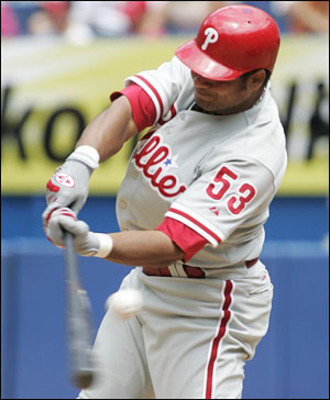
difference in our lives and in the world. In professional baseball in the USA for
example, most batters hit for an average of about .250, which means that they
get one hit for every four times at bat. Anyone who hits .300, three hits out
of ten, is considered a star. By the end of the season, there are only about a
dozen players out of hundreds in the leagues who have maintained a .300
average, and these are the ones who get the big contracts, the acclaim, and the
TV commercials.
In other words, the difference between the great players and
the ordinary players is only one hit out of twenty! This slim margin of
greatness in baseball symbolises the dynamics of greatness in life, because
when we use just a tiny bit more of our potential, we become outstanding human
beings.
Now, the purpose of being outstanding is not to win acclaim
or glory, but to be more of what we can be. If you accept the idea that most of
your present limitations are not based on any unchangeable reality but are
rather the result of beliefs you hold about your reality, then the next step is
to deliberately and systematically change those beliefs.
It’s called possibility thinking, and it’s a skill you can
learn quite easily.
Positive Leadership: Achieving Greatness
Labels:
High Potentials,
Sport and Business
Friday, September 16, 2011
Positive Leadership: What Makes A Leader
'What Makes A Leader?' was the title of the 1998 article Daniel Goleman wrote in the Harvard Business Review that the review calls one of its ten “must-read” articles of all
time. He wrote about three abilities that distinguish the best leaders from
average: self-awareness, which both lets you know your strengths and limits,
and strengthens your inner ethical radar; self-management, which lets you lead
yourself effectively; and empathy, which lets you read other people accurately.
You put all those together in every act of leadership.
For more, see: http://www.forbes.com/sites/danschawbel/2011/09/15/daniel-goleman-on-leadership-and-the-power-of-emotional-intelligence/

For more, see: http://www.forbes.com/sites/danschawbel/2011/09/15/daniel-goleman-on-leadership-and-the-power-of-emotional-intelligence/
Positive Leadership: What Makes A Leader
Labels:
Emotional Intelligence,
Leadership Theory
Tuesday, September 13, 2011
Positive Leadership: The Importance of 'You'!
A "Crash Course" on LEADERSHIP
The 10 most important
words:
“What can I do to help you be more successful?”
The 9 most important
words:
“I need you to do this, and here’s why…”
The 8 most important
words:
“That’s my mistake and I will fix it.”
The 7 most important
words:
“My door is always open to you.”
The 6 most important
words:
“Let’s focus on solving the problem.”
The 5 most important
words:
“You did a great job!”
The 4 most important
words:
“What do YOU think?”
The 3 most important
words:
“Follow my lead.”
The 2 most important
words:
“Thank You.”
The MOST important word:
“YOU”
Positive Leadership: The Importance of 'You'!
Labels:
Communication,
Leadership Lessons
Monday, September 12, 2011
Positive Leadership: Inspirational leadership secures #WalkerCup
If north-east Scotland had not been buffeted by strong winds
and rain squalls at the week-end, might the US have won the Walker Cup again?
The question is relevant following Great Britain and Ireland’s narrow victory
in a thrilling match at the stunning Royal Aberdeen golf club because winds
gusting up to 30mph and intense rain squalls were certainly less familiar to
the visitors than to the home team.
The answer to the question though is that Great Britain and
Ireland confounded all known form, including the current world amateur golf
rankings not to mention almost all the pre-match predictions and were so ably
led by Nigel Edwards that they won this biennial contest for only the eighth
time. They probably would have won under calmer conditions. But it is also true
that luck favoured Edwards. Had the wind dropped on Sunday morning so that the
second day could have been played in a calm, when the Americans improved, then
matters might have been different. In fact, perhaps it was Edwards’s performance that tipped it
for Britain and Ireland. The third Welshman to captain Great Britain and
Ireland, Edwards, 43, became the second to win, after Clive Brown’s victorious
captaincy at Royal Porthcawl in 1995.
Edwards stands comparison with Colin Montgomerie in last
year’s Ryder Cup in the way he coaxed and cajoled his men to victory. Just as
Montgomerie looked into every detail, even the smallest and least significant,
so Edwards did much of the same. His self assurance, his eye for detail, his
elaborate preparation and his knowledge of the competition as well as his
passion for it, simply overwhelmed Jim Holtgrieve, the eminent American golfer. Holtgrieve is a sturdy man from the mid West, a superb and
successful amateur and a less successful professional who returned to the
amateur ranks. But he is 63 and his rather casual style of captaincy and the
age gap between him and the rest of his team made him look out of touch at
times. His captaincy also highlighted an obvious question: why is the United
States Golf Association in the business of giving captaincy of this competition
to former players as a reward?
The 43rd Walker Cup was rather like an old Ryder Cup. Holtgrieve
gave the impression of leaving much of it to his players, believing he had the
best amateurs in the world who were sufficiently experienced to be able to look
after themselves. Edwards, by contrast, could not do enough for his men, from
taking them twice to Aberdeen for practice week-ends, to showing motivational
films and continually making sure that he was in the right place when he needed
to be. Most of all, he was able to speak from the experience of winning and
losing in Walker Cups because he had played in two winning teams as well as two
that narrowly lost. In this he was rather reminiscent of Bernhard Langer at
Oakland Hills in the 2004 Ryder Cup. While Hal Sutton progressed around while
wearing a cowboy hat that, frankly, made him look rather silly, Langer
concentrated on popping up on the tee of every short hole, always ready to give
advice and pass on information.
Edwards looked as though he knew precisely what he was doing
at all time; Holtgrieve didn’t. Edwards looked on top of his job; Holtgrieve
didn’t. Edwards is certain to be asked to captain GB and I at the National Golf
Links on Long Island, New York in two years. Holtgrieve probably will be asked
because the convention among American teams is that captains are given a home
and an away match, but he may not actually deserve it.
You make your own luck. “Prepare properly and you get your
just rewards” Edwards said. He did and he and his team won. Holtgrieve didn’t
and so he and his team lost.
Posted by John Hopkins
Positive Leadership: Inspirational leadership secures #WalkerCup
Positive Leadership: Crisis Leadership
One figure who stood tall as an example of effective
leadership during the crisis is former New York mayor, Rudy Giuliani.
Regardless of your political leanings, Guiliani's leadership
during the 9/11 tragedy is something leaders from all walks of life can learn
from.
In his book titled Leadership, Giuliani writes, "It is
in times of crisis that good leaders emerge."
Giuliani demonstrated that during times of crisis, leaders
must do four critical things: be highly visible, composed, vocal, and resilient.
1. BE VISIBLE
Giuliani writes, "While mayor, I made it my policy to
see with my own eyes the scene of every crisis so I could evaluate it
firsthand."
During a crisis, leaders must be out front rather than
running or hiding from the ordeal. They must go to the scene of disaster and
stand front and centre - to accurately assess the situation as well as show
their concern, while also demonstrating confidence that the group will
persevere.
Business author Tom Peters writes of Guiliani's courage to
be visible: "Rudy 'showed up' - when it really mattered, on 9/11. As one
wag put it, he went from being a lameduck, philandering husband to being Time
magazine's 'Man of the Year' in 111 days. How? Not through any 'strategy,'
well-thought-out or otherwise. But by showing his face. By standing as the
embodiment of Manhattan's Indomitable Spirit."
As a leader, be sure you don't retreat when faced with a
crisis. Rather than hide from the chaos and confusion, be sure to step in to
sort things out and find a solution.
Again, political preferences aside, the importance of being
visible during a crisis can also be learned from George W. Bush's presidency.
Like Giuliani, Americans rallied around President Bush when he went to Ground
Zero and grabbed a bullhorn amid the rubble to reassure the nation.
Contrast that with President Bush's lack of a timely
response to Hurricane Katrina. Bush was noticeably absent during the first few
days of the crisis and his poll numbers took a big hit.
Bottom Line: Step up during a crisis to survey the scene and
be there for your people.
2. BE COMPOSED
Guiliani writes: "Leaders have to control their
emotions under pressure. Much of your ability to get people to do what they
have to do is going to depend on what they perceive when they look at you and
listen to you. They need to see someone who is stronger than they are, but
human, too."
No matter how difficult things may seem, you must maintain
your poise under pressure. People will look at your face as well as tune into
the tone of your voice to determine whether they should panic or remain calm;
to give in or maintain hope.
As Duke men's basketball coach Mike Krzyzewski reminds us in his book Leading with the Heart, "A leader must show the face his team needs to
see."
Bottom Line: Be sure to show your team that you are calm and
in control, even though you may not exactly feel that way at the time. Your
calm demeanour will go a long way toward helping your team think clearly and
react appropriately during the crisis.
3. BE VOCAL
Giuliani writes, "I had to communicate with the public,
to do whatever I could to calm people down and contribute to a orderly and safe
evacuation [of lower Manhattan.]"
In addition to being visible and composed, leaders must step
up in an effort to calm people down and communicate with them.
Bottom Line: You must speak up and take charge of what
people are thinking and feeling at the time. You must reassure them and give
them a simple yet specific plan that will get people through the crisis.
Outline important action steps that they can take immediately to help
themselves and the team.
4. BE RESILIENT
As difficult as the crisis can seem, remind people that
there is hope.
Giuliani writes: "I am an optimist by nature. I think
things will get better, that the good people of America and New York City will
overcome any challenge thrown our way. So in the face of this overwhelming
disaster, standing amid sixteen acres of smouldering ruins, I felt a mixture of
disbelief and confidence... that Americans would rise to this challenge."
While your athletic challenges pale in comparison to 9/11,
they can still discourage, distract, and debilitate those on your team.
Bottom Line: Give your team a sense of hope. Let them know
that they have the ability to make it through the crisis.
9/11 was undoubtedly a horrendous day in the USA’s history.
Yet, in the course of this tragedy, countless leaders emerged to help the
nation through.

Positive Leadership: Crisis Leadership
Tuesday, September 06, 2011
Positive Leadership: Talent is Not Everything
Do you know people who talk about children who can learn and
ones who can’t? Or, children who can be helped and ones who can’t? Well, they
are wrong, and we will tell you why.
Some 30-odd years ago, the great Japanese teacher, Dr.
Suzuki, who taught over 20,000 children to understand and play the violin like
virtuosi, had some words of wisdom to share with us. He said, “People today are
like gardeners who look sadly at ruined saplings and shake their heads, saying
the seeds must have been bad to start with – not realising that the seed was
all right, and that it was their method of cultivation that was wrong. They go
on their mistaken way, ruining plant after plant. It is imperative that the
human race escape from this vicious circle.” These words have value even today.
You see, Dr. Suzuki did not believe that some children were
gifted while others were not. He believed that every child could be superior,
and that every child could be educated. Talent, he believed, was no accident of
birth, but a purposeful effort, a powerful creation.
Let’s teach our children to understand that when they see
someone of ability, they see a person who has been carefully taught, and who
has worked hard to realise their unlimited potential. Let’s teach them that
they have the same unlimited potential. And let’s teach them to believe in
sustained effort, self-discipline and self-determination.
We have the opportunity and the ability to raise an entire
generation of superstars every day. Why would we settle for less?
Positive Leadership: Talent is Not Everything
Labels:
Hard Work,
Talent,
Talent Master
Monday, September 05, 2011
Positive Leadership: Helping Your Employees Find Their Voice
There is a difference between employees not speaking up at
work because they don’t have anything to say about a specific issue and not
speaking up because they fear the consequences of expressing their ideas.
Managerial behaviour can signal employees that it is unwise to speak up. But
even when managers hold positive beliefs about the value of employee voice that
manifest in encouraging behaviour towards employees, some employees will still
be reticent to share information they believe is risky.
The Academy of Management Journal recently published an
extremely well done study by James Detert and Amy Edmondson (full citation
below) that examined employee taken-for-granted beliefs about when and why
speaking up at work is risky or inappropriate.
The authors found that “sometimes unwillingness to speak up is not
experienced as intense, discrete fear but rather as a sense of
inappropriateness; voice seems risky because it seems wrong or out of place.”
(p. 481).
Through a series of four separate studies, they identified
the following five beliefs employees can hold about authority figures that can
cause them to exhibit self-protective silence:
1. Negative career
consequences of voice: e.g. if you want advancement opportunities in today’s
world, you have to be careful about pointing out needs for improvement to those
in charge.
2. Don’t embarrass
the boss in public: e.g. you should always pass your ideas for improvement by
the boss in private first, before you speak up publicly at work.
3. Don’t bypass
the boss upward: e.g. loyalty to your boss means you don’t speak up about
problems in front of his or her boss.
4. Need solid data
or solutions (to speak up): e.g. unless you have clear solutions, you shouldn’t
speak up about problems.
5. Presumed target
identification: e.g. it is not good to question the way things are done because
those who have developed the routines are likely to take it personally.
This research is important because it shows that the boss is
not always to blame for organisational silence. Individuals arrive at work with
a set of implicit theories about work and authority figures that they learned
via past direct and vicarious experiences. The authors conclude “managers
appear saddled not only by their own actual behaviours inhibiting voice but
also by subordinate beliefs about managers.” (p. 484).
If you want employee voice to become an operational
priority, you are going to have to make changes to your selection, training,
evaluation, reward, and promotion systems. Our advice is to make employee voice
an expected, measured, and rewarded behaviour. Hire employees that can demonstrate
a proven record of coming forward with specific suggestions and solutions at
their previous jobs. Never promote to a position of management an employee that
in addition to mastering the performance expectations of their assigned job did
not also attempt to partner with managers to improve that job.
If you discover you have a manager that stifles employee
voice, help them with training but don’t promote them again until they
demonstrate that they understand how to encourage employee voice. If you
discover you’ve hired an employee with strong self-protective beliefs about the
safety of silence, help them engage in behaviour at work that directly and
specifically challenges those beliefs; otherwise, “it is unlikely that they
will revise, set aside, or develop new implicit theories related to speaking
up.” (p. 465).
Full citation: Detert,
J.R. & Edmondson, A.C. (2011). Implicit Voice Theories: Taken-For-Granted
Rules of Self-Censorship at Work. Academy of Management Journal, 54 (3):
461-488.
Positive Leadership: Helping Your Employees Find Their Voice
Subscribe to:
Posts (Atom)