Positive Leadership has also been recognised as a Top 50 Leadership Expert to Follow on Twitter.

Follow us on Twitter @posleadership


LEADERSHIP IS A PROCESS OF SOCIAL INFLUENCE, WHICH MAXIMISES THE EFFORTS OF OTHERS TOWARDS THE ACHIEVEMENT OF A SHARED GOAL.
Showing posts with label Humility. Show all posts

Wednesday, November 07, 2012

Positive Leadership: The Qualities of the Most Successful US Presidents


Knowing the traits that forged the best U.S. presidents could have helped US voters grasp what's necessary to succeed in the Oval Office. Here are some interesting historical perspectives on the key qualities needed for success:

• Show vision. The best-rated presidents conveyed the direction they wanted to take the nation. Abraham Lincoln and George Washington, fixtures at the top of historical rankings, exuded that quality of setting a futuristic tone. Thus Washington shaped the presidency, and Lincoln reshaped the nation. Ronald) Reagan had it too. His concept that it was possible to win the Cold War was visionary. Almost no one else, in or out of government, thought there was any prospect of that.

• Have self-confidence.  Washington was secure enough to recruit the greatest minds ever assembled in a Cabinet: future high-ranking Presidents, Thomas Jefferson and James Madison, plus Alexander Hamilton. The first president knew he needed their help to shape the nation. Lincoln, a one-term congressman, had no problem deferring to or overruling his secretary of state, William Seward, who many thought was more qualified to be president.

• Be humble. It's not just that Lincoln had the ability to reject advice from more qualified people. It's that sometimes he listened to the advice, took it seriously and changed his mind. The 16th president could acknowledge that he very well might be wrong on issues. That attribute prevented Lincoln from making the catastrophic mistakes that someone who lacked humility might make. Washington and Lincoln were secure enough that they didn't feel they were the smartest people in the room. The same could be said of Harry Truman. The 33rd president called George Marshall the greatest man in the country and that if the former Army chief of staff could take the presidency, he'd resign in a minute.

• Character does matter. The top-ranked presidents who were most upstanding were Lincoln, Washington, Reagan, Truman and Dwight Eisenhower.

• Be diverse. Career politicians were less capable as president when rated against men who entered office with varied backgrounds. Some soldier-presidents — such as Washington, Eisenhower, U.S. Grant and Truman, with their sense of management were highly capable presidents. The ones who didn't plan on being president from the time they were little tended to excel! For example, political ambition came to Ronald Reagan late in life and Washington thought he'd die a soldier. As it turned out, the general won the Revolution and became the father of the USA.

Share/Save/Bookmark

Tuesday, October 23, 2012

Positive Leadership: C.K. Prahalad on Leadership


The late C.K. Prahalad was more than an academic; he was one of the foremost business thinkers of our time.

Coimbatore Krishnao -- CK -- Prahalad was born in the town of Coimbatore in Tamil Nadu. He studied physics at the University of Madras (now Chenai). He worked as a manager in a branch of the Union Carbide battery company, before continuing his education in the United States, and earning a PhD from Harvard. He has taught in India and America, eventually joining the faculty of the University of Michigan's Business School, where he holds the Harvey C Fruehauf chair of Business Administration.


Share/Save/Bookmark

Wednesday, May 23, 2012

Positive Leadership: The Importance of the Softer Side of Leadership


Never underestimate the softer side of leadership.

By the time you become a senior leader, you have already mastered the technical skills. What may be missing, however, are the nuances and the seemingly simple truths that get lost in the noise around how to run an organisation. These are the softer skills, which may look simple, but are deceptively so.

There is nothing simple about empowering people so that the decisions they make and the actions they take are aligned with the overall values and strategy of the organisation. It is not easy to remember the importance of rewarding your team continuously with praise and acknowledgement of milestones achieved, especially while you’re steering an organisation to an endpoint over the horizon.

Leading is less about analytics and decisions, and much more about aligning, motivating, and empowering others to make those decisions. These truths are part of essential elements of leadership. Although strategic and practical, they are inspiring and motivational, as the entire organisation becomes aligned behind a greater purpose and a grander mission that is bigger than any one individual.

To be a leader is to make others believe; in challenging times to convey that “everything will be okay,” and that together the team will find a way forward. As a leader, you must have confidence in your own ability, but most important in your team. Leadership is humbling, knowing that it is never about you, as the leader. Leadership is all about what others achieve.

No matter how many times a footballer practices a shot, what counts most is his performance with the team. So too it is with leadership. Leaders seek feedback on what can be improved, make the change, and measure the outcome. Leaders review some performance indicators on a daily basis and others weekly. However, the best measure of all is talking to and observing customers and employees. Through the tone, cadence, and content of the feedback you receive, you can glean what no computer screen or spread-sheet can reveal; you can gauge the subtleties of whether the organisation is engaged and aligned to the purpose, vision, and strategy, as well as where the opportunities and challenges can be found.

The softer side of leadership is vital to results because if unheeded, it will become a leader’s blind spot. 

Being a leader, being a CEO, is not just a position; it is a privilege and a responsibility. 

The lessons learned from the leadership journey are numerous. Leaders are not simply messengers of corporate strategy. The leader’s job is to be the message—not only in words, but in demeanour, mannerisms, decisions, and actions.

It is the nuances of leadership that make the difference—the soft side, which just may be the hardest part of all.

Share/Save/Bookmark

Thursday, April 12, 2012

Positive Leadership: Humility in Great Leaders

A core competency in great leadership is humility – thinking more of other people and less of ourselves. 

Many people lack this trait, which is why, if they are in a leadership position, they fail long term. Those who truly want to be first need to put themselves second.

 Former Super Bowl winning NFL coach, Tony Dungy powerfully shares why he is second in this video:

 
Share/Save/Bookmark

Thursday, March 10, 2011

Positive Leadership: Leadership Lessons from Walmart

Walmart CEO Mike Duke leads the world's biggest retailer, which has 2.1 million employees and serves 200 million customers each week. Here are excerpts from a recent interview Duke did with The Associated Press:

‘Q. What ideals from Sam Walton do you embrace?

A. Leadership is about showing respect to every individual, about humility over arrogance, about listening and getting feedback from a broad array of constituents. It's about a passion for customers and knowing customers first-hand, not theoretical, not through some data, but by having personal, passionate communication with customers.

And leadership is about striving for excellence. It's about setting aggressive goals and not being afraid to go after very aggressive goals and targets. I think it's even better for a leader to set an aggressive goal and come up a little short than it would be to set a soft goal and to exceed it.

Q. What should a leader value most?

A. Integrity and trust. If a leader doesn't have the trust of associates, of customers, of shareholders, then all the other things, the ability to speak eloquently and to sing and dance and entertain, (don't) mean a thing if a leader is not trusted.’

Share/Save/Bookmark

Monday, July 12, 2010

The 5 Characteristics of a CHAMP Leader

These five characteristics of a CHAMP are to be applied inside organisations in two ways:

A standard for how organisational leaders must lead;

As a standard against which all potential team members are measured for during the hiring process and are held accountable to after becoming a part of the team.

These are same characteristics expected of all within an organisation although they are applied slightly differently. Here we outline how leaders should apply the five traits.

Commitment

Leaders need to know how to gain commitment to a compelling vision and the strategy to achieve it. This also includes investing the time and energy in creating that compelling vision and strategy and having the courage to ask for help in achieving it. This comes from leaders who know how to communicate in a way that influences their team members in a positive way. It's a way of communicating that shows how each individual team member benefits when the organisation fulfils it vision and strategy, gaining buy-in from all.

Humility

Leaders must lead by example in setting the expectation of constant and never ending improvement, and they show it by being open to feedback from all sources. Being open to feedback means more than just proclaiming there is an "open door" policy. It must be shown by actually taking feedback and true appreciation for that feedback by saying "thank you' without rationalising and justifying the present situation and then communicating back to the individual who offered the feedback with what is being done with it (it doesn't have to be implemented, it just needs to be shown as being truly considered, to have been effective).

Accountability

Leaders must set the tone that there is accountability to responsibilities and roles throughout the organisation. Leaders must set up systems for identifying realistic goals and outcomes with accountability to them (in all sports there is a Scoreboard in the arenas, a Scorecard for everyone involved to track progress in a game and a Final Score in the newspaper for all to see the results the next day).

Motivation

Leaders must be exemplars in showing they are motivated in nuanced ways. It is usually easy for leaders to look motivated by showing up early and staying late and expecting others to do the same. But motivation is more than just "hard work" and "long hours." It means being motivated to take action on difficult decisions and in challenging situations. This means avoiding procrastination at all costs and refusing to tolerate things that do not improve the organisation and support the best efforts of team members.

Leaders must understand human motivation and apply the following assumptions in their approach:

Everyone on the team wants to d a good job.
Actions/decisions are always done with positive intent with the best resources individuals have available to them at the time.
People want to be recognised for their contributions.
People are motivated by intrinsic factors.

Preparation

Leaders must also lead by example and set the tone for their organisation that preparation is vital to an organisation's success. It means that leaders should be certain any meeting they hold are designed in a way in which all those invited to a meeting  clearly communicated. Schedules should be well maintained and projected as far in to the future as possible while offering enough flexibility to allow for reasonable adjustments. The leader should be continually looking for ways to raise the bar on individual and organisational preparation. This includes punctuality, meeting deadlines, returning phone calls, and planning the year, quarter, month, weeks and days to maximise results.

Share/Save/Bookmark

Thursday, May 13, 2010

Bono at 50: The Leader We Need

Earlier this week, Bono, the U2 singer, global activist and one of the most powerful leaders on the world stage, turned 50. At this important milestone, it is worth briefly taking stock of his journey thus far--a journey of purpose, impact, passion, and humour. It is a path with lessons for leaders from all walks of life.

So what has Bono been up to that accounts for his enormous influence--influence that extends from the 100,000-seat stadiums that U2 plays to the White House, Vatican, and Downing Street to debt forgiveness and medical aid to Africa? After all, he was not born with cash or connections.

Bono's leadership journey has its roots in U2, the Irish band that he and several schoolmates, including Larry Mullen, Jr., David Evans (who later became known as "The Edge"), and Adam Clayton, founded in 1976. The story of U2's success is one of commerce as much as art. At its centre is the creation and stewardship of a very powerful brand, a brand that, in the midst of an ongoing perfect storm of turbulence in the music distribution business, is still going strong around the world.

Leading this enterprise has meant keeping the key team members motivated, engaged and growing--as human beings as well as music makers--for almost 34 years. Growing the organization four gangly teenagers - who in 1979 had to sell one of their instruments in order to buy passage home after a short London tour--to one of the most successful rock bands in history has demanded abiding faith, a steady stream of courage, huge reserves of personal energy, and a disciplined openness to the world as he continues to meet it.

From this solid foundation, Bono has acquired great agency. Not only money for himself and sway with his customers--music fans of all ages, shapes and sizes--but also extraordinary access to other movers and shakers as well as influence on a wide range of issues outside rock music. One of the most compelling aspects of Bono's leadership is how he has chosen to use the authority that has accompanied business success. He has decided, over and over again, to put his artistic, political, strategic, and spiritual muscle to work to alleviate suffering in the world's poorest countries.

Amidst all this activity, Bono keeps turning his energy to making and distributing music. His work as a musician is as central to his humanitarian efforts as the money he helps raise or the politicians he wins over for debt relief. At the same time, his activism has become part of the U2 brand, animating the way that millions of people think about the group and their offerings.

Herein lie several lessons. First, all successful organisational leaders wield power, often in excess of that granted them by their office. How such individuals decide, explicitly or not, to use this control is a question of grave importance for the world today.

The most important problems confronting us now, including a precarious global financial system and an equally vulnerable environmental system, do not come in separate buckets labelled "business" and "public policy." These are challenges that are smashing through older boundaries and helping redefine organisational place and mission.

Second, as Bono seems to understand, these issues demand a new kind of leadership, one based not in aging hierarchies and status systems but in humility, an ardent desire to learn and a respect for the individuals that organisations serve.

Third, individual leaders have to keep getting right with themselves about their own path and impact.

Finally, effective leadership today demands a willingness to stay open, not only to one's own enterprise but also to the teeming global village around it.

Bono, like Abraham Lincoln 150 years ago, has not let himself become isolated in an elite atmosphere. He has used his touring and travels as classrooms to help him understand the hopes, dreams and tribulations of his fellow citizens, whom he often calls his brothers and sisters. And he has used this knowledge to light his way, his music and his leadership.

Happy Birthday, Bono!

Share/Save/Bookmark

Wednesday, May 05, 2010

BP Boss Needs to Do More

As a result of the Gulf of Mexico oil spill, BP faces huge clean-up and compensation bills, a barrage of lawsuits, and a political backlash against the deep-water drilling that has become an important part of its business. When Tony Hayward took the top job three years ago, he made safety his main priority. By all accounts, there have been considerable improvements, but that hardly matters now.

Mr Hayward's reputation depends on how rapidly BP brings the spill under control, even though this is out of his hands, and could take days or weeks or months. But whatever happens, the chief executive sets the tone. We judge organisations now on whether their leaders seem suitably humble and sincere and decent.

In particular, the crisis-stricken boss must weigh up the dangers of defiance against the perils of penitence: Toyota was disastrously slow to acknowledge its recent safety failings, just as Gordon Brown was reluctant to accept any responsibility for Britain's economic woes. 

And even though Hayward promised to cover the costs of the clean-up, his early insistence that the oil slick was "not our accident", since the rig was run by another company, was not what the fishermen of Louisiana wanted to hear. Greater eagerness to shoulder responsibility quickly ensued.

The central problem is that, for most of their careers, executives and politicians are drilled by lawyers and advisers to avoid admitting liability for anything. Yet when things get really bad, taking a hit to next quarter's profits may be less dangerous than the longer-term impact of punitive legislation or regulation (especially in the US, where a political backlash is the inevitable consequence of any crisis). 

Whether you call this the growth of a blame culture, or a greater holding to account of those who mess up, it is an increasingly powerful force – and should prompt bosses to spend more time worrying about the consequences of excessive risk, and less time lobbying for fewer restrictions.

Does anyone remember the late Sir Ian MacGregor and the plastic bag during the 1983 miners' strike in the UK?


Share/Save/Bookmark

Sunday, May 02, 2010

Great Leaders are Fair Leaders

Many great leaders understand intuitively that they need to work hard to create a sense of safety in others. In this way, great leaders are often humble leaders, thereby reducing the status threat. Great leaders provide clear expectations and talk a lot about the future, helping to increase certainty. Great leaders let others take charge and make decisions, increasing autonomy. Great leaders often have a strong presence, which comes from working hard to be authentic and real with other people, to create a sense of relatedness. And great leaders keep their promises, taking care to be perceived as fair.

Share/Save/Bookmark

Thursday, April 08, 2010

Earl and Tiger


Share/Save/Bookmark

Sunday, February 28, 2010

Values Based Leadership

"Humility is the one indispensable trait of truly values-based leaders,” explains leadership expert George Greenfield in Davis H. Taylor’s book, THE IMPERFECT LEADER: A Story About Discovering the Not-So-Secret Secrets of Transformational Leadership. Values-based leadership has, at its core, basic human traits such as integrity, humility, compassion and gratitude. These values are not so secret, but codifying them into a leadership philosophy is.

“I wrote ‘The Imperfect Leader’ to explore the ‘not-so-secret’ secrets of transformational leadership,” Taylor writes in his introduction. “It takes a leader who embraces a worthy mission, envisions a compelling, preferred future, and then leads from personally-held core values to engage and motivate employees to exceptional performance through values-based leadership.”

The book is appropriate for anyone who finds themselves in a leadership position, be it the upper echelons of corporate management or a small subcommittee, school, church or even at home.

The elegantly-written narrative acquaints the reader with Josh McCall’s plight: he is drawn to leadership positions and does reasonably well in them. Unexpectedly, he finds himself unemployed, humiliated and unable to provide for his family. At first he is insulted by leadership-expert George’s questions: “What are you trying to do, and what about you is standing in the way?” It does not take long before the two men are meeting weekly in a coffee shop to discuss values-based leadership. Through their discussions, George’s presentation and a meeting with a local business owner who successfully puts the values into practice, the reader gains an understanding of this common-sense leadership philosophy.

Interspersed throughout the book are the main tenets of values-based leadership to aid the reader in examining the framework of the philosophy. “Humility is the one indispensable trait of truly values-based leaders.” Humility is also almost impossible for the characters to define.

Nonetheless, the message here is that a good leader is not after personal gain and status but a positive, satisfying, encouraging environment for those they lead and clients they serve. Everyone must share the organisation’s values to achieve superior and transformational results.

Share/Save/Bookmark

Wednesday, February 17, 2010

How to Become a Positive Leader

In the words of a 19th century American writer Nathaniel Hawthorne, “ No man can for any considerable time wear one face to himself and another to the multitude without finally getting bewildered as to which is the true one.” You should therefore concentrate on building your inner character rather than building reputation or image. D. L. Moody said “if I take care of my character, my reputation will take care of itself.”.

To become a person of integrity and a positive influencer, you need to develop the following qualities:

1. Fulfill your commitments-one of the surest ways to break trust with people is to renege on a promise. Hence never promise anything you can’t or don’t intend to keep. 

2. Live honestly- choose to be truthful; avoid telling lies. Avoid hypocrisy and duplicity; be consistent in your character with everyone. This will make people have good impressions about you.

3. Exemplify humility-People tend to distrust someone they perceive to be driven by ego, jealousy or an air of superiority. Humility is one of the hallmarks of an effective leader and a positive influencer.

4. Imbibe an attitude of service- leadership is all about serving others and not an opportunity to be served. Sir Wilfred T. Grenfell says “the service that we render to others is really the rent that we pay for our room on this earth.” Leaders are to give of their time, energy and gifts to others.

5. Do the first things first- Resist the temptation to do the easy and quick activities because these are often the trivial things. Zig Ziglar says “when you do the things you have to do when you have to do them, the day will come when you can do the things you want to do when you want to do them.”

Share/Save/Bookmark

Tuesday, February 16, 2010

Why Sport Matters

Governments don’t back sport simply for its economic value. They back it because it provides such a powerful tool for nation-building. 

Spectators, on the other hand, love sport because it offers mythic lessons in the great themes of life. Sport is about the rewards of courage, self-discipline and faith in oneself. Sport is unflinching proof that every hero’s fate – and by association our own — is ultimately one of defeat either by an opponent, by circumstance or by age. Sport reveals that victory and defeat balance the same equation, that there cannot be one without the other and that it’s important for the winner to honour the loser. Sport teaches humility. Sport demonstrates that time is the master of all. Sport reminds us that we all live in the fleeting moment and that at some point we, too, must arrive at that one last moment that is all we have and all we will ever have. Sport affirms the moment’s value. 

The public response to sport is a measure of its importance.

Approximately half the population of the planet is expected to watch the Vancouver and Whistler Olympics on television. This audience isn’t coerced, it is self-selecting. The audience alone reflects a degree of interest that opponents of sport as spectacles prefer to ignore.

Share/Save/Bookmark

Friday, February 12, 2010

Five Ways for a Leader to Motivate the Team

1. Lead with Optimism - Negativity and fear are likely knocking your people off balance and it’s time to regroup, refocus, and unite to create a winning mindset, culture and positive team environment. Now, more than ever, is a time for positive leadership. Now is the time to uplift, encourage and inspire your teams. When your people talk about the challenges, you talk about the opportunities. When others talk about why they can’t succeed, you give them every reason why they can. So often the difference between success and failure is belief and as a positive leader you need to inspire this belief and optimism in your people.

2. Jump into the Trenches – You need to be humble and hungry. Humble in that you seek to learn, grow, and improve every day, and hungry with a passion to work harder than everyone else. Now is not a time to be barricaded in your office. Now is a time to be in the trenches with your people, leading, working, and building a successful future.

3. Fill the Void - These are uncertain times. Employees are questioning how their industries and jobs will be impacted by the current economy. They’re unsure about what actions to take. Unfortunately this uncertainly creates a void and where there is a void, negativity will fill it. In the absence of clear and positive communication, people start to assume the worst, and they will act accordingly. Make transparency the norm, not the exception—after all, the more you communicate, the more you foster trust, and the more loyalty is built. Talk to your team members often, and let them know where they stand. Host frequent town hall meetings, host a weekly conference call, send out a daily email, and share your positive vision for the future. As a leader, you must continually communicate, communicate, and communicate.

4. Share a Positive Vision – Rally your team around a positive vision for the road ahead. Instead of being disappointed about where you are, decide to be optimistic about where you are going. Vision helps you and your team see the road ahead and it gives you something meaningful and valuable to strive towards. Discuss where you have been, where you are going and why you are going there. Martin Luther King Jr. had a dream/vision and he changed the world with it. Share your dream and improve your organisation with it. After all, if you think your best days are behind you, they are. If you think your best days are ahead of you, they are.

5. Teach Your People to Be Heroes, Not Victims - Heroes and victims get knocked down. The distinction between the two groups lies in the fact that heroes get back up while victims simply give up. Help your employees to realise that they are not victims of circumstance. Rather, remind them that they have a high locus of control—in other words, they have a significant influence over how things turn out. Faith and belief in a positive future lead to powerful actions today! Life is a story, and the story we tell ourselves and the role we play determines the quality and direction of our life. The most successful people and teams are able to overcome adversity by telling themselves a more positive story than the rest. Instead of a drama or a horror movie, they define their life as an inspirational tale. Instead of being the victim, they see themselves as a fighter and over-comer.
Share/Save/Bookmark

Tuesday, February 09, 2010

Being a Champion

A great champion is not just a person who is good at sport. You do not become a champion because you have a great drive or a great forehand; these are just part of the package. You need discipline. You need a strong sense of self, combined with a special sort of humility. You need the taste for work. You need self-criticism, you need a self-belief that defies logic and reality. Being a champion involves the whole person.

Share/Save/Bookmark

Monday, February 01, 2010

What Sets Roger Federer Apart as a Sporting Leader


This is a very interesting article and well worth reading -

http://www.brisbanetimes.com.au/sport/tennis/theres-only-one-roger-federer-20100129-n26k.html
Share/Save/Bookmark

Thursday, January 28, 2010

Attitude is a Key Value of Positive Leadership


At Positive Leadership, we define attitude as an overall outlook on life, a mind-set or way of thinking that affects everything that you do. It's your demeanour.

Attitudes can be either positive or negative. The notion of a positive attitude can be looked at from a whole variety of important dimensions, including courage, confidence, passion, enthusiasm, humour, patience, happiness and humility. A positive attitude often includes a simple smile.

While it's more common to promote a positive attitude, negative aspects can pop-up quite easily -- like arrogance, selfishness, complaining, comparing and judging others. These are dimensions of attitude that don't serve us well or for very long.

For this occasion, let's look at attitude from a couple of perspectives, enthusiasm and optimism.

Enthusiasm is derived from the Greek word for spirit. When you're enthusiastic, what spiritual well are you calling upon? Some say it's a virtue that inspires others to action even while it pushes fear and worry away for others.

Enthusiasm is contagious, but you can't pass it on unless you've got it yourself. George Bernard Shaw once said, “A candle loses nothing by lighting another.”

Greeting people with “I'm feeling great today” rather than just “I'm fine” or “OK” can set the tone for your conversations. Think about how a smile communicates your attitude. And a good belly laugh can really feel great, too.

People just naturally want to be around others who are upbeat. Enthusiasm is an attitude that we can choose.

Some wise person once said that an optimist is a human manifestation of spring. And springtime is when we're looking forward, we're planting, we're starting new projects, we're upbeat. This kind of positive outlook is a huge asset for anyone -- students, teachers, parents and leaders.

Humility is another valuable element of attitude. While some people think of this quality as meekness -- some say weakness -- it's more about respect and an unpretentious way of holding yourself.

As opposed to exalting yourself, it's about having a healthy ego. To many people, humility is born from one's spiritual perspective and has to do with yielding to a higher power, however you conceive of that. In the end, if you say you're humble, you're probably not.

There are lots of ways to work on your attitude. Here are just a few: be courageous and take calculated risks; try being patient; have confidence in your abilities; be open to seeing new possibilities; start your day with quiet reflection; and be grateful for the blessings you've received.

Viktor Frankl, the Holocaust survivor, once referred to attitude as “the last of the human freedoms.” Attitude is a choice. Choose well !
Share/Save/Bookmark

Wednesday, January 06, 2010

Avoiding the Unforced Error

The Unforced Error

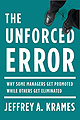
We all make them. Ethics breaches and scandals and performance-related turnover are increasingly found in today’s headlines. As in tennis, the unforced error is made by someone with the ability to keep the ball in play but who makes a mistake, resulting in the loss of a point. To improve your game you need to develop the habits that will help you keep the ball in play. It is your performance over time—a steady game—that will get you where you want to go. That’s what The Unforced Error: Why Some Managers Get Promoted While Others Get Eliminated by Jeffrey Krames aims to help you do.

The most dangerous errors—and the one discussed in this book—are “the ones we don’t recognise, so we can’t fix them before the damage is done.” Krames divides unforced errors into two groups: the unforced operating error (the ones we all make in the course of doing our job; a bad call) and the unforced nonoperating error (errors not directly related to the conducting of business, but can shatter a career nonetheless - errors of character). Krames writes, “There are seldom excuses for unforced nonoperating errors. You have to have the awareness, self-control, and maturity to avoid them.” The focus of this book is the former kind, the unforced operating error.

There is a key to avoiding unforced errors. Not surprisingly, the key is humility. “That’s because humility—one of the most underrated of all leadership qualities—is essential to developing the strength and consistency to avoid unforced errors.” It’s the kind of humility that comes from having the self-confidence to admit mistakes, blind spots and then move on to correct the mistake. Rarely would you be told that you were fired due to a lack of humility, but it is the trigger for so many unforced errors. Krames successfully helps you to recognise an unforced error when you see it. In each chapter that covers a specific unforced error, he offers sensible and pragmatic advice on how to avoid these “career killers.” His advice includes:
  • Never say the ball was out by a mile. Face reality at all times.
  • Nothing is as important as people decisions. Get the right people.
  • When you do make a people mistake, fix it as quickly as possible.
  • Don’t overlook the wild card. Develop the next generation of leaders.
  • Keep your game inbounds. Living and leading by the rules.
  • Step up to the net. Take ownership of your part of the court.
  • Watch the whole court. Find out who the real line judge is in your game and make sure they know how you’re doing.
Krames is very readable as always. The tennis metaphor works well to demonstrate the importance of these ideas. If you take the time to study the advice Kramer has gathered together, you could save yourself from committing these errors. In the words of Billie Jean King, “Self-awareness is probably the most important thing towards being a champion.” 
Share/Save/Bookmark

Friday, December 18, 2009

Derek Jeter - Sports Illustrated's 2009 Sportsman of the Year


Even if you know little about the sport of baseball, this story is well worth reading for many reasons:

'Derek Jeter of the New York Yankees captained the U.S. team in the 2009 World Baseball Classic, after which MLB commissioner Bud Selig sent him a letter of thanks in which he called him "Major League Baseball's foremost champion and ambassador."

"You embody all the best of Major League Baseball," Selig wrote in the March 30 letter. "As I mentioned to you in our recent telephone conversation, you have represented the sport magnificently throughout your Hall of Fame career. On and off the field, you are a man of great integrity, and you have my admiration."

For those achievements, but most especially for the principled, selfless manner in which he earned them, Jeter is SPORTS ILLUSTRATED's 2009 Sportsman of the Year. He is the first Yankee to win the award in its 56-year history and only the third baseball player in the past 34 years to win the award alone, joining Orel Hershiser (1988) and Cal Ripken Jr. (1995).

Jeter is an anachronism if you believe that manners and humility, the pillars of sportsmanship, are losing ground in an increasingly stat-obsessed, self-absorbed sporting culture in which the simple act of making a tackle, dunking a basketball or getting a base hit calls for some burlesque act of celebration, a marking of territory for individual purpose. Jeter is the unadorned star, and not only in the literal sense in that he is free of tattoos, piercings, cussing, posses and the other clichés of the big-time-jock starter kit. The actress Kim Basinger once captured the essence of Jeter as well as any scout, telling SI in 1999, "He's a hunk, and I don't even like that word. Women like guys who have a big presence but sort of play it down. It's very appealing."

Such uncalculating humility, alloyed to his formidable skills, is the same attribute that makes Jeter so appealing to teammates and foes alike.

Jeter's rare gift as a superstar athlete is that he doesn't so much inspire awe as he engenders comfort. To be around Jeter is to truly believe that things are going to turn out well, whether you are a fan who still wants to believe in the inspirational quality of sports and the people who play them, or a Yankee who wants to believe there is some way back from three runs down, five outs from elimination, against Pedro Martinez in his prime.

"Everything he does has such a grace about it," Oakland A's general manager Billy Beane says. "Even now, this last postseason, people would say to me, 'You must be rooting against the Yankees.' But you know, maybe because of Jeter, the Yankees know how to win. It's not an act. The Yankees' brand name in this era is that it is Jeter's era. It's similar to what DiMaggio was in his era."

Eight years ago, to his recollection, Beane watched Jeter run out a routine ground ball to shortstop in the late innings of a routine game in which the Athletics were beating the Yankees. Jeter ran down the first base line in 4.1 seconds, a time only possible with an all-out effort. Beane was so impressed by the sprint that he ordered his staff to show the video of that play to all of the organisation's players in spring training the following year.

"Here you have one of the best players in the game," Beane says, "who already had made his money and had his four championships by then, and he's down three runs in the seventh inning running like that. It was a way of showing our guys, 'You think you're running hard, until you see a champion and a Hall of Famer run.' It wasn't that our guys were dogging it, but this is different. If Derek Jeter can run all out all the time, everybody else better personally ask themselves why they can't."

Told the story, Jeter says, "It makes you feel good whenever anybody appreciates how you do things. My whole thing is, you're only playing for three hours a day. The least you can do is play hard. You have what, four or five at bats? O.K., it's not difficult to run, to give it a hundred percent. It's effort. You don't have to have talent for effort."

The idea of Jeter as a template stretches beyond 90 feet. He is a role model not only for how to play baseball but also for how to remain atop the wobbly pedestal of fame. '

For more, see - http://sportsillustrated.cnn.com/vault/article/magazine/MAG1163403/index.htm
Share/Save/Bookmark

Friday, October 30, 2009

The Qualities of a Leader


James Riady is the CEO of Lippo Group, one of Indonesia's largest conglomerates with annual revenues of some $3 billion. Fifteen years ago, Riady was responsible for the establishment of Universitas Pelita Harapan in Indonesia, and he has a strong interest in the social impact of business.

During an interview with Knowledge@Wharton, Riady was asked what are the most important qualities of a leader?

'A leader needs to have a vision, because at the end of the day, the vision must drive the organisation. It must drive people. And a strong vision attracts people like a magnet and gets people to make changes in the community. But it's not just about having a vision. It's also about having humility. That's very difficult. The more successful you are, the more you face the temptation of being egoistic and full of pride. It's also about having the heart to serve, to do things not for yourself but for others. Those are the three things: vision, humility and the ability to serve.'

Riady was also asked for examples of what gives him pride in the work he is doing in education and healthcare? His answer points the way towards why Indonesia is making progress in international education tables and highlights what needs to happen in the UK as we slip further behind in education performance (eg the 2008 OECD international rankings place the UK 13th in reading - down from seventh in 2000 - and 18th in maths).

'I was not born into and did not grow up in a particularly educational environment. But it wasn't until when I went back to Indonesia in 1978 with my four children, who grew up in the U.S., and I had to look for schools for them that I realised that we do not have top schools in Indonesia that I would consider putting my children in. There is a great deficiency in education in Indonesia. I set out to contribute something, to make a change. So we set up the non-profit called [Pelita Harapan] Educational Foundation and started building schools and universities. Today, we have 20 schools and one university, which have transformed Indonesian education.

We introduced an education system that is not based on rote memorisation but the creative process of learning. It's not about knowledge; it's about the process of learning. We wanted small class sizes, and a holistic education that gets students to develop all parts of life. We don't just want to have good schools. We want to have model schools that other schools look at and want to copy. For the next generation, our schools hopefully will be a role model of what good education is all about, what good schools are all about. It's exciting because that's transformational.

We started paying teachers salaries that they deserve, increasing salaries three to four times more than what they were earning over the last 15 years and so instilling in the community that education has a high value. In today's modern society, there has been a shift. People do not respect and value teachers as much as they should.... I hope that when I finish my life that the biggest impact I have made will be in education.'

For the full interview, see - http://knowledge.wharton.upenn.edu/article.cfm?articleid=2365
Share/Save/Bookmark