Positive Leadership has also been recognised as a Top 50 Leadership Expert to Follow on Twitter.

Follow us on Twitter @posleadership


LEADERSHIP IS A PROCESS OF SOCIAL INFLUENCE, WHICH MAXIMISES THE EFFORTS OF OTHERS TOWARDS THE ACHIEVEMENT OF A SHARED GOAL.
Showing posts with label Excellence. Show all posts

Friday, March 28, 2014

Positive Leadership: Scaling Up Excellence

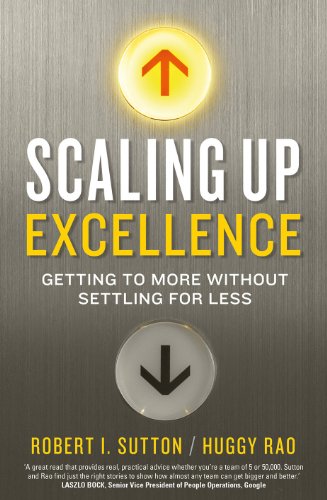
Stanford Professor Bob Sutton shares principles and colorful examples from his most recent book, Scaling Up Excellence, co-authored by Huggy Rao. 

Touching on concepts around emotion, complexity, and connecting people, Sutton explains why scaling is about spreading and sustaining a mindset, not just a footprint.


Share/Save/Bookmark

Monday, January 13, 2014

Positive Leadership: Scaling Up Excellence

In Scaling Up Excellence, Stanford faculty Robert Sutton and Hayagreeva "Huggy" Rao tackle a challenge that determines every organisation's success: scaling up farther, faster, and more effectively as a programme or an organisation creates a larger footprint. 

Sutton and Rao have devoted much of the last decade to uncovering what it takes to build and uncover pockets of exemplary performance, to help spread them, and to keep recharging organisations with ever better work practices. 

Drawing on inside accounts and case studies and academic research from a wealth of industries -- including start-ups, pharmaceuticals, airlines, retail, financial services, high-tech, education, non-profits, government, and healthcare -- Sutton and Rao identify the key scaling challenges that confront every organisation.

They reveal how the best leaders and teams develop, spread, and instil the right mindsets in their people -- rather than ruining or watering down the very things that have fuelled successful growth in the past. They unpack the principles that help to cascade excellence throughout an organisation, as well as show how to eliminate destructive beliefs and behaviours that will hold them back.

Robert Sutton is professor of management science and engineering in the Stanford Engineering School. His previous books include Good Boss, Bad Boss: How to be the Best...and Learn from the Worst, and The No Asshole Rule: Building a Civilised Workplace and Surviving One That Isn't. Huggy Rao is professor of organisational behaviour at Stanford Graduate School of Business, and the author of Market Rebels: How Activists Make or Break Radical Innovations.


Share/Save/Bookmark

Thursday, November 21, 2013

Positive Leadership: Excellence

"If you want to achieve Excellence, you can get there today. As of this second, quit doing less than Excellent work. The first 99.9% of getting from here to there is the determination to do it and not to compromise, no matter what set of road blocks those around you erect.” 
Tom Peters

Share/Save/Bookmark

Friday, September 06, 2013

Positive Leadership: Possibilities

We're all capable of a little more -- a little faster, a little higher, a little stronger, a little more. And when we look at all of the little things we've done, we'll see the big things we're doing.
Share/Save/Bookmark

Monday, July 01, 2013

Positive Leadership: Do One Thing Better Today

Many individuals, teams and organisations have tasted excellence periodically. It goes down well on the palate, doesn't it? Like the perfectly aged Bordeaux, the perfectly executed recipe, the perfect balance of flavours in a great meal. But consistently delivering superior results over time is another story. It requires process, discipline and focus. It requires energy, effort and persistence. It requires daily attention.

A technique we have found helpful with performers to deliver sustainable excellence is to focus on one thing every day to improve from the day before. It could be personal, professional or relational. It doesn't have to be monumental every day.

Why does this process work?

Confidence is the result of an accumulation of success experiences. By doing one thing better each day you consistently experience (and expect) success.  Each day builds upon the last.

Improving every day creates focus. How many times have you wound up at the end of a day wondering what you truly accomplished? By committing to daily improvement you organise your thoughts, energy and effort.

Continuous improvement becomes a habit, not a cliché. 

When you commit to daily improvement, development opportunities are expected and welcomed. You look forward to development feedback rather than dreading it and reacting defensively.

Sustainable excellence is not rocket science. It is the result of establishing an effective system and having the discipline to follow it. Getting better each day establishes the mindset. What are you going to improve today?

Share/Save/Bookmark

Friday, June 28, 2013

Positive Leadership: The Difference between Success and Excellence

Most performers believe success and excellence are interchangeable terms. After all, if I'm successful I'm excellent--right? Wrong.

Success is an absolute term. If you are the highest producing salesperson, win the game or beat the earnings forecast you are successful. Success in the performance world is about achieving outcomes better than others by comparison.

Excellence, on the other hand, is a relative term. It is about maximising your personal and organisational potential. If you are the highest producing salesperson but you can sell more, you have not fulfilled your sales potential. If you win the game but could have scored more points, you have not fulfilled your athletic potential. If you beat the earnings forecast but leave some organisational profit on the table, you have not fulfilled the potential of your company. 

If you are excellent you deliver the best performance you are capable of, regardless of the absolute outcome.

If you are excellent, you will be successful but you can be successful without being excellent. Commit to excellence--it's more meaningful. And, by the way, it's also more fun!

Share/Save/Bookmark

Thursday, December 27, 2012

Positive Leadership: The Campbell Soup Leadership Model


Campbell's Soup Company CEO, Doug Conant talks about the Campbell Leadership Model.

Share/Save/Bookmark

Tuesday, September 11, 2012

Positive Leadership: Remarkable is a Tough Choice


Too often, we're presented with choices that don't please us. We can pick one poor alternative or the other. And too often, we pick one.

We were struck by Apple's choice to put a glass screen on the original iPhone. Just six weeks before it was announced, Steve Jobs decided he wanted a scratchproof glass screen. The thing is, this wasn't an option. It wasn't possible, reliable, feasible or appropriately priced. It couldn't be done with certainty, and almost any other organisation would have taken it off the list of appropriate choices.

It was unreasonable.

And that's the key. Remarkable work is always not on the list, because if it was, it would be commonplace, not remarkable.

Share/Save/Bookmark

Thursday, August 30, 2012

Positive Leadership: Unleashing Collective Genius


As business leaders, each of us is faced with a similar dilemma today. How do we need to change to stay effective despite the rapid and continuous change we are faced with in the business environment today?

Linda A. Hill, Professor of Business Administration at Harvard Business School, a widely read author, and the Faculty Chair of the Leadership Initiative, discusses how leaders need to be value creators and game changers.


Share/Save/Bookmark

Friday, April 20, 2012

Positive Leadership: Why Some Companies Outperform


What is the secret of the success of the World’s Most Admired  Companies?  Four factors are essential according to the Hay Group | FORTUNE World's Most Admired Companies Report 2012 -

1. Strategic excellence
2. Structures and processes that sustain performance over time
3. Achieving success through people
4. Placing a high value on leadership and talent.

These companies also outperform (total shareholder return) industry peers and the market as a whole over 1, 3, 5 and 10 years.


Share/Save/Bookmark

Wednesday, November 16, 2011

Positive Leadership: Achieving True Greatness

When most of us learn a new skill, we work to get just "good enough" and then we go on autopilot. We hit what journalist and bestselling author of Moonwalking with Einstein, Joshua Foer calls the "OK Plateau," where we have gained sufficient skills for our needs and we stop pushing ourselves.

 But experts do it differently.

Looking at the research on everyone from incredible athletes to memory champions, Foer has extracted four principles that describe how to push through the OK Plateau to achieve true greatness.

Watch this fantastic talk to learn strategies for developing expertise in any field.

 
Share/Save/Bookmark

Thursday, October 27, 2011

Positive Leadership: Bridgewater Associates' Pursuit of Truth and Excellence


In both 2010 and 2011, Bridgewater Associates (www.bwater.com) ranked as the largest and best performing hedge fund manager in the world. 

Bridgewater’s unique results are a product of its unique culture. Truth and excellence are valued above all else. 

As Bridgewater founder, Ray Dalio says: 

'In order to be excellent we need to know what’s true, especially those things that we would rather not be true, so that we can decide how best to deal with them. We want logic and reason to be the basis for making decisions. It is through this striving to be excellent by being radically truthful and transparent that we build meaningful work and meaningful relationships.

At Bridgewater, our overriding objective is excellence, or more precisely, constant improvement. We believe that producing excellence requires approaching both work and people in a principled way. Above all else, we want to find out what is true and figure out how best to deal with it. We value independent thinking and innovation, recognizing that independent thinking generates disagreement and innovation requires making mistakes.

To foster this thinking and innovation, we maintain an environment of radical openness, even though that honesty can be difficult and uncomfortable. At Bridgewater each individual has the right and the obligation to ensure that what they do and what we do collectively in pursuit of excellence makes sense to them. Everyone is encouraged to be both assertive and open-minded in order to build their understanding and discover their best path. The types of disagreements and mistakes that are typically discouraged elsewhere are expected at Bridgewater because they are the fuel for the learning that helps us maximize the utilization of our potential. It is through this unique culture that we have produced the meaningful work and meaningful relationships that those who work here and our clients have come to expect.'

Underpinning the Bridgewater philosphy are Ray Dalio's Principles, which the organisation uses, debates and changes to agree on how individuals should be with each other in their collective pursuit of excellence.


Share/Save/Bookmark

Saturday, October 08, 2011

Positive Leadership: Commitment To Excellence

Commitment To Excellence
Share/Save/Bookmark

Monday, July 25, 2011

Positive Leadership: "What Have I Become Used To?"


It has been said that people can get used to almost anything. We believe this to be true, especially if it happens gradually over time. When you get used to things being a certain way, you develop what we call a “comfort zone,” which is pretty much just what it sounds like. Adaptability can be a good thing, but not always.

If you are used to cleaning up your house every day because you like things neat and tidy, you will be uncomfortable when the sink is full of dishes. You will experience tension until you restore order.
On the other hand, if you are used to a pile of dirty dishes in the sink, it won’t bother you at all – unless, of course, you are expecting company. Then, the things you’ve become used to and comfortable with may suddenly become very un-comfortable. “That’s OK for me,” you may think, “but I don’t want my company to see it like that!”
People who go on crash diets before a big event, or clean out their car before they pick up the boss are doing the same sort of thing. But think about it – aren’t you worth the same considerations as your company? Don’t you deserve to live by the same high standards that you adopt to impress others?

Take a look at your life. What have you become used to over time that you never really meant to happen? 

If you want to change your comfort zone for the better and raise your internal standards, correct use of affirmations and imagery can be a great help. Tell the people close to you what you are trying to do, and stick with it. You can get used to excellence, too!

Share/Save/Bookmark

Thursday, March 10, 2011

Positive Leadership: Leadership Lessons from Walmart

Walmart CEO Mike Duke leads the world's biggest retailer, which has 2.1 million employees and serves 200 million customers each week. Here are excerpts from a recent interview Duke did with The Associated Press:

‘Q. What ideals from Sam Walton do you embrace?

A. Leadership is about showing respect to every individual, about humility over arrogance, about listening and getting feedback from a broad array of constituents. It's about a passion for customers and knowing customers first-hand, not theoretical, not through some data, but by having personal, passionate communication with customers.

And leadership is about striving for excellence. It's about setting aggressive goals and not being afraid to go after very aggressive goals and targets. I think it's even better for a leader to set an aggressive goal and come up a little short than it would be to set a soft goal and to exceed it.

Q. What should a leader value most?

A. Integrity and trust. If a leader doesn't have the trust of associates, of customers, of shareholders, then all the other things, the ability to speak eloquently and to sing and dance and entertain, (don't) mean a thing if a leader is not trusted.’

Share/Save/Bookmark

Thursday, February 24, 2011

Positive Leadership: The Ethics of Excellence


The ethics you live out as you go about your work can provide the foundation for excellence. The high calibre organisation is, after all, merely a reflection of its people.


Share/Save/Bookmark

Thursday, February 10, 2011

Positive Leadership: Helping Others Shine

Earl Miller, a neuroscientist at MIT says, “Success has a much greater influence on the brain than failure.” 

Ned Hallowell comments in Shine: Using Brain Science to Get the Best from Your People: "While of course mistakes need to be acknowledged and, one hopes, learned from, it may be more likely, from a purely neurological point of view, that a person will learn more from a success than a failure.” The brain’s plasticity—its ability to grow and change throughout life—means that none of us are stuck with who we are. With the proper attention we can learn to perform better. “All people want to work hard and will work hard, given the right job and the right conditions, because it feels supremely good to excel.”

Hallowell points out that acknowledgment or recognition serves two important functions. Of course there is the familiar purpose of giving the recipient encouragement, motivation and greater confidence, but recognition also promotes moral behaviour through connection. Hallowell explains: “When a person feels recognised and connected to the larger group, she knows viscerally, not just intellectually, that she has made a contribution others value. Not only does this motivate her to do more and try harder, but it instills a desire to look out for the larger group…. It leads a person to do the right thing even when no one is looking.”

Showing appreciation and giving recognition is part of the Cycle of Excellence process he calls 'shine'. In our busy culture it is easy to overlook opportunities to acknowledge others. Noticing the positive is a daily challenge.
In Shine, Hallowell offers these ten tips for promoting shine with the people you influence:
  • Recognise effort, not just results. Of course, you want the results, but if you recognise ongoing effort, results will more likely ensue. Cheerleading works.
  • Notice details. Generic acknowledgment pales next to specific recognition.
  • Try, as much as possible, to provide recognition in person. E-mail packs much less of a punch than human moments.
  • In meetings—and everywhere—try to make others look good, not bad. Scoring points off the backs of others usually backfires.
  • As a manager, you should know that the self-esteem of each employee is perhaps your most important asset. Recognition is a powerful tool to preserve self-esteem.
  • Acknowledge people’s existence! Try always to say hello, give a nod of the head, a high five, a smile in passing. It’s withering to pass someone and feel as if that person didn’t even see you.
  • Tap into the power of positive feedback. Remember that positive feedback often consolidates gains better than learning from mistakes.
  • Monitor progress. Performance improves when a person’s progress toward a goal is monitored regularly.
  • Remember, as a manager, the more you recognise others, the more you establish the habit of recognition of hard work and progress as part of the organizational culture.
  • Bring in the marginalised people. In most organisations, about 15 percent of people feel unrecognised, misunderstood, devalued, and generally disconnected. Not only is recognition good for that 15 percent to help them feel valued, it is good for the other 85 percent as well, as it boots the positive energy across the organisation.
Hallowell reminds us that “recognition is so powerful because it answers a fundamental human need, the need to feel valued for what we do” and as leaders we are in a unique position to offer or withhold that recognition. 

Share/Save/Bookmark

Tuesday, February 08, 2011

Positive Leadership: Winning

‘Players have to have passion and emotion to succeed and achieve.  Winning and a belief in winning is emotional. It gets the adrenaline moving which sends you on a high when you win and makes you cry when you lose – because it matters. There must be passion to succeed; to achieve and to keep achieving; to raise horizons and expectations. Excellence is continuous; you’ve never done enough; you can never be satisfied, but as the team grows it achieves a special identity – no longer one person’s image – but a reflection of everyone’s interests, their abilities and their beliefs.' 

Sir Ian McGeechan, British & Irish Lions Rugby Coach 1989, 1993, 1997, 2009

Share/Save/Bookmark

Wednesday, February 02, 2011

The Seven-Step Path to Sustaining Success

The Seven-Step Path to Sustaining Success (courtesy of Tom Peters):

You take care of the people.
The people take care of the service.
The service takes care of the customer.
The customer takes care of the profit.
The profit takes care of the re-investment.
The re-investment takes care of the re-invention.
The re-invention takes care of the future.
(And at every step the only measure is EXCELLENCE.)

Share/Save/Bookmark

Wednesday, January 19, 2011

Leaders Live Their Values (part 1)


Pure and simple, but not always easy to do - Leaders Live Their Values. That makes them authentic and credible. Unfortunately, some leaders do not walk the talk.

This is from the 1998 Annual Report of one company which failed the test - Enron. (See also - http://www.nytimes.com/2002/01/19/opinion/enron-s-vision-and-values-thing.html )


Share/Save/Bookmark