Positive Leadership has also been recognised as a Top 50 Leadership Expert to Follow on Twitter.

Follow us on Twitter @posleadership


LEADERSHIP IS A PROCESS OF SOCIAL INFLUENCE, WHICH MAXIMISES THE EFFORTS OF OTHERS TOWARDS THE ACHIEVEMENT OF A SHARED GOAL.
Showing posts with label Leadership Development. Show all posts

Tuesday, January 21, 2014

Positive Leadership: Why Leadership Development Programmes Often Fail


This is an excellent article from McKinsey on why leadership development programmes often fail -http://www.mckinsey.com/insights/leading_in_the_21st_century/why_leadership-development_programs_fail

The key reasons?

1. Overlooking context
2. Decoupling reflection from real work
3. Underestimating mind-sets 
4. Failing to measure results

Companies can avoid the most common mistakes in leadership development and increase the odds of success by matching specific leadership skills and traits to the context at hand; embedding leadership development in real work; fearlessly investigating the mind-sets that underpin behaviour; and monitoring the impact so as to make improvements over time.

Share/Save/Bookmark

Monday, November 11, 2013

Positive Leadership: Leadership Development

To become an effective CEO, work for companies committed to leadership development, and take responsibility for your own development on the job. Joseph L. Bower, Professor, Harvard Business School. 


Share/Save/Bookmark

Tuesday, May 28, 2013

Positive Leadership: Who Wants to Lead a Large Corporation?

How many young people today want to become leaders of large corporations? Too few!

Why?

Many young people simply lack trust in today’s leadership models. Here are some of the concerns they voice:

Are leaders transparent enough in their actions?  

Often times, leaders are not open enough about how they make the big decisions that impact their organisations. This lack of transparency makes it difficult for people to hold their leaders to account. When the research team at the Future of Work Research Consortium asked over 3,000 corporate executives about the significance of various leadership traits, they ranked transparency as increasingly important in the future. Yet they also acknowledged that right now this was not a well-developed capacity and is a high-risk trait in need of attention.

Are leaders engaging their stakeholders effectively? 

Some believe that leadership teams of large corporations seem to be stuck in traditional management models that do not help them build trusting relationships with stakeholders. Inside corporations they can fail to create effective democratic processes with employees, while externally they aren’t always demonstrating real commitment to wider social challenges. This is a major challenge for leaders as people increasingly look at companies’ ethical practices and the way they treat employees when deciding whether to trust them or not. It’s clear from the broader research that delivering consistently strong financial performance does not guarantee a corporation the trust of its stakeholders unless accompanied by good practice and ethical behaviour.

Do leaders do as they say? 

A recurring theme is the challenge of intent and actions. Leaders may talk about strong corporate values, but some are all too quick to bypass them in the interest of the bottom line. No doubt this scepticism is a response to the wave of corporate scandals in 2012 that has increased suspicions about corporate leaders. A global survey by consulting firm Edelman Berland, found that less than 1 in 5 people believe business leaders will actually tell the truth when confronted with a difficult issue. 

It is clear that there is still much scepticism about leadership intent. What we need now is deeper insight into what it takes to restore some of the lost faith in today’s corporate leadership.

Share/Save/Bookmark

Friday, April 05, 2013

Positive Leadership: The Changing Face of Leadership Development


Leadership Development needs to move -

From:
To:
Case studies
Real-time challenges
Intellectual, cerebral learning: new insights and good intentions
Behavioural transformation: new actions in the workplace
Individual, leader development
Relational, leadership development
Competency based – for success in the past
Involving real stakeholder perspectives – for success in the future
No attention being paid to dropping old habits that are no longer relevant
The inclusion of unlearning, addressing of limiting assumptions, mind-sets, habitual patterns


Share/Save/Bookmark

Tuesday, March 05, 2013

Positive Leadership: Developing Leaders


Share/Save/Bookmark

Tuesday, October 30, 2012

Positive Leadership: Cultivating #Leadership Success


Here are some guidelines to cultivating leadership success across an organisation:

Make It a Priority: Acknowledge the risk, and put a formal action plan in place. Start by clearly defining the behaviours and skills which make a successful leader in your organisation.

Look Beyond Performance: Have a full picture of the leadership potential across your organisation and don’t restrict that view to only those you think are high potential. Do not confuse ambition with ability.

Replace Subjectivity with Objectivity: Gut instinct won’t do. Using scientific data, benchmark your people against competitor talent and identify leadership shortages to avoid succession risk.

Be Pragmatic & Proactive: Don’t wait for yearly review cycles, instead, employ development interventions at the point-of-pain with individual employees or across departments. This includes where and when to spend learning and development budgets throughout the company.

Cast a Wider Net: Take a global view of where your leadership talent is located and be prepared to use creative strategies to source talent across borders to fill leadership gaps.

Share/Save/Bookmark

Thursday, September 27, 2012

Positive Leadership: Assessing Team Performance and Potential


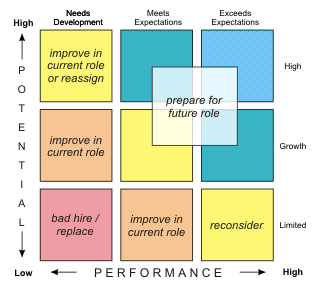
The performance and potential matrix (9 box model) is one of the most widely used tools in succession planning and development. It can be a valuable tool for anyone who works in talent management, or for any manager.

The performance and potential matrix, commonly referred to as “the nine box”, is a simple yet effective tool used to assess talent in organisations. It assesses individuals on two dimensions – their past performance and their future potential.

The X axis (horizontal line) of 3 boxes assesses leadership performance and the Y axis of 3 boxes (vertical line) assesses leadership potential. A combination of Y and X axis makes up the box within the grid that the leader is placed. 1A - High Performance/High Potential, 3C - Low Performance/Low Potential, etc...

The tool is best if used by a team and facilitated by someone who has experience with the process. 


For more, see: http://www.linkageinc.com/thinking/linkageleader/Documents/Jon_Warner_Using_a_Performance_and_Potential_Grid_to_Guide_Coaching_Interventions.pdf


Share/Save/Bookmark

Wednesday, August 22, 2012

Positive Leadership: A Leadership Skills Gap


Fortune 1000 companies do not have enough leaders coming up through the ranks to fill open and future leadership positions, according to a survey by The CARA Group, Inc. 

To remedy the current lack of leadership skills and limited talent pipeline, caused in part by recession cuts to critical leadership programmes, the survey reveals there is an emerging renewed commitment to leadership development among companies of all sizes.

Key findings of the 2012 CARA survey include:
  • More than half—62% of respondents—say their organisations face a leadership skills gap
  • 84% of respondents say their organisations have increased leadership development focus in the last two to three years
  • Only 9% of respondents say their current leadership development programmes are “very effective,” while 56% describe their programmes as only “somewhat effective” or “ineffective”
  • The top three most critical skill gaps of leaders-in-training are leading others (54%), managing change (43%) and strategic planning/vision development (40%)
  • Online learning and development (66%) is the number one way companies are leveraging technology in their leadership development programmes.

Share/Save/Bookmark

Friday, April 27, 2012

Positive Leadership: Global Management Challenge Launching in Scotland

The Global Management Challenge is the largest Strategy and Management Competition for Students in the world. 

Positive Leadership is delighted to be involved with the forthcoming launch of the competition in Scotland. 

Over 40 countries around the world already take part in the annual competition and to date, over 480 000 university students and company managers have participated in the event.

For more information, please see: www.gmcscotland.co.uk


Share/Save/Bookmark

Tuesday, March 27, 2012

Positive Leader: Becoming a Global Leader


For aspiring leaders who want to become global citizens and increase their global fluency, here are some suggestions to get started:

1. Target at least one fundamentally different culture. While it may be tempting to live in a culture similar to your own — for example, Britons working in America — the most compelling learning experiences come from living in cultures that are sharply differently from your own. Chinese professionals working in South Africa, for example, will find their existing cultural assumptions challenged as they gain increased humility by learning local languages and coping with different norms.

2. Spend time studying overseas. Studying in different cultures enables young leaders to understand cultural nuances and become actively engaged with global organisations. Global organisations prefer candidates who have studied abroad because these early experiences will broaden your perspective about seeking fascinating global opportunities throughout your life. Look for opportunities, and if you're already out of university, ask if your organisation offers programmes to give you experience abroad.

3. Learn the local language. As English becomes the language of business, it is tempting to get by with limited knowledge of local languages. That's a mistake. Learning local languages enables you to appreciate cultural nuances and develop more personal relationships. Being fluent in multiple languages makes it easier to learn new ones and opens up career opportunities.

4. Don't judge cultural differences or local people. When your new environment is sharply different from prior experiences, it's tempting to make snap judgments about your experiences and stay attached to your own culture. Resist that temptation by observing, listening, learning, and understanding rather than judging. Use your insights to improve local ways of operating, but don't rush to criticise.

5. Share international experiences with your family. Living in new countries brings your family much closer together and will be a time for growth, bonding and learning as a family. Hold parties for your local neighbours join a local church and get involved in your children's school. Host regular visits from parents and close friends. Balance breadth and depth in your travels to explore many different areas and countries, and spend time talking with local people. But don't travel so much that you fail to get deeply involved in your new community and explore its richness.

Share/Save/Bookmark

Wednesday, February 29, 2012

Positive Leadership: Great Leaders Continue to GROW


Great leaders make the choice to GROW in four areas:

Gain Knowledge. Gain self-knowledge, knowledge of others, your industry, and the field of leadership

Reach Out to Others. You need to be proactive about helping others grow if you’re going to grow and learn. Teaching isn’t just about sharing information, it’s also about helping people draw out new learnings for themselves by the questions you ask.

Open Your World. You will add much more value as a leader if you open up and expand your world with leadership experiences and life experiences. Be on the lookout for experiences inside and outside work that will make you a better leader over time.

Walk Toward Wisdom. Growth in wisdom has no formula, but it almost always involves at least one of four elements: rigorous self-evaluation, honest feedback, counsel from others, and time.

The two primary reasons leaders get off track are ego and fear. For many leaders, their ego is fueled by a heightened sense of confidence—you might call it overconfidence or pride. This, combined with the fear of losing control, often prevents leaders from serving people and growing.

Share/Save/Bookmark

Tuesday, February 28, 2012

Positive Leadership: Correlation between High Performance and Investment in Leadership Development


Just over two out of five bosses consider their line managers to be ineffective, according to a study into the business benefits of management and leadership development, released today by the Chartered Management Institute (CMI) and Penna.

The research shows organisational performance and management abilities to be clearly linked - with only 39% of managers in low performing businesses deeming their line managers to be effective, compared to 80% in high performing organisations.

The CMI-Penna report, produced with Henley Business School, draws on findings from almost 4,500 managers, including more than 300 CEOs and 550 HR decision makers.

The research provides evidence showing how management and leadership development activities can lead to increases of up to 32% in people performance and 23% in overall organisational performance, across organisations of all sectors and sizes.

The findings show high performing organisations spend on average 36% more on management and leadership development per manager per year than low performing ones.


Share/Save/Bookmark

Monday, December 05, 2011

Positive Leadership: Identifying Future Leaders


One of the best ways to identify a potential leader is to ask people: “Who do you enjoy working with?  Who do you respect in the workforce?”  The names you hear in answer to those questions are the kind of people you want to identify as potential leaders and promote.

Great leaders are great because their people trust and respect them, not because they have power. So think about it: Who do people trust and respect in your workplace? Who do people go to for advice who might not be a leader now?  Those are the ones you want to identify. Those are the ones who have the potential to be leaders, because people are already attracted to them.

Share/Save/Bookmark

Friday, November 04, 2011

Positive Leadership: The Role of Chaos in Leader Development


In our view, the best way to develop leaders for the challenges of today is to deliberately introduce chaos into the development process. 

In leader development today, chaos is an imperative. 

Think about that—the idea that you would deliberately introduce chaos into leadership experiences and see how different leaders react to it. 

While we may have enough chaos in our lives, the only way to really test leaders is to see their response when confronted with turmoil.  A wise idea in a tumultuous world?

Share/Save/Bookmark

Thursday, July 28, 2011

Positive Leadership: High Potentials


Today’s organisations find it challenging to locate and put in place a new generation of leadership that is both proactive and pragmatic. 

Disproportionately this new generation of leaders will come from the pool of people within an organisation, often referred to as, “high potentials.” But there’s the rub. By what criteria do we decide whether somebody is a high potential suited for a leadership position?

Face it, not everyone is a high-potential. Some have reached their potential and others are quite comfortable where they are. They are good, if not great, performers who are satisfied with their accomplishments and focused on doing what they do best.

So what are the criteria by which you evaluate whether someone can be a high-potential leader?

Here are five suggested criteria:

1. Knowledge
They know their business. Simply put, high-potential leaders are those individuals who have displayed a certain amount of accumulated expertise. This expertise may be technical or it may be based in networks, but it’s invaluable for an organisation. More importantly, they understand how their activities, their sector, and their realm of knowledge, is related to the wider organisational agenda.

2. Reputation
They have legitimacy in the eyes of others. Others in the organisation must appreciate the relevance of the knowledge base that a high-potential possesses. It’s a simple reality that having expertise or a skill base isn’t enough to make one a high-potential leader. High-potential leaders must also have the ability to garner the professional respect of others.

3. Ambition
They have a strong career mindset. We want our high potentials to be ambitious—but we want them to be ambitious in a very focused way. And the best way to get a sense of their ambition is to evaluate their commitment to their career progression. High potentials need to be committed to accumulating new responsibilities, new successes, acquiring additional knowledge, and, for better or worse, achieving additional recognition.

4. Partnering
They understand the importance of working with others. While a strong career mindset is important, high-potentials must also have a deep appreciation of partnership. A high-potential leader’s partnering ability shouldn’t be a politically correct exercise, but rather a pragmatic, tactical skill that will allow them to make better, more informed decisions. Lone-rangers and lone-wolves may be creative and ambitious, but they may not be suitable for the next leadership rung in the organisational ladder. 

5. Courage
They are bounded risk takers. High-potential leaders must understand that no matter how good they think a decision may be—they are making it under conditions of uncertainty. No matter how much information you have, no matter how many cost-benefit analyses you have done, no matter how many market surveys you have completed, a high-potential leader will know all information is limited. They’ll know that some decisions are inevitable, but they’ll also have the courage to take risks.

Identifying high-potential leaders requires an appreciation of what it is we want from our leaders. We want our leaders to know their business, and therefore knowledge is critical. We want others to accept their expertise, and therefore reputation is critical. We want them to be personally driven, and therefore ambition is essential. We want them to understand that nothing can be done alone, and therefore partnering is critical. And finally, we want them to know that nothing is guaranteed, and therefore courage is fundamental.

These five criteria, when identified appropriately—be it through skill matrixes, interviews, delineated questionnaires or peer review–will go a long way toward identifying high-potential leaders.

Share/Save/Bookmark

Saturday, June 25, 2011

Positive Leadership: Are You Committed To Leadership Development?

Do you have a relentless commitment to your leadership development programme?

This is not necessarily a question for the training manager but rather you as a leader. As we introduce Positive Leadership to organisations we sometimes find that there is not really a strong commitment to leadership development. Here are some questions that can be answered in the positive by those who we find do have a strong commitment to leadership development. 

How are you doing on these questions?

Do your emerging leaders know they are emerging leaders?
Do you discuss career development regularly with your emerging leaders?
Do you share stories of your development progress to this point and your next steps?
Do you hire emerging leaders or do you merely fill positions?
Do your emerging leaders work on the challenges of the company?
Do your emerging leaders teach each other?
Do your emerging leaders teach you?
Do your emerging leaders have access to the top executive?
Are career plans measured in your performance measurement?
Do your emerging leaders make cross-boundary staffing decisions?

Just a few questions to get you started.

Share/Save/Bookmark

Wednesday, June 15, 2011

Positive Leadership: Unfocused Focus

What to do when you have no time to think.

Unfocused focus. Sounds like a nice walk in a garden.


Share/Save/Bookmark

Wednesday, May 25, 2011

Positive Leadership: Sir Alex Ferguson, Talent Master

Sir Alex Ferguson may be cantankerous but he's a family man to his core. 

As the nurturing of his youth teams proves, he is an older man who believes in the next generation. His success springs from his love for his team and for the game they play – and his absolute loyalty both to them and to his principles. That makes him cantankerous and unbending. But it also makes him a model of the supportive parent. This probably reflects the fact that Ferguson himself is driven to succeed by his respect for his own father and his desire to please him.

Whether you believe that or not, the idea that those family values lie at the heart of what he has achieved, is surely worthy of applause – whatever team you support.


Share/Save/Bookmark

Saturday, May 07, 2011

Positive Leadership: The Business Case for Leadership Development

One of the biggest challenges HR professionals face when they propose new leadership development initiatives is convincing CEOs of the financial impact of the proposed initiative.  Without a clear sense of the positive financial impact, it’s easy to write-off a new proposal as too expensive, or that now is not the right time.  The lack of urgency to improve performance is based on the idea that that the current level of leadership skill in the organisation is good enough.  But is it? A look at most companies has shown that the typical organisation is leaving considerable value in untapped potential lying on the table through less-than-optimal leadership practices.  

For example, in 2006 The Ken Blanchard Companies conducted a year-long study to identify the connections between leadership effectiveness, employee passion, customer devotion, and overall organisational vitality.  

They identified several correlations:
  • Effective operational leadership directly predicts positive employee passion
  • Positive employee passion directly predicts customer devotion
  • Customer devotion directly predicts organisational vitality.

Share/Save/Bookmark

Sunday, May 01, 2011

Positive Leadership: How Video Games Build Leaders

           Stanford professor Byron Reeves explains how online multiplayer games like 'World of Warcraft' are creating the next generation of leaders:


Share/Save/Bookmark