Positive Leadership Limited is a strategic leadership and corporate finance advisory firm. We use our considerable experience to provide unique perspectives and innovative solutions which help corporate leaders unlock maximum value from complex business challenges. There is no dress rehearsal for delivering answers to critical business challenges. When you are under intense pressure to succeed, we help deliver the vitally important marginal gains which let your business excel and win.
You should watch this short clip — not because it’s a
remarkable story (which it is) or because it will make your eyes well up (which
it might), but because it’s a good reminder of two basic facts we tend to
overlook:
1) Respecting and caring for the tools of your skill — what
some educators call “the enchantment of everyday objects” — ignites powerful
motivation
Music is a powerful mood setter, transcending time and
place, and has the ability to evoke memories made yesterday or thirty years
ago. We all know that music makes us feel, but what is it about music that gets
us pensive, or full of life and on our feet and dancing?
British psychologist, John Sloboda, conducted a study
where he asked participants to identify the parts of a song they thought were
most powerful. The results showed that a significant number of the 'powerful
song parts' were created by appoggiatura – a process which creates emotional
tension in the listener.
If appoggiatura doesn't sound familiar, you'll be able to
relate to it when we say it's the moment in a song when you feel shivers down
your spine. If you've heard "Someone Like You" by Adele, you'll know
what we mean. Appoggiatura creates an emotional connection with our brains
which leads us to think that these are the most powerful parts of a piece of
music.
What's really interesting
is that listening to emotionally charged music, whether happy or sad, releases
dopamine which makes us feel good. The more goosebumps you feel when listening
to a song, the more your brain craves it.
When a leader tunes his or her instrument first and ensures
that each instrument in the orchestra is tuned, harmony is created and people
are drawn to see and hear what the organisation has to offer.
Boston Philharmonic Orchestra Conductor Ben Zander had a startling realisation at the age of 45 as it occurred to him that “the conductor doesn’t make a sound. His power depends on his ability to make other people powerful. My job is to awaken possibility in others. If their eyes are shining, you know you are successful.”
Zander’s lesson is a valuable one for those in leadership.
'The conductor of an orchestra doesn't make a sound. My picture appears on the front of the CD but the conductor doesn't make a sound. He depends for his power on his ability to make other people powerful.
And that changed everything for me. It was totally life-changing. People in my orchestra came up to me and said, "Ben, what happened?" That's what happened. I realised my job was to awaken possibility in other people. And of course, I wanted to know whether I was doing that. And you know how you find out? You look at their eyes. If their eyes are shining, you know you're doing it.
And, I have a definition of success. For me it's very simple. It's not about wealth and fame and power. It's about how many shining eyes I have around me.'
Former US Secretary of State Condoleezza Rice joined Aretha Franklin, for a rare music performance in Philadelphia earlier this week to raise money for charity:
People have been wondering who sang One Shining Moment at the end of the 2010 NCAA Division I Basketball Championship Game. The honour went to Grammy award winner Jennifer Hudson.
Hudson, who is the first female to sing the song, joins an impressive cast of past singers who have recorded the song, including Luther Vandross and Teddy Pendergrass.
“This is the biggest honour to be the first woman to record ‘One Shining Moment,’” Hudson said in a statement. “I am so excited to be singing such a great song behind the likes of Luther Vandross and Teddy Pendergrass. The song inspires you. It moves you. It motivates you and helps you reach that goal and that dream.”
One Shining Moment is an inspirational song written by David Barrett about the Men’s College Basketball Championship (at the end of the NCAA Division I Men’s Basketball Tournament). One Shining Moment is traditionally played at the end of CBS Sports’ coverage of the championship game of the tournament. The song is played as the winning team’s players cut down the nets, to a montage of highlights from the tournament.
Barrett, a singer/songwriter from Michigan, wrote the song after seeing Larry Bird star for Indiana State in the 1979 NCAA tournament. In 1986, he passed the song along to high school friend Armen Keteyian, an investigative journalist for CBS Sports and, at that time, Sports Illustrated, who in turn passed it to CBS Sports Creative Director Doug Towey. However, Towey originally planned to debut the song not after a basketball game, but after a football game, Super Bowl XXI. It was to have been the postgame montage from that contest, but CBS ran past the expected airtime and had a primetime show to debut in the next time slot, so the montage was cancelled. CBS then asked Barrett for use of the song after the 1987 NCAA championship game, in which Indiana beat Syracuse. Towey decided to use "One Shining Moment" to close CBS' coverage of the Tournament. The positive public response led to it becoming an annual feature. It has been used to end CBS' coverage ever since.
The first verse is about inspiration and hard work. The second verse deals with adversity, accompanied by highlights of injured players and missed shots. The bridge includes lines such as "Feel the beat of your heart", often shown with players thumping their chests, and "Feel the wind in your face", with video of drives towards the basket.
Listen to Jennifer Hudson’s One Shining Moment rendition below:
No matter how your present circumstances may be, the light of your loving will show you a way to improve some aspect of your life. You can accept yourself, and forgive any shortcomings. You can love yourself through your challenges. Learn from the past and let go of it. You may see yourself for the goodness you truly are. Celebrate your inner strengths and qualities. You can choose a new start. You need never limit your ability to love.
Love cannot be bought by the coin in your purse. Love grows from the inside out.
"The Bob Dylan line always appealed to me: 'There's no success like failure and failure is no success at all.' It was a while before I understood it. Leaders need the ability to fail and then get up and go on. It doesn't matter if you don't learn from the failure. But it does matter that you get up and get on." Bob Geldof
How's this for a gripping corporate story line: Youthful founder gets booted from his company in the 1980s, returns in the 1990s, and in the following decade survives two brushes with death, one securities-law scandal, an also-ran product lineup, and his own often unpleasant demeanour to become the dominant personality in four distinct industries, a billionaire many times over, and CEO of the most valuable company in Silicon Valley.
What does a young debut conductor need to know as she steps up on to the podium, looking out at all those expectant, demanding faces? It seems that a maestro and an executive face very similar challenges and that what helps on the podium can help in the corner office.
• Have a clear and vibrant vision for your people's success
Leaders who have not yet done the hard work of imagining a best-case scenario for their organisations will inevitably default to leading through correction and criticism. But when your highest priority is developing the right goals and strategy, you will spend most of your time inspiring people about them and guiding them towards successful achievement.
• Listen carefully to your people
A maestro listens "microscopically" to the orchestra. She uses the special perspective of her podium to take in both the big picture and the relevant details. In her imagination she juxtaposes the reality of the orchestra's playing with her best-case vision of how they might sound. Subtracting one from the other shows the crucial gap she needs to narrow or even eliminate. Armed with this knowledge she can focus the organisation's attention on those few crucial points.
• Translate your agenda into directions that can easily be understood and executed by the players
It is a major accomplishment to devise the right goals, but that is no guarantee they will be achieved. Only your workforce can accomplish that, and the leader and the worker will have vastly different understandings of the vision. The leader's understanding is based on the pressing strategic needs, as seen from the podium. The worker's view is shaped by the chair he occupies, where the big-picture view of the organisation is very much in the distant background. So the leader needs to translate the vision so that it makes sense from every chair. The workforce cannot act effectively until the leader expresses directions and assignments in the language they understand.
• It's not about you. It's about how the orchestra sounds under your direction.
It's very easy for a conductor to personalise the orchestra's behaviour and see it as reflection on him or his abilities. But the orchestra is not nearly so concerned with what a conductor does or says as they are with how they sound. Therefore sharpen your focus on simply getting the best results, and don't get distracted by interpersonal dynamics.





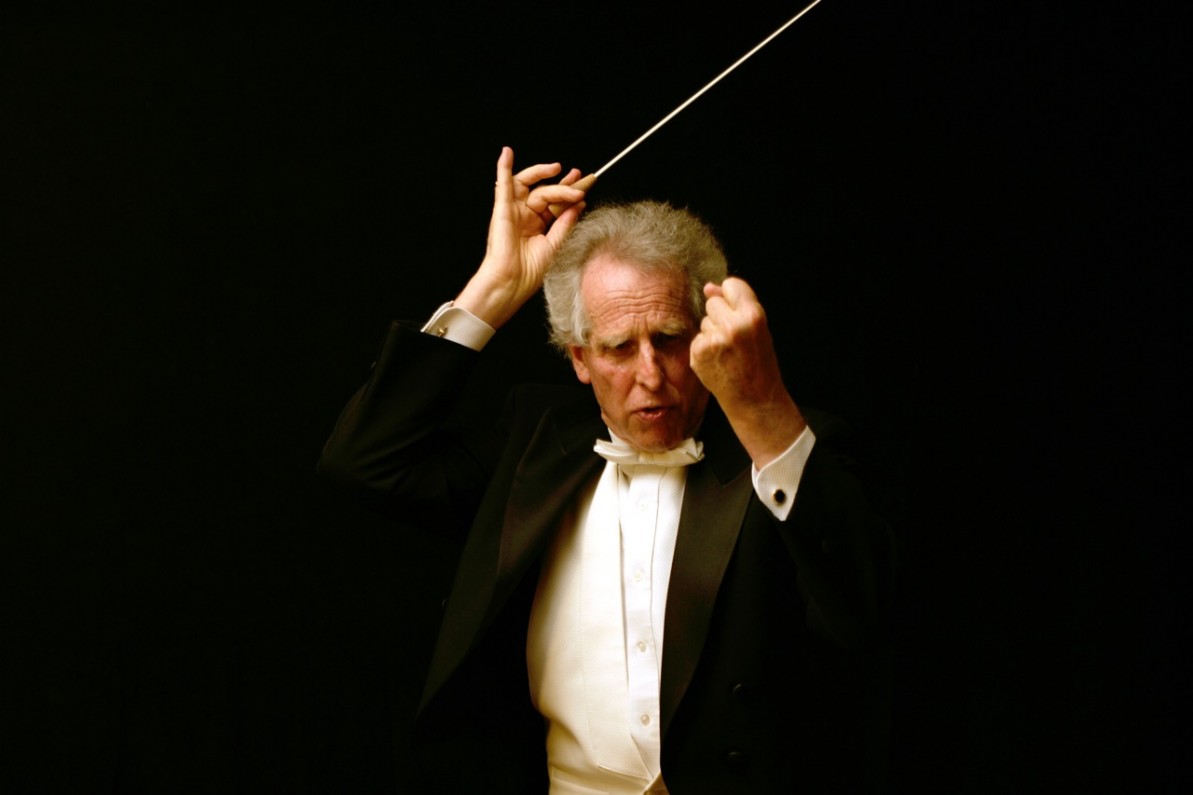

 . He has an interesting perspective on leadership and success:


