Positive Leadership has also been recognised as a Top 50 Leadership Expert to Follow on Twitter.

Follow us on Twitter @posleadership


LEADERSHIP IS A PROCESS OF SOCIAL INFLUENCE, WHICH MAXIMISES THE EFFORTS OF OTHERS TOWARDS THE ACHIEVEMENT OF A SHARED GOAL.

Thursday, January 20, 2011

Earning Respect

Respect is not something that is bestowed upon you.  Respect is earned.

If you have ever had to remind someone that you are in charge; if you have ever had to resort to using the words, "Because I said so;" or if you have ever wondered why your colleagues just aren't listening to you, you need to take a step back and ask yourself if you have worked to earn their respect.

Respect is the ultimate reward for your continued leadership efforts. If you can consistently demonstrate the following behaviours then you’re on the fast track to earning the respect you seek:

  • Treat People As if They Are #1 Leaders focus on making others feel as if they are a top priority.  That means putting down the blackberry, making eye contact and taking the time to really listen to your colleagues’ ideas and concerns.   When you can genuinely communicate in word and deed that you value others, you lay the foundation for a relationship built on trust and respect.
  • Be Predictable - Leaders earn respect when they consistently bring calm to chaos, harness their emotions during stressful times, and bring perspective to challenging circumstances.  When you show others that you can be counted on time and time again, even when times are tough, others will look to you and rely on your positive example.
  • Lead As You Are - Leaders recognise that life is not a popularity contest.   When you have the courage to be who you are – projecting your strengths, improving upon your weaknesses – then you inspire trust, confidence and respect.
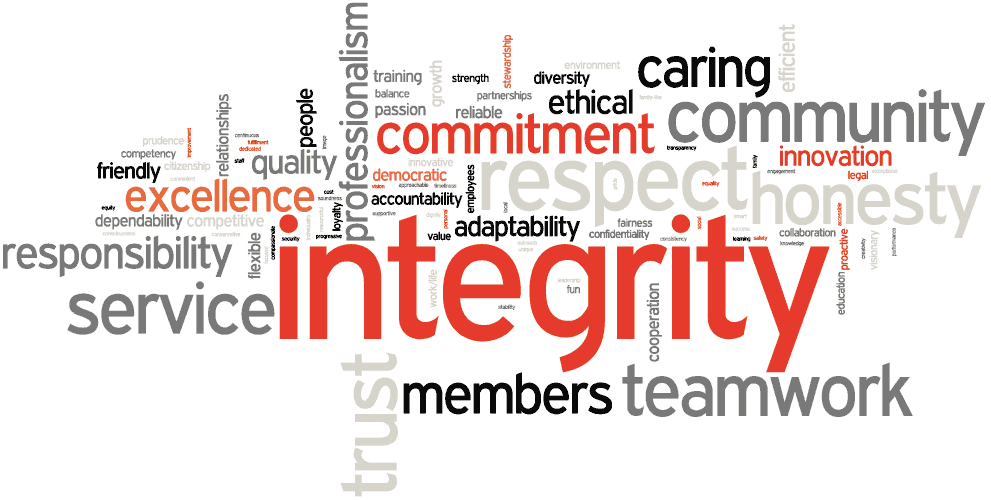
  • Demonstrate Integrity in All that You Do - Respected leaders are those who are able to tell you not what you want to hear, but what you need to hear. They are able to praise positive results, and also able to deliver bad news when it is needed. When you rely upon your integrity to communicate with honesty, compassion, sincerity and directness, you will earn the respect of others.
If you can work to improve upon these four behaviours, you will discover that earning respect will have a profound impact on your leadership abilities.

Share/Save/Bookmark

Wednesday, January 19, 2011

Leaders Live Their Values (part 2)

This is from the Enron new employee orientation package.


Share/Save/Bookmark

Leaders Live Their Values (part 1)


Pure and simple, but not always easy to do - Leaders Live Their Values. That makes them authentic and credible. Unfortunately, some leaders do not walk the talk.

This is from the 1998 Annual Report of one company which failed the test - Enron. (See also - http://www.nytimes.com/2002/01/19/opinion/enron-s-vision-and-values-thing.html )


Share/Save/Bookmark

Tuesday, January 18, 2011

Becoming Extraordinary

How do athletes go from contender to superstar? How do ordinary people become extraordinary? 

Everyone has times when they feel like they are unstoppable, times when they are doing whatever it is they do with ease, grace and incredible skill. But no one, not even the best of the best, can operate in that ideal performance-state 100% of the time.

The secret to achieving extraordinarily high levels of performance is learning how to take command of your mind and body so that you can operate at your peak when you need to, and relax and recover in between. Here’s how:
  • First, goal-setting is a key. Many people don’t like to set goals because they don’t like to fail. However, you must develop mental toughness if you’re going to grow, and setting and achieving goals is one way to do it. 
  • Another way is to develop the ability to get rid of negative thoughts when they occur and substitute images of success and positive results.
  • Finally, sticking to a sensible programme of self-care – including good nutrition, regular restful sleep, built-in periods of laughter and play, and vigorous physical exercise – will do wonders for your self-image.

Share/Save/Bookmark

Monday, January 17, 2011

Dr Martin Luther King Jr on Leadership

As a tribute to the great leadership of Dr Martin Luther King Jr., here are some of his words to reflect on regarding leadership.

LEADING BY EXAMPLE
"People are often led to causes and often become committed to great ideas through persons who personify those ideas. They have to find the embodiment of the idea in flesh and blood in order to commit themselves to it."
"The people are looking to me for leadership - and if I stand before them without strength and courage, they too will falter."

COMMITTED/COMPELLED
"If a man hasn't discovered something that he will die for, he isn't fit to live." 
      
CONFIDENCE
"I have a dream my four little children will one day live in a nation where they will not be judged by the colour of their skin but by the content of their character. I have a dream today!"

COMPOSURE
"The ultimate measure of a man is not where he stands in moments of comfort and convenience, but where he stands at times of challenge and controversy."


Description: http://www.teamcaptainsnetwork.com/public/images/space.gif
CHARACTER
"The time is always right to do what is right."
"There comes a time when one must take the position that is neither safe nor political nor popular, but he must do it because his conscience tells him it is right."

VOCAL LEADERSHIP
"I will not be intimidated, I will not be harassed. I will not be silent, and I will be heard."

SERVANT-LEADERSHIP
"A man all wrapped up in himself is a mighty small package."

CONFIDENCE-BUILDER
"We've got some difficult days ahead. But it doesn't matter with me now. Because I've been to the mountaintop... I've seen the promised land. I may not get there with you. But I want you to know tonight, that we, as a people will get to the promised land."

RE-FOCUSER
"The first thing we must do here tonight is to decide we are not going to become panicky. That we are going to be calm, and we are going to continue to stand up for what is right. Fear not, we've come too far to turn back... we are not afraid and we shall overcome."

TEAM-BUILDER
"A genuine leader is not a searcher for consensus but a moulder of consensus."

ENFORCER
"Injustice anywhere is a threat to justice everywhere."
"We are not asking, we are demanding the ballot... "
"When evil men plot, good men must plan. When evil men burn and bomb, good men must build and bind."

RECOMMENDED READING

For more information on Dr. King and his powerful leadership, read the following:

King: The Photobiography of Martin Luther King, Jr. by Charles Johnson and Bob Adelman 

Share/Save/Bookmark

Having a Positive Influence


A person has a positive influence (and thereby exhibits Positive Leadership™) in a specific situation when they rigorously answer four questions:


  1. What result do I want to create?
  2. What would my story be if I were living up to the values I expect of others?
  3. How do others feel about this situation?
  4. What strategies could I use to accomplish my purpose for this situation?
There are many reasons why answering these questions causes a person to exhibit Positive Leadership™. 

However, a key reason is that when people answer these questions, they create and pursue a purpose that is broadly inclusive of different people’s needs and desires, and they are open to learning how to accomplish that purpose as they go along. 

Share/Save/Bookmark

Sunday, January 16, 2011

Effective Leaders

Effective leaders are those rare human beings who have an emotional commitment to their values and can inspire others to commit to these values too. Leaders develop in organisations that consistently allow managers to live their values at work without the company constantly facilitating the process.  

However, before you can live out your values, you need to determine what they really are and which are most important. Here’s how to get started:

1. Understand your values
 

It’s tough to live a life of consciously-chosen values because there is relentless, seductive pressure to alter your beliefs.

Anybody who has a role for you — as consumer, constituent or manager — stands to profit from you not having a sure sense of self.  After all, when you’re not on your own agenda, you’re prey to the agenda of others. It takes just a little more work to list your personal values, why they are important to you, and which ones really matter the most but it’s important to do so.
 
2. Get support from your people

 If your employees know what your values are and care about them, then you can live them. If they don’t, you won’t.  Translate your leadership values — the meaning of family, integrity, adventure, creativity, spirituality, and health or whatever your values are — into the promise of better working conditions for your employees.  If they want those conditions, they’ll protect your values to help make them happen.
 
3.  Take responsibility

 Leadership doesn’t come with a job title — and you can’t order it on the Internet and can’t just wait for it to happen to you.  Leadership happens when you understand your values and understand how to enrol others in supporting them.  It’s your responsibility to assume an active role in forming your values and then evangelise them to your employees. 

The irreducible essence of leadership is living your deepest personal values every day at work and at home without compromise.  Leaders use those values to make life better for their employees.  This is why people become leaders and why people follow them. 

Share/Save/Bookmark

Saturday, January 15, 2011

Leadership in Education

Teach for America CEO Wendy Kopp speaks in conversation with Stanford University Political Science professor, Robert Reich.


Share/Save/Bookmark

Friday, January 14, 2011

Take "the Other" to Lunch

Elizabeth Lesser is the co-founder of Omega Institute, the US’ largest lifelong learning centre focusing on health, wellness, spirituality, creativity and social change. She’s the author of Broken Open: How Difficult Times Can Help Us Grow

In this talk, she explores the two sides of human nature within us (call them "the mystic" and "the warrior”) that can be harnessed to elevate the way we treat each other. She shares a simple way to begin real dialogue -- by going to lunch with someone who doesn't agree with you, and asking them three questions to find out what's really in their hearts. 


Share/Save/Bookmark

Thursday, January 13, 2011

Core Values

Leading from your own deepest core values is going to increase your performance and the performance of your company. 

This means:

1. understanding your core values
2. sharing them with your team
3. showing your team why bringing them into work makes life better for them
3. encouraging them to bring their core values to work
4. demonstrating that the emotional commitment will greatly increase your team’s performance
5. ensuring your company responds well to increased performance.

Share/Save/Bookmark

Wednesday, January 12, 2011

Get Buy-In by Keeping It Simple

When presenting a new idea or proposal, chances are that you know more about the topic than your audience. When this is the case, it can be tempting to bombard them with data and analysis. But rather than being convinced, your audience is likely to feel overwhelmed. Forget the hundreds of pages of numbers you have to back up your argument and keep it simple. Present your point in a short, uncomplicated, and clear manner. Focus on what the audience cares about and use common sense — not fancy charts and complicated analysis — to win their approval.


Share/Save/Bookmark

Tuesday, January 11, 2011

Setting Up in Business - The Importance of Integrity

In the rush to start a business, keep it running and make money, there’s one important detail that can get lost in the process: integrity. Integrity isn’t something easily monetised, but when it’s implemented into a business’s DNA, there is plenty of money to save and the great potential to make more.

It’s easy to overlook the quality of integrity when running a business -- but incorporating it into all of your business dealings and decisions can advance your company to greater levels of success.

Integrity is synonymous with trust in the business world. After all, clients have to trust the people they do business with to keep them, so owning up to every responsibility is paramount.

The bottom line is consistency. A company needs to maintain what it says it does, and who it says it is.  There shouldn't be an external impression of the business that is dramatically different from the internal version. Especially in rough economic times, to be someone the buying public can trust is priceless. So while it might not seem immediately top on your list, your business can't afford to compromise its integrity in this competitive market. When people choose to lead with integrity they position themselves at the top of their industry. All the other details, like the product, or service, or whatever, come after integrity because people do business with people they know, like, and trust.

Here are a few thoughts on how to keep your integrity at the forefront of your professional life:

Remember that your reputation and relationships are all you really have. So nurture them and care about how you treat people from housekeeping to the most senior person. The proprietor is the best spokesperson for the brand as he/she has put his/her blood sweat and tears into their business and as the face of the brand, the reputation of the owner of the company is as and sometimes more important that the products or services offered.

Be likeable. You don’t have to be buddies, but you should be respected for the person you are – again it comes back to how you treat people. “If you set the example and treat your employees well, you minimise the conflicts involving HR. There’s no issues with sexual harassment, there isn’t stealing of materials, padding expense reports. When you feel you are cared about and you have a voice and an identity in the workplace, it’s easy to put integrity into practice.

Keep a positive online presence. With consumer driven content and social networking dominating the Internet, there’s nowhere to hide. So it’s imperative to keep that integrity through and through. The Internet seems to reveal those who aren’t trustworthy. It’s no longer the case of asking for a recommendation for a plumber from your neighbour. It’s pages upon pages of comments and reviews on various sites -- some more trust worthy than others -- that will really give insight into the experience the customers of the brand had.

Take the defensive out of the equation. You can feel the energy of a dysfunctional and therefore integrity-lacking company by just listening to how people at work communicate. “The tone with which HR and senior management communicate to their employees sets the stage. When integrity is in place and people respect one another details like being on time to work and with deadlines fall into place. It’s not about Big Brother watching over you, but it’s suddenly about you watching over yourself. The power is in the employee. That’s what you get to have control over – how you conduct yourself. It’s behaviour modification in the workplace. And a better workplace ends up being ripe with loyalists working together to grow the business.

Share/Save/Bookmark

Monday, January 10, 2011

Effectively Manage Your Mistakes


Perfection is unrealistic.  If you are attempting to perform to your greatest ability, you are going to make mistakes along the way.  It is not the mistake but rather the manner in which you handle it that shows your strength as a leader.


  • Acknowledge your mistakes.  As soon as you realise that you have made a mistake or as soon as someone brings it to your attention, acknowledge it.  The absolute worst thing that you can do is ignore or attempt to hide it. What is bad today will only be worse tomorrow!
  • Attack your mistakes head on.  Spend time mapping out your corrective course of action before you start blindly trying to fix your error.
  • Take responsibility for your mistakes.  Attempting to divert attention or shift the blame onto someone else will only make you look worse.
  • Learn from the experience.  Reflect upon your mistake.  Ask yourself what you can do to avoid making the same mistake in the future.
  • Don’t beat yourself up.  Mistakes, even big ones, happen.  You may be upset with yourself.  Others may be disappointed.  But at the end of the day, you cannot undo what has already been done.  Go forward knowing that you are a wiser person for it!
Learn to effectively manage your mistakes and you will set an inspiring example for others! 

Share/Save/Bookmark

Sunday, January 09, 2011

Want to Lead? Steer Clear of Rarefied Air


This extract is from an interview with Abbe Raven, president and C.E.O. of A&E Television Networks, which was conducted by The New York Times:


Q. If you had only two or three questions you could ask somebody to decide whether you’re going to hire them, what would they be?

A. Tell me about the biggest mistake you ever made at work, and how did you deal with it. And tell me what, outside of work, are you the most passionate about. And the third would be, tell me a little bit about how you grew up.

Q. Let’s say you’re on a cross-country flight, and you sit down next to someone who, it turns out, is on track to become C.E.O. at her company. And she asks you, “What do I need to know?”

A. I would tell them to avoid rarefied air.


Share/Save/Bookmark

Saturday, January 08, 2011

Leadership Quotes


Share/Save/Bookmark

Friday, January 07, 2011

A Positive Future - By Intent

Do you look at the future with hope and a belief that no matter what comes your way, you will succeed? Or, do you look at the future as hopeless, and there’s nothing that can be done to change it? What you believe has a lot to do with how well you weather the challenges in life. A couple of things to keep in mind: 1) As human beings, we move toward and become like what we think about; and 2) Our present thoughts determine our future.

As human beings, we are teleological or goal-oriented. Also, we are picture-oriented. We think in pictures. If you say, “red apple” you don’t see the words “red” and “apple.” In your mind, you actually “see” a red apple. You see, we don’t see with our eyes. We pick up light with our eyes and then it is translated into images in our brains, depending upon how we’ve been conditioned to translate the light. Words create pictures, and we are drawn to pictures.

So, if you believe the future is hopeless, you will be drawn to every hopeless, depressing, “it’s only going to get worse” story you can find. We are comfortable when we find evidence to prove what we believe is true, and we act in accordance with those beliefs. This is also known as a self-fulfilling prophecy. “I knew it was going to be bad, and it is.”

The same thing holds true if we believe the future is full of opportunity, and that we have the power to make it even better. We will see evidence of the possibilities, and be drawn to them because that’s what we are thinking about. It is not surprising that people who look with positive intent are healthier, happier and more successful.

So, how do we make that switch in belief? It’s all about changing that internal picture you hold, and it isn’t going to happen by accident. It is made, first, by your intent. 

Share/Save/Bookmark

Thursday, January 06, 2011

How to Lead (part 5)

Yale University President Richard Levin and Admiral Mike Mullen on how to lead. 


Share/Save/Bookmark

Wednesday, January 05, 2011

Poisonous Carrots, Blunt Sticks


Author Dan Pink talks about motivating employees, the importance of autonomy, and why the workplace is one of the 'feedback-less' parts of American society.


Share/Save/Bookmark

Success Secrets of Michael Jordan


Share/Save/Bookmark

How to Lead (part 4)

Former IBM CEO Lou Gerstner on leading through change. 


Share/Save/Bookmark

Sunday, January 02, 2011

How to Lead (part 3)

Admiral Mike Mullen, Chairman of the Joint Chiefs of Staff talks to CNN's Fareed Zakaria about how to lead.


Share/Save/Bookmark

Saturday, January 01, 2011

Happy New Year to all Followers of the Positive Leadership Blog


Share/Save/Bookmark

Thursday, December 30, 2010

Preparing for the New Year

As we slowly approach the end of another year, there is once again a discernible feeling of anticipation for what the upcoming year will bring. In many ways, this is quite natural and expected since, like a present wrapped in shiny paper, the start of a New Year often stirs a sense of optimism that better times and new opportunities for recovery, growth and development await us just around the corner.

While leaders use the end of the year to focus on developing plans for what they need to achieve in the New Year, it’s also important that they not lose sight of the lessons learned over the course of the previous one. Indeed, the successes and failures incurred over the past twelve months can provide a wealth of insights that can help leaders chart a clearer path towards their organisation’s goals, provided that they take the time to reflect and review on what came out of these past outcomes.

With this in mind, here are ten questions leaders can ask to reflect and assess both their own performance and that of their employees, and how they can ensure that their team remains focused and driven toward reaching their shared goals:

1. What goals did we succeed in reaching this past year?
2. What goals did we fail to achieve and why? What obstacles did we encounter and how can I help my team overcome them now that we’re aware of these challenges that stand in our way?
3. How many failures did we encounter and did we really learn anything from them? Is there a risk that we’ll repeat them or have we properly addressed and resolved the issues behind our failure?
4. How can I encourage my employees to be more open to failure?  To stepping forward with new ideas for us to test and explore without fearing that the outcome might be not what we hoped for?
5. What unexpected opportunities came up and what did we learn from them? How did my response shape the reactions of those I lead?
6. How consistent was my message to my team? Did I respond to misunderstandings by listening to what was being said and clarifying what I meant?
7. How much time did I spend outside of my office, watching how my team operates and listening to what’s going on around them? How can I make myself more aware of the challenges they face and how it impacts our goals?
8. Did I provide my team with enough opportunities for growth and development? What other measures can I use to improve the coaching/mentoring I offer to my team?
9. What events/moments during the past year opened my eyes to new ideas, insights or opportunities for growth? What can I do to learn more and explore these untapped outlets for growth?
10. Who did I often turn to for support, guidance and calls to action? Can they continue to help me as I move forward? And how can I help them succeed with their goals?

Naturally, there are other questions we can ask ourselves that can help us with assessing what we’ve done and where we can go next. But by asking ourselves these questions listed above, leaders can ensure that their focus is directed on building on their team’s accomplishments, as well as on what they’ve learned through their experiences over the course of the year, both key factors to creating a realistic guide for where we want – and can – grow in the coming year.

With such a guide at their disposal, leaders stand to benefit from not only from having a clear sense of direction of where they need to lead their team over the coming months, but also a keen appreciation for where they’ve been and the lessons learned along the way.

Share/Save/Bookmark

How to Lead (part 2)

Former New Jersey Governor Christie Whitman discusses how to lead in a male dominated world. 


Share/Save/Bookmark