Positive Leadership has also been recognised as a Top 50 Leadership Expert to Follow on Twitter.

Follow us on Twitter @posleadership


LEADERSHIP IS A PROCESS OF SOCIAL INFLUENCE, WHICH MAXIMISES THE EFFORTS OF OTHERS TOWARDS THE ACHIEVEMENT OF A SHARED GOAL.

Friday, January 24, 2014

Positive Leadership: It’s Not Too Late to Reinvent Yourself

Professional reinvention is different later in your career. 

Over-50 professionals who hope to make a transition should consider these tips:


   Overqualified? Own it. Instead of ducking the issue, lead with it. Having been a manager, you understand the pressures and frustrations your potential employer faces, so you can be an even better employee.
  
   Social media is no longer optional. If you don’t have a presence on basic sites like LinkedIn or Twitter, you’re likely to be dismissed as a Luddite. Your social presence is increasingly viewed as a proxy for staying current professionally.

   Connect with your past. Some of the most valuable professional opportunities come from people we’ve lost touch with. In the years since you last communicated, your “dormant ties” have connected with new people and gathered new knowledge. Your history and shared experience makes it more comfortable to reconnect; reach out and reintroduce yourself.


Share/Save/Bookmark

Thursday, January 23, 2014

Positive Leadership: No Standing Still


Share/Save/Bookmark

Wednesday, January 22, 2014

Positive Leadership Leads to Higher Levels of Performance

Positive relationships enhance individuals’ resiliency, their ability to adapt and bounce back from different experiences, create stronger self-identity and more accurate self-assessments, greater degrees of creativity, trust, and openness to new ideas, higher levels of commitment to the organisation, higher levels of energy, learning, cooperation, resource utilisation, cost reduction, time savings and human capital development, as well as higher levels of project performance in organisations.


Share/Save/Bookmark

Tuesday, January 21, 2014

Positive Leadership: Why Leadership Development Programmes Often Fail


This is an excellent article from McKinsey on why leadership development programmes often fail -http://www.mckinsey.com/insights/leading_in_the_21st_century/why_leadership-development_programs_fail

The key reasons?

1. Overlooking context
2. Decoupling reflection from real work
3. Underestimating mind-sets 
4. Failing to measure results

Companies can avoid the most common mistakes in leadership development and increase the odds of success by matching specific leadership skills and traits to the context at hand; embedding leadership development in real work; fearlessly investigating the mind-sets that underpin behaviour; and monitoring the impact so as to make improvements over time.

Share/Save/Bookmark

Monday, January 20, 2014

Positive Leadership: Building Trust as a New Leader

Too many new leaders believe they’re expected to know answers without input or guidance, but many of the best insights on how to fix a company lie with employees further down the org chart. 

Creating a trusting, honest dialogue with these key personnel should be every new leader’s top priority. Meet with as many individual contributors as you can, as soon as you can. Ask simple but effective open-ended questions: “If you were put into my role tomorrow, what are the first three things you’d do and why?” “What are the three biggest barriers to our success, and what are our three biggest opportunities?” Listen intently and take notes. 

Really great ideas can emerge from these meetings — along with some really mediocre ones — and your intent listening will show your employees that you respect their expertise.

For more, see: http://blogs.hbr.org/2013/12/the-best-way-for-new-leaders-to-build-trust/


Share/Save/Bookmark

Thursday, January 16, 2014

Positive Leadership: Staying in Love


"When anyone asks me what I would recommend to anyone to whom they were writing to or speaking with on how to develop themselves as better leaders for the future question, I tell them I have the secret to success in life. 

The secret to success is to stay in love. 

Staying in love gives you the fire to really ignite other people, to see inside other people, to have a greater desire to get things done in other people. A person who is not in love doesn't really feel the kind of excitement that helps them to get ahead and to lead others and to achieve. I don't know any other fire, and other thing in life that is more exhilarating and is more positive a feeling than love is." 

- Major General John Stanford

Share/Save/Bookmark

Wednesday, January 15, 2014

Positive Leadership: The Importance of Rest and Recovery

World-class competitors, from athletes to pianists, limit the arduous part of their practice routine to a maximum of about four hours each day. 

Rest is an equally important part of their training regimen, to restore their physical and mental energy. 

Without rest, our brains grow more depleted, often signified by distractedness, irritability, and fatigue. At work, all too often we try to “push through it,” even though there is no magical energy reserve waiting for us. 

To recharge, take a break; a short rest at midday reboots the brain for the rest of the day. If you can’t take a nap, try mindfulness meditation, which can serve as the mental equivalent of a weightlifting rep. 

Attention is a mental muscle—strengthen it with the right practice. 


Share/Save/Bookmark

Tuesday, January 14, 2014

Positive Leadership: Leading Through The Generations

Regardless of the hashtag used to mark our generation, most of us need:
  • Focus and direction
  • Meaningful work, and the freedom to pursue it
  • Clear, helpful feedback
  • Appreciation
  • A leader who cares about us and has our best interest at heart.

Share/Save/Bookmark

Monday, January 13, 2014

Positive Leadership: Scaling Up Excellence

In Scaling Up Excellence, Stanford faculty Robert Sutton and Hayagreeva "Huggy" Rao tackle a challenge that determines every organisation's success: scaling up farther, faster, and more effectively as a programme or an organisation creates a larger footprint. 

Sutton and Rao have devoted much of the last decade to uncovering what it takes to build and uncover pockets of exemplary performance, to help spread them, and to keep recharging organisations with ever better work practices. 

Drawing on inside accounts and case studies and academic research from a wealth of industries -- including start-ups, pharmaceuticals, airlines, retail, financial services, high-tech, education, non-profits, government, and healthcare -- Sutton and Rao identify the key scaling challenges that confront every organisation.

They reveal how the best leaders and teams develop, spread, and instil the right mindsets in their people -- rather than ruining or watering down the very things that have fuelled successful growth in the past. They unpack the principles that help to cascade excellence throughout an organisation, as well as show how to eliminate destructive beliefs and behaviours that will hold them back.

Robert Sutton is professor of management science and engineering in the Stanford Engineering School. His previous books include Good Boss, Bad Boss: How to be the Best...and Learn from the Worst, and The No Asshole Rule: Building a Civilised Workplace and Surviving One That Isn't. Huggy Rao is professor of organisational behaviour at Stanford Graduate School of Business, and the author of Market Rebels: How Activists Make or Break Radical Innovations.


Share/Save/Bookmark

Thursday, January 09, 2014

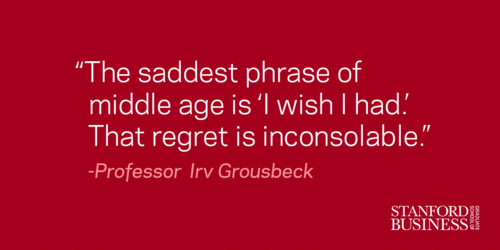
Positive Leadership: No Regrets!


Share/Save/Bookmark

Wednesday, January 08, 2014

Positive Leadership: Making Mistakes

"Next time someone complains that you have made a mistake, tell him that may be a good thing. Because without imperfection, neither you nor I would exist." - Stephen Hawking

Share/Save/Bookmark

Tuesday, January 07, 2014

Positive Leadership: Luck


Share/Save/Bookmark

Wednesday, January 01, 2014

Happy New Year from Positive Leadership!


Share/Save/Bookmark

Wednesday, December 25, 2013

Merry Christmas from Positive Leadership!


Share/Save/Bookmark

Friday, December 20, 2013

Positive Leadership: Congratulations @sallywatsongolf

Apologies for the absence of posts recently but the Positive Leadership team has been on location in Turkey and Morocco helping Sally Watson gain her Ladies European Tour card for 2014 at the LET Tour School.

Congratulations Sally on putting the Values of Positive Leadership to the test so successfully!


Share/Save/Bookmark

Friday, November 29, 2013

Positive Leadership: Never Give Up On A Dream


Share/Save/Bookmark

Wednesday, November 27, 2013

Positive Leadership: Reaching for the Top


Share/Save/Bookmark

Tuesday, November 26, 2013

Positive Leadership: What is Talent?

Talent is a set of personal characteristics that enhance one’s ability to achieve expertise in an accelerated manner.  

These traits allow one to improve at quicker rates than others in their field that are at the same level of expertise/fitness/skill, etc.  This is because talent is one’s ability to adapt to training and develop skills in their specialized field.  

Talent exists when strong genetics and a desire to practice come together to create superior ability for a specific activity.  It can only exist along with a deliberate interest.  Because of this, talent will often only become apparent after a moderate amount of practice as this is when one’s ability to adapt and improve is more clearly visible.  

Share/Save/Bookmark