Positive Leadership has also been recognised as a Top 50 Leadership Expert to Follow on Twitter.

Follow us on Twitter @posleadership


LEADERSHIP IS A PROCESS OF SOCIAL INFLUENCE, WHICH MAXIMISES THE EFFORTS OF OTHERS TOWARDS THE ACHIEVEMENT OF A SHARED GOAL.

Thursday, October 11, 2012

Positive Leadership: The Ten Commitments of Leadership


The Ten Commitments of Leadership

Clarify Values – Affirm shared values.
Set the Example – Live the shared values. Teach others to model the values.
Envision the Future – Imagine the possibilities. Find a common purpose.
Enlist Others – Appeal to common ideals. Animate the vision.
Search for Opportunities - Seize the initiative. Exercise outsight.
Experiment and Take Risks - Generate small wins. Learn from experience.
Foster Collaboration - Create a Climate of Trust. Facilitate relationships.
Strengthen Others - Enhance self-determination. Develop competence and confidence.
Recognise Contributions - Expect the best. Personalize recognition.
Celebrate the Values and Victories - Create a spirit of community. Be personally involved.


Share/Save/Bookmark

Wednesday, October 10, 2012

Positive Leadership: Innovating on a Shoestring


Scott Anthony, president of Innosight, explains how to innovate when time and money are tight.

Share/Save/Bookmark

Tuesday, October 09, 2012

Positive Leadership: How Winners Achieve Success


How winners 'ACHIEVE' success:

A - acceptance; the ability to accept that you do not always succeed the first time and you must keep on trying until you do succeed.

C - criticism; the ability to receive negative feedback and use it positively to affect your performance. 

H - help; use a good coach to work towards your goals - it is not a sign of weakness or lack of ability to use a coach. 

I - inspiration; be inspired by other people. If someone who you often beat wins against you take inspiration that it means you are good enough to do the same.

E - evaluate; honestly take stock of where you are with your skills and then work on the aspects that need to be improved.

V - vivid; have a clear image of what you want to achieve, how you are going to achieve it and who you need to help you to do so.

E - equal; all people have the ability to do great things. Our future is not pre-determined for us. Genetics plays a role but hard work plays an even bigger role.

Share/Save/Bookmark

Positive Leadership Podcast: Delivering Consistent High Performance Under Pressure In Your Business


Exceptional Leadership: Delivering Consistent High Performance Under Pressure In Your Business
Share/Save/Bookmark

Monday, October 08, 2012

Positive Leadership: 12 Signs That Someone Is Not A Good Leader


12 Signs That Someone Is Not A Good Leader:

1. They are not willing to fail.
2. They only talk and never listen.
3. They don’t develop and produce other leaders.
4. They micro-manage.
5. They are generally insecure or threatened by those they lead.
6. They are not willing to follow and learn from their subordinates.
7. They are more focused on what people think about the results, than the results themselves.
8. They don’t have a genuine care and concern for those they lead.
9.  They put policy over people, no matter the situation or circumstance.
10. They are willing to make the wrong decision, for fear of fall-out from making the right decision.
11. They take all of the credit and none of the blame.
12. They only dream about being like others rather than dreaming about becoming who they are capable of becoming.

Share/Save/Bookmark

Friday, October 05, 2012

Positive Leadership: The Wise Leader


Hirotaka Takeuchi and Ikujiro Nonaka, authors of the HBR article "The Wise Leader," explain how the best executives strive for the common good.

Share/Save/Bookmark

Thursday, October 04, 2012

Positive Leadership: Stress Can Be Positive!


Firdaus Dhabhar is a Professor of Psychiatry who researches the mind-body connection at the Immunology Institute and the Cancer Institute at Stanford University. He studies the positive aspects of stress on the body.

Share/Save/Bookmark

Wednesday, October 03, 2012

Positive Leadership: Behaviours Loyal Employees Trust


Here are 5 behaviours for leaders to adopt when struggling to keep employees happy and loyal:

1) Tell the truth. Not everyone is a star. Pick out those with leadership or other valued talent potential and nurture them. This will come back to the business as these individuals, in turn, nurture other workers.

2) Communicate roles and responsibilities. Provide a path to success not only for those with leadership promise but for all employees. Sometimes this will mean difficult changes, but remember the most important skill of a leader: never surprise an employee with bad news. Have a development plan for all, and a get-well plan for those whose performance lags. Make sure everyone knows the plan.

3) Create a workplace culture that values real people relationships. For many employees, workgroup relationships and relationships between managers and workers drive engagement and loyalty more effectively than wearing the corporate branded shirt.

4) Be fair and open. This does not mean treat everyone equally – it means have transparent processes for managing and leading. Employees are more likely to respond positively to change when the process used to manage change is fair.

5) Model the behaviours you seek. Accept your responsibility as a leader and act with engagement, commitment and responsibility. Do this every day.

Each of us possesses skills, strengths, talents and flaws. Each of us seeks to belong, to be engaged, to relate to those around us. Loyalty is built on relationships, shared understanding and trust. Engagement and commitment require loyalty, shared goals and fair treatment. Don’t take loyalty and engagement for granted – create a remarkable culture where there are possible and rewarding outcomes of the workplace.

We are only human after all – Every one of us. Every leader. Every brand. Every workplace. Every person.

Share/Save/Bookmark

Tuesday, October 02, 2012

Positive Leadership: Courage


Share/Save/Bookmark

Monday, October 01, 2012

Positive Leadership: When is the Most Important Part of a Coaching Lesson?


A question for coaches and teachers: What’s the single most important moment of a lesson? 

Is it:
(A) the initial explanation of the skill being taught?
(B) the first couple of tries?
(C) the moment things click, when the learner “gets it”?

We think the answer is (D) — None of the Above.

There’s a strong case to be made that the single most important moment of learning happens before the lesson actually begins.

We know that master coaches are extremely skilled at quickly making a strong emotional connection with a learner, to create the bond of trust that’s the foundation of all learning.

But mere emotional connection isn’t enough. The world is filled with extremely charismatic, fantastically entertaining teachers who are wonderful at creating connection but not so great at actually improving skill.

Because it’s not enough just to capture the learner’s attention — you have to create intention: an urgent desire to work hard toward a concrete goal, toward some vision of their future self.

Science is giving us a peek inside that process. A group of researchers at Case Western were able to look at the brains of learners in two conditions. In the first, the coach was judgmental, and focused on negatives and the past. In the second, the coach was empathetic, and focused on the future.

With the judgmental coach, the visual cortex showed limited activity. With the positive, future-oriented coach, however, it lit up like a Christmas tree. The researchers concluded that this correlated with someone imagining their future.

The takeaway: when it comes to learning, brains work exactly like flashlights. It’s not enough just to turn them on; they have to be pointed toward a target.

A few simple ways to do this:

Encourage expression about future goals. Where do they want to be a month from now? A year? Five years?

Ruthlessly eliminate negative statements — especially judgements — that cause brains to shut down.

Count down until some Big Future Event. How many practices do we have left until the tournament? How many more lessons until the recital?  A calendar with Xs is a powerful tool.

Share/Save/Bookmark

Positive Leadership: We Said It Could Be Done! Self-Belief! Congratulations Ryder Cup Team Europe!


Share/Save/Bookmark

Sunday, September 30, 2012

Positive Leadership: Winning the Ryder Cup


If this Ryder Cup is to be saved by Europe then each of the team has to take inspiration from Ian Poulter and find the champion within themselves. 

It's simply a matter of pride and, of course, passion.

There are few lonelier places in sport than the final day singles of a Ryder Cup. Nowhere to hide, no-one to hide behind. These men are on their own. Still a team but on their own. While stroke play might be the better test of golf, match play is by far the better test of character. 

Twelve points to be won by twelve great golfers. It can be done! Good luck Team Europe!

Share/Save/Bookmark

Positive Leadership: Being a Winner


Share/Save/Bookmark

Friday, September 28, 2012

Positive Leadership: The Challenges of Goal Setting


When you set goals do you struggle to find the right balance between being too tough or too easy?

Here are the “seven deadly sins” of goal-setting, all motivated by the desire to avoid uncomfortable confrontations. 

As you read the descriptions of these “sins”, ask yourself if you recognise any of them in your own dealings with subordinates (or interactions with your boss):

Backing away from tough expectations: You spend more time negotiating the goal downward than in figuring out how to achieve it.
Engaging in charades: You and your people know from the beginning that the goal is just an exercise to convey the appearance of progress, but there’s no hope of achieving it.
Accepting seesaw trades: When your people take on one goal, they are relieved of another one.
Setting vague or distant goals: The time frame is not explicitly defined or set too far into the future, so no one takes it seriously.
Not establishing consequences: You don’t really differentiate between those who successfully achieve goals and those who do not.
Setting too many goals: By assigning an overabundance of objectives you allow subordinates to pick and choose the goals that they either want to do or find easiest to do — but not necessarily the ones that are most important.
Allowing deflection to preparations, studies, and research: You allow people to spend time planning instead of committing to a real goal.

Setting specific goals in a clear and compelling way — and insisting that people work together to achieve them — is the best way to get results.

Are you putting the right kinds of demands on your people, or are you committing some of the deadly sins?

Share/Save/Bookmark

Thursday, September 27, 2012

Positive Leadership: Assessing Team Performance and Potential


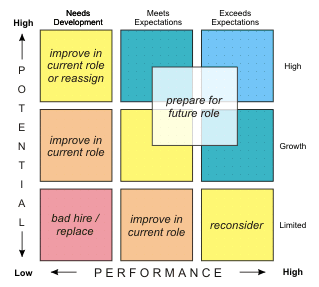
The performance and potential matrix (9 box model) is one of the most widely used tools in succession planning and development. It can be a valuable tool for anyone who works in talent management, or for any manager.

The performance and potential matrix, commonly referred to as “the nine box”, is a simple yet effective tool used to assess talent in organisations. It assesses individuals on two dimensions – their past performance and their future potential.

The X axis (horizontal line) of 3 boxes assesses leadership performance and the Y axis of 3 boxes (vertical line) assesses leadership potential. A combination of Y and X axis makes up the box within the grid that the leader is placed. 1A - High Performance/High Potential, 3C - Low Performance/Low Potential, etc...

The tool is best if used by a team and facilitated by someone who has experience with the process. 


For more, see: http://www.linkageinc.com/thinking/linkageleader/Documents/Jon_Warner_Using_a_Performance_and_Potential_Grid_to_Guide_Coaching_Interventions.pdf


Share/Save/Bookmark

Wednesday, September 26, 2012

Positive Leadership: Top-Ranked Leadership Companies Perform Better


Key takeaways from Chief Executive’s 2012 40 Best Companies for Leaders report:  

  • The best companies for leaders generate dramatically greater market value over time than the weakest companies for leadership development.
  • Leading public company CEOs commit a higher priority to leadership development in spite of the added burden of more complex and “distracting” environments with added pressures for short-term financial results.
  • Smaller and private company CEOs spend more of their personal time (25 percent versus 15 percent) on both developing others as well as developing themselves, but are less likely to install systematic processes for leadership development.

Top-Ranked Leadership Companies Perform Better
Summary 10-year performance comparisons*
Chief Executive/Chally Worldwide
Best Companies for Leaders Survey Ranking
Average % Market Capitalization Growth
Top 15% of Resopnding Companies+22%
Bottom 15% of Resopnding Companies-23%
*Includes companies where public data is available for 2001 through 2011. Reasons for unavailable data include merger, acquisition or start-up within the period. A full survey report is available at www.chally.com.


Share/Save/Bookmark

Positive Leadership: Exceptional Leadership


Share/Save/Bookmark

Tuesday, September 25, 2012

Positive Leadership: Accountability


Developing colleagues who are accountable to themselves and your team is a huge factor to creating a winning culture in any organisation. 

Here are some thought provoking quotes on accountability you can use with your team:

“Responsibility equals accountability equals ownership. And a sense of ownership is the most powerful weapon a team or organization can have.”  Pat Summitt, Former Tennessee Women’s Basketball Coach

“When your teammate looks you in the eye and holds you accountable, that’s the greatest kind of leadership there is.” Doug Collins, Philadelphia 76ers Coach

“In putting together your standards, remember that it is essential to involve your entire team. Standards are not rules issued by the boss; they are a collective identity. Remember, standards are the things that you do all the time and the things for which you hold one another accountable.” Mike Krzyzewski, USA Men’s Basketball Coach

“Everybody is going to have to be accountable. If you’re on the field, you have to give me 100 percent. Always. We have to weed out the bad seeds, point blank. If you can’t give me what I’m giving you on the field, I don’t need you on the field with me. I have no problem telling that guy I don’t need him on the field, and I have no problem going to tell Bill (Belichick) I don’t want him on the field. That’s how you win.” Vince Wilfork, New England Patriots

"Coach Belichick holds us accountable everyday. We appreciate when he's tough on us. He gets the best out of us." Tom Brady, New England Patriots

“The most important quality I look for in a player is accountability. You’ve got to be accountable for who you are. It’s too easy to blame things on someone else.” Lenny Wilkens, Former NBA Basketball Coach

“Leaders must develop a lower threshold for alibis and become better communicators and enforcers of what they want done. If you are more interested in being liked and popular than holding people accountable for results, you have a serious leadership weakness. It is not your job to make people happy. Your job is to get them better. Holding people accountable to high standards and results is nothing to apologize for. Failing to stretch them to their potential is.” Dave Anderson, Author of No-Nonsense Leadership

“New cadet, you are allowed four responses: ‘Yes, sir,’ ‘No, sir,’ ‘No excuse, sir,’ and ‘Sir, I do not understand.’ New cadet, what are your four responses?” It takes a couple of tries before the neophytes learn the codes. It will take a little longer for them to stop trying to explain things. In that phrase, “No excuse, sir” (or “ma’am”) is an early, critical lesson. Take responsibility for your actions. Always. No matter what the consequences. Ed Ruggerro, Author of Duty First

“The big thing that we want is someone who is willing to be accountable on a daily basis.” Jim McElwain, Colorado State Football Coach

“It is not only what we do, but also what we do not do, for which we are accountable.”  Moliere

“Our tradition calls for a commitment to accountability. This is not an assumption – this is a promise that I will be there for you; and I can count on you being there for me.”  Bob Ladouceur, De La Salle High School Football Coach

“If you’re going to lead, you need to make goals.  And those goals can’t come from the top down, they’ve got to come from the people who are responsible for achieving them.  Your job is to help them get there, and remind them every day what their goals are, and what they have to do to make their dreams come true.  Sorry, but showing them a slide once a year about what you think their goals should be just doesn’t cut it, and it never will.  Their goals have to come from them, and those goals have got to be in their bones. Trust your people with that crucial responsibility, and they will never disappoint you.  Far from it, they will almost always set the goals higher than you would have ever dared – and then they are the ones who are accountable for their goals!” Bo Schembechler, Former Michigan Football Coach

“Being there every week for my teammates is really important to me. It's about accountability.” Peyton Manning, Denver Broncos

“There is nothing hard-hearted about holding people accountable for high standards and making tough, agonising decisions concerning yesterday’s heroes who no longer contribute. It’s tough love. Leaders must care enough about their people, their futures, and the welfare of the organisation. You’re not getting paid to maintain anyone. You are paid to lead and stretch them. Do your best to motivate and equip these people to perform, but if they don’t, you must stop hugging and burping them and take swift, appropriate action to cut your losses. Dave Anderson, Author of No-Nonsense Leadership

“All that is necessary for the triumph of evil is that good men do nothing.” Edmund Burke, Irish Statesman

Share/Save/Bookmark

Monday, September 24, 2012

Positive Leadership: Today's CEO


Today's CEOs must:

Empower employees through values
Engage customers as individuals
Amplify innovation with partnerships

Source: IBM 2012 Global CEO Survey

Share/Save/Bookmark

Friday, September 21, 2012

Positive Leadership: Curiosity


Share/Save/Bookmark

Thursday, September 20, 2012

The Values of Positive Leadership

Financial performance is linked to organisational performance and organisational performance is reinforced by the Values of Positive Leadership™.

Share/Save/Bookmark

Positive Leadership: How Honest Are You With Yourself?


How Honest Are You With Yourself?

Answer on a seven-point scale, with 1 being 'not true,' 4 being 'somewhat true,' and 7 being 'very true.'

1. My first impressions are always right.

2. I don't care to know what other people really think of me.

3. Once I've made up my mind, other people can seldom change my opinion.

4. I am fully in control of my own fate.

5. I never regret my decisions.

6. I am a completely rational person.

7. I am very confident of my judgments.

ANSWER KEY: For each question, give yourself one point for answering 6 or 7. The higher your score, the more self-deceptive you tend to be.

SOURCE: Del Paulhus, University of British Columbia


Share/Save/Bookmark

Wednesday, September 19, 2012

Positive Leadership: Greatness

                 
Share/Save/Bookmark

Tuesday, September 18, 2012

Positive Leadership: Finding Thinking Time


Former British Prime Minister Tony Blair discusses the advice he received from Bill Clinton about the need to schedule time to think strategically. He spoke at the Stanford Graduate School of Business with Stanford GSB Dean Garth Saloner.


Share/Save/Bookmark