Positive Leadership has also been recognised as a Top 50 Leadership Expert to Follow on Twitter.

Follow us on Twitter @posleadership


LEADERSHIP IS A PROCESS OF SOCIAL INFLUENCE, WHICH MAXIMISES THE EFFORTS OF OTHERS TOWARDS THE ACHIEVEMENT OF A SHARED GOAL.

Tuesday, October 19, 2010

Finding True, Positive Leadership

Most people see leadership as something people do in front of others, but true leadership starts within each of us. It starts with knowing your true purpose and aim and then acting on that knowledge in a way that remains true to your core values.

True, Positive Leadership involves:

Thinking – a true leader will dig deep inside to gain knowledge about herself in order to learn what her core values are. If you do not know yourself, you cannot lead else effectively.

Feeling – true leaders have a deep capacity for understanding the plight of others because they are completely honest with themselves that they are not perfect; therefore, they are able to find compassion, acceptance, and forgiveness for others.

Doing – true leaders allow deep and meaningful experiences in life so that they are able to engage fully in activities that enable them and others to realise their full potential.

If you are missing this kind of joy and fulfillment in your life, perhaps it is time to do the work that needs to be done to reach your highest potential.

Ask yourself the following questions:

·         Have you sought to look within to find your own core values and convictions?
·         Have you fully examined the logic behind your views?
·         Do your convictions match up with values that uplift humankind?
·         Do your actions match up with your convictions?
·         Are you living your life as a leader in private and in public?
·         Do you feel as if you are merely surviving or thriving?

If you are unsure about your answers, seek to empower yourself through books, education, seminars, counseling, life coaching, and/or positive and powerful friendships of like-minded people.

If you are currently unhappy with your place in the world, try new experiences, new friends, and new ways to break out of whatever is holding you back.

Do not give up because once you find your leader within you will be able to move from survival, begin to thrive, and live the life you want.

Share/Save/Bookmark

Monday, October 18, 2010

The 1000th post on the Positive Leadership Blog

Here are nine ways Social Media has helped Positive Leadership, and can help you too:

1.  Blogging about leadership organises and crystallises your thoughts.
2.  Reading other leadership blogs adds to your knowledge base.
3. Social Media is a great place to road test your ideas.
4. Talking about leadership with other leaders helps to shape your vision.
5. You get to talk to (and learn from) other leadership gurus.
6. Being an active participant in the medium keeps you up-to-date and in the loop.
7. Personally monitoring the thoughts and comments of your clients and customers is a big advantage.
8. Social Media gets you more opportunities to lead.
9. There is no better way to work on your communication.

Share/Save/Bookmark

Sunday, October 17, 2010

UK leaders lag behind in the first global ranking of leadership effectiveness

The leaders of UK organisations are seen as less effective than their counterparts in India, China, Russia, the United States and Germany, according to a worldwide study by the Kenexa Research Institute (KRI).

The Kenexa Research Institute’s 2010 WorkTrends research report, entitled Exploring Leadership and Managerial Effectiveness, identifies what ‘followers’ want from their leaders and managers and it includes a global ranking of leadership effectiveness, showing which countries and industry sectors have the highest-rated leaders.

The study identifies ten ‘drivers’ of effective leadership - the characteristics that followers look for in their leaders. These include the ability to inspire trust and confidence; to value quality and customer service; to be open and communicative; to have a multi-stakeholder perspective, and to hold lower-level managers accountable for being ‘good managers’.

As part of the study, KRI created and applied a Leadership Effectiveness Index, which measures the extent to which employees believe their leaders communicate their vision, handle challenges, value employees, are committed to improving quality and inspire trust. According to this Index, India and China have the world’s most effective leaders.

The UK ranks 17th out of the 21 countries surveyed. The UK Leadership Effectiveness Index score (47%) lags a notable 25 percentage points behind India’s score (72%) and is below the global average score of 55%.

The study shows that, in the UK, effective leaders are mostly found in the manufacturing, healthcare and retail sectors. Government and financial services have the lowest rankings of leadership effectiveness.

The research also identifies the key priorities for leadership development. The two most significant are the need to build leadership trust and the need to engage in open, honest, two-way communication.

As well as focusing on leadership, Kenexa has also created a Managerial Effectiveness Index, which measures aspects such as a manager’s performance, their people and work management skills and whether they are trustworthy and inspirational. The results show that, according to employees, the most effective managers are those who are fair, communicative and involving, act as problem-solvers, provide recognition for a job well done, support employee growth and development and in general demonstrate an employee orientation.

Kenexa’s study highlights that effective leadership and management have a positive and significant impact on important financial performance metrics for organisations, such as diluted earnings per share and total shareholder return. They also have a beneficial and substantial influence on employee engagement and on organisational creativity and innovation. The study found that employee engagement levels can be five times higher if your leaders are more effective.


Share/Save/Bookmark

Saturday, October 16, 2010

Prioritising Leadership Development

Here are 7 compelling reasons to take seriously, to invest in, and to put priority on leadership development.

1. Leadership makes a difference.
The more change that lies ahead, the more important great leadership will be. The quality and quantity can be improved through development.

2. Companies can’t always find outside or buy the leadership they need.
If they do, it is expensive and does not come with a money-back guarantee. Sports teams can rarely buy a championship. In business, success in one company does not always translate to success in another.

3. Derailments are expensive.
The higher the level, the more expensive they are. Costs include wasted salary, relocation expenses, finding and installing a replacement, buy-out packages, damage to morale and productivity, and many other intangibles.

4. Survival of the fittest is not the same as survival of the best.
Leaving leadership development to chance is foolish. There just are not enough potential leaders around to allow most of them to drown with no assistance.

5. Most of the cost of development is sunk.
Leadership development is already taking place within any organisation (job changes, stretch assignments, making mistakes, and role model bosses). Not to reap a return on the investment is bad business.

6. Creating a learning environment is consistent with business strategies that involve having employees take on more responsibility, assume more risk, and solve problems.

7. It's good business practice.
Investors consider the quality of a company’s management. Talented people prefer to work for companies that invest in their development. Customers prefer to work with companies that can solve their problems. Companies like that have strong cultures that place high value on leadership.

Share/Save/Bookmark

Success Takes Time

Instant Success Takes Time - new products, people, or ideas that appear to burst on the scene unheralded and soar to the top quickly have often been preceded by a long period of preparation, rehearsal, and trial-and-error experimentation.

One of the more mundane differences between perpetual winners and long-term losers among businesses, sports teams, and other organisations is that the winners simply work harder.  Winners are more likely to take the time to keep honing skills and testing ideas in preparation for change. That's not too dramatic or glamorous, but it's among the biggest differentiators.

In contrast, teams or organisations headed for losing streaks lurch from tactic to tactic without any apparent long-term direction. They lack discipline, do not always rely on facts before chasing fads, and panic under pressure.

Those building winning streaks remain calm and professional. Winners learn and experiment in a disciplined manner with a commitment to enduring principles and a long-term purpose that help them be patient on what can be a long road to victory.

Eventual winners have invested in three underpinnings of confidence:

First is accountability. They have faced facts honestly and taken responsibility for their own actions.

Second is collaboration. They make allies and partners, not enemies.

Last but not least is initiative. They encourage constant small innovations rather than relying only on the occasional blockbuster hit.

In short, winners are not necessarily flashy nor endowed with the hottest new thing; they are simply steady, disciplined, and prepared. They have some "instant successes" but even better, they have fewer outright failures. They bounce back faster from setbacks and can weather attacks because they stand on a firm foundation.

Share/Save/Bookmark

Friday, October 15, 2010

Executive Leadership and Business Performance

Efficiency and productivity are strategic imperatives in every corner of industry—from energy consumption to business processes and everything in between. How any and everything connects to the bottom line is fair game for scrutiny or is it?

What about the effects of executive leadership style and resulting corporate culture? Do certain leadership styles have a competitive edge? Could CEO as brand actually kill a company? Which Silicon Valley companies are best positioned for success, and which could be at a disadvantage? This is an insightful and spirited discussion about the psychology of executive leadership style and corporate culture, and their effects on business performance.

Speakers:
Bill Campbell, Chairman of the Board, Intuit
Gordon K. Davidson, Chairman, Fenwick & West, LLP
Daniel Denison, Professor of Management and Organization, IMD; CEO, Denison Consulting
Kavin Stewart, Co-founder & CEO, LOLapps

Moderator:
Rebecca Turner, Professor of Organizational Psychology, MGSM, Alliant International University; Owner, Turner Consulting Group


Share/Save/Bookmark

Failure Is An Essential Part of Process


Outsourcing giant Wipro chairman, Azim Premji fosters an environment in which workers feel safe taking risks.


Share/Save/Bookmark

Thursday, October 14, 2010

Helping Women Climb the Corporate Ladder

Most company employees will be familiar with the colleague who talks a lot at meetings, frequently in the first person: 'I have done this' or 'I will do that'. More often than not, that colleague will be male.

"Men are typically better than women at impression management – or the art of managing one's reputation and image," says Halla Tomasdottir, an Icelandic businesswoman who founded Audur Capital, an investment company that survived the country's financial meltdown. "Women, or men, who say 'We did this deal' rather than 'I did this deal' often make better leaders – but the world of business and finance frequently values a more masculine approach – where you blow your horn more."

Mentoring – the process of guiding and supporting a less senior colleague – has come to be seen as central to helping more women break into male-dominated boardrooms. 


Share/Save/Bookmark

Chile's Heroes Have a Lesson for Rio and Co

If the stream of remarkable footage from Chile can teach Rio Ferdinand and his bungling England football comrades anything, it is in its ultimate expression of positive leadership and what it means to be a team.


Share/Save/Bookmark

Women and the Transition to Senior Management


Here is some advice from Positive Leadership on how women can best make the transition to senior management:

Anticipate transitions. At a certain point in your career, you will be expected to move beyond managing and will need to demonstrate leadership capability to move into the senior ranks. Instead of simply ensuring efficiency, planning and organising staff, you will need to create a vision for change and then inspire your team to bring it to fruition. These role shifts can be difficult to see. Watch out for them.

Development isn’t just about your skills. You won’t succeed in senior management if you rely solely on what got you this far. Two common hurdles for high-potential women include adopting a strategic perspective and managing stakeholders. Big-picture thinking and learning how to create influence through coalitions and networks are key to leadership success. Get on assignments that are key to the success of your company, as well as cross-functional projects that bring together diverse stakeholders from across the company.

Watch out for identity traps. Another common trap for women during the transition to senior management is that they fall victim to their natural leadership style. You’ll need to knock off the micromanaging, learn how to delegate and cultivate the ability to influence without authority.

Authenticity is also about your future self. It takes 15 seconds for a person to form an opinion about you. Think about how you want to be perceived and manage your image accordingly. Keep in mind that it is particularly difficult for women to be perceived as both competent and warm. Networking can also be a challenge for women, but growing your strategic network is essential. Cultivating mentors is also key to future success in senior management. 

Share/Save/Bookmark

Treating Customers and Employees Well

Most of the U.S. airline industry is under assault from skyrocketing fuel prices and a sluggish economy, but the message that Southwest Airlines president Colleen Barrett brought to the recent Wharton Leadership Conference was about the importance of treating employees and customers well. 

Innovative leaders such as Southwest chairman Herb Kelleher and smart management of non-human resources -- especially Southwest's fuel purchasing hedges that have saved the company more than $2 billion -- have certainly helped the airline post profits for 35 consecutive years. But the foundation for all that, she said, has been making the satisfaction of employees and customers the highest priority.


Share/Save/Bookmark

Wednesday, October 13, 2010

Positive Leadership is an Effective Motivator

A recent McKinsey & Company research study, titled, Motivating people: Getting beyond money, has found that positive leadership attention, along with praise and commendation from a person’s immediate manager, are the most effective motivators available in any organisation. In fact, McKinsey has found that they outperform financial incentives.

Based on a global survey of executives, managers and employees from a range of sectors, 67% of respondents rated ‘praise and commendation from immediate manager’ as an effective motivator, 63% rated ‘attention from leaders’ as effective, and 62% rated ‘opportunities to lead projects or task forces’ as effective. By contrast, 60% of respondents rated ‘performance-based cash bonuses’ as an effective motivator, 52% rated ‘increase in base pay’ as effective, and 35% rated ‘stock or stock options’ as effective.

For more information on how Positive Leadership can help you become a high performer, please contact: graham.watson@positiveleadership.co.uk

Share/Save/Bookmark

Create Candor in the Workplace

Jack Welch, former chairman of General Electric and author of  WINNING tells his audience to foster honest feedback: "If you reward candor, you'll get it."


Share/Save/Bookmark

Tuesday, October 12, 2010

Attitude


Share/Save/Bookmark

Maximising the Value of Investment in Leadership Development

Here are a few ideas to make sure your investment in becoming a positive leader is optimised:

1. Make a public declaration

Share your plans with your manager, colleagues, significant others, whatever. Let them know what you are working on and ask for their support. Once a goal is made public, you’ll feel more accountable to make it happen. As an added bonus, research has shown that managers that share their development goals with others receive higher follow-up scores on surveys than those that don’t.

2. Get an “accountability partner”

Find someone who can help hold yourself accountable. It could be your manager, a peer, a coach, a friend, or a family member. Make an agreement to call each other at a regular interval and check in on each other’s progress. Ask each other a series of yes/no questions for every goal, covering all aspects of life (development, business, fitness & health, spiritual, personal). This process works great when it’s implemented at the end of a training programme.

3. Track and measure your progress

Try to make your goals measurable, and keep a log of progress. Then, establish your own rewards, or positive consequences, for when you hit key milestones along the way.

Share/Save/Bookmark

Monday, October 11, 2010

10 Aspects of Executive Presence

Genuine. Open, straightforward, comfortable in your skin; no sugar-coating.
Passion. You love and feel strongly about what you do and how you do it.
Clarity. Communicate thoughts, feelings, and insights in crystal clarity and simplicity.
Intelligence. No way around this one, and yes, it shows through.
Insight. Ability to boil complex factors and mounds of data down to rare conclusions.
Determination. Driven and full of purpose, determined to achieve and succeed.
Confidence. Not overconfident, but with enough self-doubt to be objective.
Humility. Willingness to admit mistakes, misjudgment, fear, and uncertainty is endearing.
Courage. Willingness to take risks and take a position against considerable odds.
Humour. Not over-the-top, but in the right measure, brings down other’s defences.

Share/Save/Bookmark

Sunday, October 10, 2010

Fear

A lot of people are afraid of failure, but do you know anyone who's afraid of success? Let's talk about this rather common problem.

Abraham Maslow, one of the 20th Century's great psychologists, called it a "Jonah Complex," because Jonah chose to turn his back on the great things God had planned for him. Of course, the Bible tells us that Jonah eventually found himself inside the belly of a great fish, but most people who fear success eventually find themselves consumed with regrets for things that might have been.

We turn away from the challenges that will bring us success for many reasons. Mainly, we just don't believe we have what it takes to pull it off. Our self-efficacy is low, which means we have a low estimation of what we can cause or bring about.

However, self-efficacy can be improved. You can do it by remembering successes you've had in the past and imagining yourself repeating similar successes in new situations. Make a list of all the qualities you possess that you consider to be strengths, and surround yourself with people who believe in you and what you can do.

You see, you can take on challenges that are bigger than you are right now and then grow into them. And you can control your self-talk and your negative thinking so that you don't stop yourself before you start. Live your life in the present so that you'll have no regrets in the future. 

Share/Save/Bookmark

Saturday, October 09, 2010

What Drives Our Leadership Impact?

“Where others see hierarchies, the new leaders see connections”, writes Emmanuel Gobillot in his book, The Connected Leader: Creating Agile Organisations for People, Performance and Profit.

What differentiates a connected leader is the way in which they impact and influence those around them and this is largely determined by the way in which they view good leadership. More than even our individual skill-set, how we see the role of leadership greatly determines the impact we have on others and the success we will have as leaders.

Our impact is the result of a number of factors. Using the iceberg metaphor, above the waterline for all to see, are skills and knowledge. Gobillot writes; “Skills and knowledge are important because they give the leader the ability to take part in the game. On their own, they do not differentiate between average and superior performance…. But it is below the waterline that the real differentiators lie. …Below the waterline, the drivers of impact can be found. Performance will differ depending on how people see their role. If doctors believe that their primary role is solving problems, their behaviour is likely to be different from that of surgeons who see their roles as healers.”


We need to examine our beliefs if we are to change our impact and effectiveness with those around us. 

Often we adopt the "smartest person in the room" or "the leader of all leaders" mind-set when thinking about leadership. With this mentality we won't have the necessary ability to work well with other leaders and  develop community. As Jean Lipman-Blumen wrote in Connective Leadership: Managing in a Changing World, "leaders cannot just issue orders; instead, they have to join forces, persuade, and negotiate to resolve conflicts."

Your ability to do this is largely determined by the "below the waterline" type factors.

Share/Save/Bookmark

Why Good Boards Aren't There When You Need Them

There has been a lot of talk about governance in the wake of the financial crisis. People have been wondering: where were the directors when numerous financial institutions bet the proverbial mortgage on, well, mortgages and their related products? Those directors are supposed to be there to defend the shareholders against self-interested executives trying to maximise their personal compensation by taking excessive risks.

We thought that we had board oversight in hand after the last crisis. We tightened up governance dramatically, for example with Sarbanes-Oxley in the USA: more scrutiny, more independent directors, financial experts on the audit committee, etc. With SOX behind them, boards should absolutely be able to do the job. Shareholders should have good protection.

But there's a flawed assumption buried under the logic of SOX, which is that it assumes a relatively random distribution of smart, experienced people smeared across boards like peanut butter. In other words, every board should, on the whole, have at least one or two smart, experienced independent directors. 

It is worth examining that assumption, because it is the soft underbelly of board governance.


Share/Save/Bookmark

Friday, October 08, 2010

Four Presentation Tips from Obama's U.N. Speech

In many ways, when President Obama stood up to deliver his address to the United Nations on September 23, he faced challenges similar to a business leader working inside a multi-national corporation. He's addressing a group of rough equals (who nonetheless form a hierarchy); he wants to move an agenda forward, and to do so he has to combine persuasion and truth in a delicate mixture. 

Business leaders can learn four lessons from the way in which Obama approached his task:

1. You can gain leverage with your colleagues by telling the truth rather than sticking to familiar cant.

All companies, like all countries, deceive themselves in ways large and small, and form tacit agreements to leave certain uncomfortable truths unsaid. Anyone who is willing to say them can wield power.

2. Finding the simplicity amidst complexity will allow you to set the agenda.

After setting the record straight on a number of issues, Obama announces "four pillars" — non-proliferation and disarmament; the promotion of peace and security; the preservation of our planet; and a global economy that advances opportunity for all people — that then form the basis of the rest of his talk. Inevitably, this simple announcement will set the agenda for many discussions that follow.

3. When you're dealing with a difficult crowd and contentious issues, give a few presents away early on.

The United States has been quixotic in its treatment of the United Nations — like many other nations — using the world body when convenient, and ignoring it when it wasn't helpful. That cavalier attitude has created ill will toward the United States in the UN. Obama's announcement that the US would pay its bills and re-engage with the UN was shrewdly calculated to sweeten the pot and create some good will. Similarly, an executive can create a warmer atmosphere by unilaterally giving away some corporate goodwill early in the talk to sweeten the pot. Address nagging issues that don't cost you very much but have symbolic import.

4. Once you've told the truth, sweetened the pot, and kept it simple, it's time to ask for the hard things.

A well-crafted speech doesn't make the difficult demands until the right atmosphere has been established. And because we have a deeply ingrained need to be reciprocal, never ask for something until you've offered something free first.

Share/Save/Bookmark

Managing in the New Economic Order

Here are some thoughts on how to manage in the new economic order post recession:

Stay flexible. Managers will need a flexible organisation, so that it can be repositioned quickly to address new threats and master new challenges. You will have to be prepared to re-evaluate your mission, strategy and goals more frequently than before, in order to adjust to the uncertain and changing environment.

Devour data. Managers will need to have their "ears to the ground" in order to hear changes as they are coming. That means you'll need to seek out fresh sources of information, intelligence and data. 

Be (somewhat) humble. Managers will not be able to assume they know the answer -- because more often than not, they won't. You'll need to be willing to hear hard truths from your employees, your customers, your suppliers and anyone else closer to a changing marketplace than you are.

Communicate. The days of keeping your head down as a manager, focusing on operations instead of external communications, are over. More than ever, managers have to become advocates. Critics will abound, and you'll need to be able to rally the support of your employees, your customers and clients and a whole array of outside stakeholders to survive and thrive.

Plan for contingencies. It's natural for people to focus on what they know, but as a result, we time and time again fail to take into account what we don't know. With rising uncertainty, the advantage goes to those who can imagine the improbable. Keeping cash and other resources on hand for emergencies will also become increasingly important.

Be proactive. If you see a problem coming, don't wait until it hits you...by then it will be too late. You will need to be prepared to react quickly.

Insist on candor. To succeed in an uncertain and rapidly changing environment, it's critical that everyone in an organisation be brutally honest. There's no time for dealing with the small lies that people routinely use to burnish their own record or avoid offending others. Everyone needs to know exactly where things stand at all times.

Stay involved. At times like the present, no manager can afford to be seen hiding in his or her office. It's important that you be seen out among your employees, in part to give them confidence, and in part to collect necessary intelligence.

Keep your organisation flat. It was a good idea before the new era; it's critical now. You can't afford to have layers of bureaucracy between you and the action. That will guarantee that you are too slow to react.

Cross-train your talent. Good managers have been knocking down silos in their organisations for years. But again, what used to be a good practice is now essential. You need people with multiple skills, who aren't qualified for just one narrow task, and who can be redeployed as the situation demands it.

Assess your team. Few organisations can afford to have people who aren't pulling their weight. You need to be constantly reassessing your team, making sure you encourage and promote the best, and dealing quickly with those who aren't contributing.

And finally...

Use your judgment. No team of Ph.D. students building computer-powered mathematical models will ever be a good substitute for common sense. You didn't have to be a rocket scientist to know it wasn't a good idea to make housing loans to people who put no money down, or to waive rules requiring them to document their income, or to make loans with payments that would balloon in two or three years when they couldn't afford the balloon payments. The bankers who survived this crisis weren't the ones with the most sophisticated risk models, but rather the ones who kept their heads.

Share/Save/Bookmark

Thursday, October 07, 2010

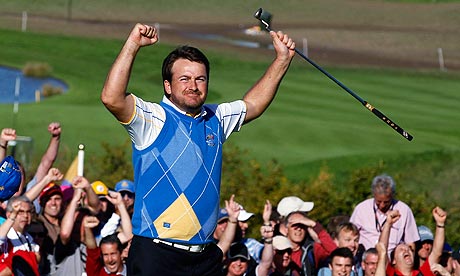
Ryder Cup = Passion


Share/Save/Bookmark

Talent Showdown

Boasting about rigorous recruiting policies has been sport at the city’s premier financial firms for decades. Even Oxbridge graduates aren’t guaranteed a job interview at blue-ribbon institutions. Instead HR departments pore over cv's for signs that a candidate is preternaturally gifted. Why trust your money to just some clock puncher when you could have a young Einstein instead?

Wrong, says a growing chorus of naysayers, who consider that approach as obsolete as analog TV. If you want somebody who will accomplish great things, they say, don’t waste your time searching for God-given ability. Because “talent” as we’ve traditionally understood it is a myth — and one we’re better off without.


Share/Save/Bookmark

Wednesday, October 06, 2010

Building a Positive Leadership Team

Once the leader is committed to the process of building a positive business, it is essential to then build a positive leadership team that shares this commitment, focus and purpose.  

Too many leaders try to create a positive organisational culture by themselves.

To build a positive organisation fueled by positive energy, the leader must invite his/her leadership team on-board and develop a shared vision, focus, purpose and direction for the business. The leadership team must join the leader in making their organisational culture a top priority and be engaged and committed to the process. 

After all, positive energy trickles up and sideways through an organisation but it flows powerfully from the top down: from leaders, to managers, to employees to customers.

Share/Save/Bookmark