Positive Leadership has also been recognised as a Top 50 Leadership Expert to Follow on Twitter.

Follow us on Twitter @posleadership


LEADERSHIP IS A PROCESS OF SOCIAL INFLUENCE, WHICH MAXIMISES THE EFFORTS OF OTHERS TOWARDS THE ACHIEVEMENT OF A SHARED GOAL.

Tuesday, October 12, 2010

Attitude


Share/Save/Bookmark

Maximising the Value of Investment in Leadership Development

Here are a few ideas to make sure your investment in becoming a positive leader is optimised:

1. Make a public declaration

Share your plans with your manager, colleagues, significant others, whatever. Let them know what you are working on and ask for their support. Once a goal is made public, you’ll feel more accountable to make it happen. As an added bonus, research has shown that managers that share their development goals with others receive higher follow-up scores on surveys than those that don’t.

2. Get an “accountability partner”

Find someone who can help hold yourself accountable. It could be your manager, a peer, a coach, a friend, or a family member. Make an agreement to call each other at a regular interval and check in on each other’s progress. Ask each other a series of yes/no questions for every goal, covering all aspects of life (development, business, fitness & health, spiritual, personal). This process works great when it’s implemented at the end of a training programme.

3. Track and measure your progress

Try to make your goals measurable, and keep a log of progress. Then, establish your own rewards, or positive consequences, for when you hit key milestones along the way.

Share/Save/Bookmark

Monday, October 11, 2010

10 Aspects of Executive Presence

Genuine. Open, straightforward, comfortable in your skin; no sugar-coating.
Passion. You love and feel strongly about what you do and how you do it.
Clarity. Communicate thoughts, feelings, and insights in crystal clarity and simplicity.
Intelligence. No way around this one, and yes, it shows through.
Insight. Ability to boil complex factors and mounds of data down to rare conclusions.
Determination. Driven and full of purpose, determined to achieve and succeed.
Confidence. Not overconfident, but with enough self-doubt to be objective.
Humility. Willingness to admit mistakes, misjudgment, fear, and uncertainty is endearing.
Courage. Willingness to take risks and take a position against considerable odds.
Humour. Not over-the-top, but in the right measure, brings down other’s defences.

Share/Save/Bookmark

Sunday, October 10, 2010

Fear

A lot of people are afraid of failure, but do you know anyone who's afraid of success? Let's talk about this rather common problem.

Abraham Maslow, one of the 20th Century's great psychologists, called it a "Jonah Complex," because Jonah chose to turn his back on the great things God had planned for him. Of course, the Bible tells us that Jonah eventually found himself inside the belly of a great fish, but most people who fear success eventually find themselves consumed with regrets for things that might have been.

We turn away from the challenges that will bring us success for many reasons. Mainly, we just don't believe we have what it takes to pull it off. Our self-efficacy is low, which means we have a low estimation of what we can cause or bring about.

However, self-efficacy can be improved. You can do it by remembering successes you've had in the past and imagining yourself repeating similar successes in new situations. Make a list of all the qualities you possess that you consider to be strengths, and surround yourself with people who believe in you and what you can do.

You see, you can take on challenges that are bigger than you are right now and then grow into them. And you can control your self-talk and your negative thinking so that you don't stop yourself before you start. Live your life in the present so that you'll have no regrets in the future. 

Share/Save/Bookmark

Saturday, October 09, 2010

What Drives Our Leadership Impact?

“Where others see hierarchies, the new leaders see connections”, writes Emmanuel Gobillot in his book, The Connected Leader: Creating Agile Organisations for People, Performance and Profit.

What differentiates a connected leader is the way in which they impact and influence those around them and this is largely determined by the way in which they view good leadership. More than even our individual skill-set, how we see the role of leadership greatly determines the impact we have on others and the success we will have as leaders.

Our impact is the result of a number of factors. Using the iceberg metaphor, above the waterline for all to see, are skills and knowledge. Gobillot writes; “Skills and knowledge are important because they give the leader the ability to take part in the game. On their own, they do not differentiate between average and superior performance…. But it is below the waterline that the real differentiators lie. …Below the waterline, the drivers of impact can be found. Performance will differ depending on how people see their role. If doctors believe that their primary role is solving problems, their behaviour is likely to be different from that of surgeons who see their roles as healers.”


We need to examine our beliefs if we are to change our impact and effectiveness with those around us. 

Often we adopt the "smartest person in the room" or "the leader of all leaders" mind-set when thinking about leadership. With this mentality we won't have the necessary ability to work well with other leaders and  develop community. As Jean Lipman-Blumen wrote in Connective Leadership: Managing in a Changing World, "leaders cannot just issue orders; instead, they have to join forces, persuade, and negotiate to resolve conflicts."

Your ability to do this is largely determined by the "below the waterline" type factors.

Share/Save/Bookmark

Why Good Boards Aren't There When You Need Them

There has been a lot of talk about governance in the wake of the financial crisis. People have been wondering: where were the directors when numerous financial institutions bet the proverbial mortgage on, well, mortgages and their related products? Those directors are supposed to be there to defend the shareholders against self-interested executives trying to maximise their personal compensation by taking excessive risks.

We thought that we had board oversight in hand after the last crisis. We tightened up governance dramatically, for example with Sarbanes-Oxley in the USA: more scrutiny, more independent directors, financial experts on the audit committee, etc. With SOX behind them, boards should absolutely be able to do the job. Shareholders should have good protection.

But there's a flawed assumption buried under the logic of SOX, which is that it assumes a relatively random distribution of smart, experienced people smeared across boards like peanut butter. In other words, every board should, on the whole, have at least one or two smart, experienced independent directors. 

It is worth examining that assumption, because it is the soft underbelly of board governance.


Share/Save/Bookmark

Friday, October 08, 2010

Four Presentation Tips from Obama's U.N. Speech

In many ways, when President Obama stood up to deliver his address to the United Nations on September 23, he faced challenges similar to a business leader working inside a multi-national corporation. He's addressing a group of rough equals (who nonetheless form a hierarchy); he wants to move an agenda forward, and to do so he has to combine persuasion and truth in a delicate mixture. 

Business leaders can learn four lessons from the way in which Obama approached his task:

1. You can gain leverage with your colleagues by telling the truth rather than sticking to familiar cant.

All companies, like all countries, deceive themselves in ways large and small, and form tacit agreements to leave certain uncomfortable truths unsaid. Anyone who is willing to say them can wield power.

2. Finding the simplicity amidst complexity will allow you to set the agenda.

After setting the record straight on a number of issues, Obama announces "four pillars" — non-proliferation and disarmament; the promotion of peace and security; the preservation of our planet; and a global economy that advances opportunity for all people — that then form the basis of the rest of his talk. Inevitably, this simple announcement will set the agenda for many discussions that follow.

3. When you're dealing with a difficult crowd and contentious issues, give a few presents away early on.

The United States has been quixotic in its treatment of the United Nations — like many other nations — using the world body when convenient, and ignoring it when it wasn't helpful. That cavalier attitude has created ill will toward the United States in the UN. Obama's announcement that the US would pay its bills and re-engage with the UN was shrewdly calculated to sweeten the pot and create some good will. Similarly, an executive can create a warmer atmosphere by unilaterally giving away some corporate goodwill early in the talk to sweeten the pot. Address nagging issues that don't cost you very much but have symbolic import.

4. Once you've told the truth, sweetened the pot, and kept it simple, it's time to ask for the hard things.

A well-crafted speech doesn't make the difficult demands until the right atmosphere has been established. And because we have a deeply ingrained need to be reciprocal, never ask for something until you've offered something free first.

Share/Save/Bookmark

Managing in the New Economic Order

Here are some thoughts on how to manage in the new economic order post recession:

Stay flexible. Managers will need a flexible organisation, so that it can be repositioned quickly to address new threats and master new challenges. You will have to be prepared to re-evaluate your mission, strategy and goals more frequently than before, in order to adjust to the uncertain and changing environment.

Devour data. Managers will need to have their "ears to the ground" in order to hear changes as they are coming. That means you'll need to seek out fresh sources of information, intelligence and data. 

Be (somewhat) humble. Managers will not be able to assume they know the answer -- because more often than not, they won't. You'll need to be willing to hear hard truths from your employees, your customers, your suppliers and anyone else closer to a changing marketplace than you are.

Communicate. The days of keeping your head down as a manager, focusing on operations instead of external communications, are over. More than ever, managers have to become advocates. Critics will abound, and you'll need to be able to rally the support of your employees, your customers and clients and a whole array of outside stakeholders to survive and thrive.

Plan for contingencies. It's natural for people to focus on what they know, but as a result, we time and time again fail to take into account what we don't know. With rising uncertainty, the advantage goes to those who can imagine the improbable. Keeping cash and other resources on hand for emergencies will also become increasingly important.

Be proactive. If you see a problem coming, don't wait until it hits you...by then it will be too late. You will need to be prepared to react quickly.

Insist on candor. To succeed in an uncertain and rapidly changing environment, it's critical that everyone in an organisation be brutally honest. There's no time for dealing with the small lies that people routinely use to burnish their own record or avoid offending others. Everyone needs to know exactly where things stand at all times.

Stay involved. At times like the present, no manager can afford to be seen hiding in his or her office. It's important that you be seen out among your employees, in part to give them confidence, and in part to collect necessary intelligence.

Keep your organisation flat. It was a good idea before the new era; it's critical now. You can't afford to have layers of bureaucracy between you and the action. That will guarantee that you are too slow to react.

Cross-train your talent. Good managers have been knocking down silos in their organisations for years. But again, what used to be a good practice is now essential. You need people with multiple skills, who aren't qualified for just one narrow task, and who can be redeployed as the situation demands it.

Assess your team. Few organisations can afford to have people who aren't pulling their weight. You need to be constantly reassessing your team, making sure you encourage and promote the best, and dealing quickly with those who aren't contributing.

And finally...

Use your judgment. No team of Ph.D. students building computer-powered mathematical models will ever be a good substitute for common sense. You didn't have to be a rocket scientist to know it wasn't a good idea to make housing loans to people who put no money down, or to waive rules requiring them to document their income, or to make loans with payments that would balloon in two or three years when they couldn't afford the balloon payments. The bankers who survived this crisis weren't the ones with the most sophisticated risk models, but rather the ones who kept their heads.

Share/Save/Bookmark

Thursday, October 07, 2010

Ryder Cup = Passion


Share/Save/Bookmark

Talent Showdown

Boasting about rigorous recruiting policies has been sport at the city’s premier financial firms for decades. Even Oxbridge graduates aren’t guaranteed a job interview at blue-ribbon institutions. Instead HR departments pore over cv's for signs that a candidate is preternaturally gifted. Why trust your money to just some clock puncher when you could have a young Einstein instead?

Wrong, says a growing chorus of naysayers, who consider that approach as obsolete as analog TV. If you want somebody who will accomplish great things, they say, don’t waste your time searching for God-given ability. Because “talent” as we’ve traditionally understood it is a myth — and one we’re better off without.


Share/Save/Bookmark

Wednesday, October 06, 2010

Building a Positive Leadership Team

Once the leader is committed to the process of building a positive business, it is essential to then build a positive leadership team that shares this commitment, focus and purpose.  

Too many leaders try to create a positive organisational culture by themselves.

To build a positive organisation fueled by positive energy, the leader must invite his/her leadership team on-board and develop a shared vision, focus, purpose and direction for the business. The leadership team must join the leader in making their organisational culture a top priority and be engaged and committed to the process. 

After all, positive energy trickles up and sideways through an organisation but it flows powerfully from the top down: from leaders, to managers, to employees to customers.

Share/Save/Bookmark

Tuesday, October 05, 2010

Passion (v 2)

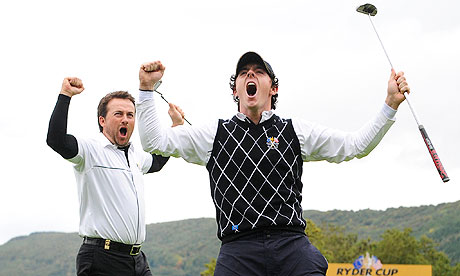
Ian Poulter, who secured Europe's first point in yesterday's Ryder Cup singles by defeating Matt Kuchar 5&4, was delighted to talk about "the best tournament in the world":

"I'm pretty passionate about this format. I love the Ryder Cup, I always have. I've watched so many matches over the years, Sevé [Ballesteros], Ollie [José María Olazábal], Colin [Montgomerie], Nick [Faldo], all the guys – they just pour out passion upon passion in this event," the 34-year-old said. "I love it. I love it from the first tee. I love it for the songs. And I love it with 11 team-mates. It truly is the best tournament in the world, and will always be. I said I was going to win today and I won a point. But more importantly, the team, as a team, managed to win the trophy back. This is a special day, for European golf to put on a display in Wales, with this many fans, is just truly unbelievable."


Share/Save/Bookmark

Passion (v 1)

 (v 10
Share/Save/Bookmark

Performing Under Pressure

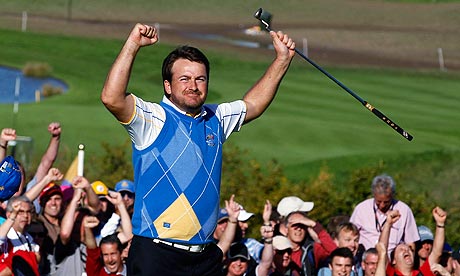
'I had a massive lot of emotions going through my head. That was the most difficult nine holes of golf I have ever played in my life. I was really nervous on every shot. The second shot at 16 was the greatest second shot of my career, and the putt on 16 was the greatest putt of my career. I imagined winning and losing in the same breath. That's just the way golf is - there are good times and bad times, great shots and bad shots. That is what makes this game so great.' Graeme McDowell, 2010 European Ryder Cup team


Share/Save/Bookmark

Team Spirit

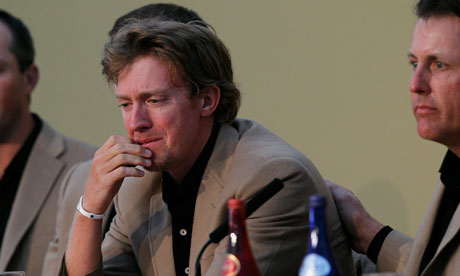
After the loss of the 2010 Ryder Cup to the Europeans, Hunter Mahan of the U.S. team was overcome with emotion. He was taking the brunt of the blame for his team's loss, as any athlete would, but his teammates would have none of it. 

In particular, Stewart Cink in the video below shows great leadership, reminiscent of Theodore Roosevelt’s famous 1910 speech at the Sorbonne in Paris:

"It is not the critic who counts: not the man who points out how the strong man stumbles or where the doer of deeds could have done better. The credit belongs to the man who is actually in the arena, whose face is marred by dust and sweat and blood, who strives valiantly, who errs and comes up short again and again, because there is no effort without error or shortcoming, but who knows the great enthusiasms, the great devotions, who spends himself for a worthy cause; who, at the best, knows, in the end, the triumph of high achievement, and who, at the worst, if he fails, at least he fails while daring greatly, so that his place shall never be with those cold and timid souls who knew neither victory nor defeat."


Share/Save/Bookmark

Passion and Desire


Share/Save/Bookmark

Benjamin Zander on Music and Passion

Benjamin Zander is the music director of the Boston Philharmonic Orchestra and the co-author of The Art of Possibility: Transforming Professional and Personal Life. He has an interesting perspective on leadership and success:

'The conductor of an orchestra doesn't make a sound. My picture appears on the front of the CD but the conductor doesn't make a sound. He depends for his power on his ability to make other people powerful.

And that changed everything for me. It was totally life-changing. People in my orchestra came up to me and said, "Ben, what happened?" That's what happened. I realised my job was to awaken possibility in other people. And of course, I wanted to know whether I was doing that. And you know how you find out? You look at their eyes. If their eyes are shining, you know you're doing it.

And, I have a definition of success. For me it's very simple. It's not about wealth and fame and power. It's about how many shining eyes I have around me.'


Share/Save/Bookmark

Monday, October 04, 2010

Lessons from the Dugout

One of the greatest lessons football has for business is the value of coaching. Too often, in business, coaching is mistaken for counseling or mentoring, to the detriment of the organisation.While both functions are valuable, genuine coaching is only about performance.

In football, coaches are judged solely on performance. Nobody watches the process, only the results. If business adopted the same appraisal system, imagine the difference.

Insert into an organisation's appraisal system the concept of judging departmental managers solely on the performance of their staff -- there would be no meetings between appraiser and appraisee, only observation of the performance of staff.

That is what happens on a daily basis with football teams. The entire management team is judged, each week, on what happens during each 90 minutes of competitive play. It is the immediacy of such judgment, and the visibility of the managerial process that makes football the all-embracing model it is.

Where else are failures in personnel selection and man-management so totally visible? That visibility provides an access to the process denied in business at least until long after the event. As a consequence, the lessons from the dugout are profound, not trivial.


Share/Save/Bookmark

Sunday, October 03, 2010

A Life in Leadership


With nearly 30 books and 85 years behind him, Warren Bennis is among the preeminent figures in the field of leadership studies.When the International Leadership Association (ILA) announced its 2010 webinar series entitled Leadership Perspectives, Bennis's August 25th presentation was a 'can't miss'. Through an interview moderated by Jean Lipman-Blumen (available here), Bennis discussed his latest book, Still Surprised: A Memoir of a Life in Leadership (J-B Warren Bennis Series)http://www.assoc-amazon.com/e/ir?t=positileader-21&l=btl&camp=213689&creative=392969&o=1&a=0470432381, and further explored his personal leadership journey through anecdotes and reflections of his life. 

Here are his key thoughts: 

1. Social animal
One of the more poignant and heartfelt insights that Bennis had to offer was the importance of people in his life. He considered his personal relationships with friends and colleagues to be the thread that unifies his many experiences, and proclaimed himself a social animal. Bennis spoke of how he best learns through conversation with others, shared his original idea for his book's title (My Self through Others), and spoke openly of the importance of people and meaningful conversation in his life.

2. Engaged Observer
Bennis spoke at length about his desire to be a part of the action of his time. He expressed a genuine interest in learning and exploring, and wanted to be a participant in our countries history and struggle. He labeled himself an engaged observer, reflecting on his service as an officer in World War II to his research on institutions and groups. He wanted to be a part of solutions, and spoke passionately about his optimism for being a part of positive and meaningful change in the world.

3. Strategic Vision
When asked about the much-used concept of vision as a guiding force behind organisations, Bennis stated bluntly that static visions are "stupid". He emphasised the importance of regularly assessing the vision that guides a company, a movement, a person in the context of the events taking place throughout the world. The environment, market, economy, politics, etc. are always changing, and being flexible in terms of what you want to achieve and how you want to achieve it is a more likely way of ensuring success.

4. Vision Subtext
Bennis also spoke fervently about the importance of identifying the subtext or undercurrent of your stated vision. Using one of his examples, a sales-person at a retail clothing store isn't simply selling suits, she's selling self esteem. In short, there is always an understated vision that is far more compelling than what lies on the surface, and leaders must work to identify it and bring it out. Leaders who spend time understanding and articulating why they do what they do will ultimately be more successful.

5. Crucibles
For Bennis, crucibles are challenges that test our character. Some challenges may be chosen while others are thrust upon us. Regardless, the adversity we face in life provides us with opportunity to find something within ourselves that we may not have known we had. Through adversity we discover ways to move forward and grow, and interestingly, Bennis stressed that growth doesn't have to be done alone. Cycling back to the beginning, Bennis suggests that relationships help us through our crucibles, and by working alongside other people we learn from and advance through life's pitfalls.

ILA's presentation of Warren Bennis provided a revealing look into the life and work of revered scholar. However, perhaps more importantly it provided a platform for one man to share his life's story in conjunction with hopeful insights for leaders everywhere. Bennis's upbeat and hopeful tenants are of great value, and as the study of leadership advances it will be interesting to revisit the value of his beliefs. 

Share/Save/Bookmark

Saturday, October 02, 2010

Gifted Children No More Likely To Succeed

Well hurrah, let’s trample on the Non-Verbal Reasoning test papers immediately, mes enfants. And while we’re at it, please stop all those silly French mornings when our children have to do le badinage. And can we can the violin practice before school, and all the other preposterous hurdles we expect our children to vault. 

Because the news is that hot-housing your child and encouraging them to walk the path of mathematics, musical or linguistic genius doesn’t make a blind bit of difference to their future success, happiness or material gains.

Prof. Joan Freeman, who studied the adult careers of 210 child prodigies for her book Gifted Lives: What Happens When Gifted Children Grow Up, has discovered that not every child who is labeled an infant Mozart will necessarily become one. Far from it: of the 210, only six became incredibly successful in later life. 

Indeed, the book reveals that the old schoolboy riposte “Winston Churchill failed his exams at school and he didn’t do too badly, did he?” might have something in it after all. Apparently, fate, personality and good old-fashioned drive are just as important to adult success and fulfillment as the ability to describe Shape A after twisting it by 90 degrees, or describe Pi to 60 decimal points. Probably more, in fact. 


Share/Save/Bookmark

Friday, October 01, 2010

What Motivates Us?

Several years ago, in A Whole New Mind: Why Right-Brainers Will Rule the Future, Daniel Pink argued that American professions have been dominated by analytical thinkers, but soon these left-brained MBA number crunchers would be replaced by a different kind of worker, the right-brained designer, storyteller and big picture thinker. These new workers would offer a new skill set to their employers — creativity, empathy, joyfulness and meaning.

In his new book, Drive: The Surprising Truth About What Motivates Us, Pink picks up the related theme of motivation. He argues that the incentive plans used by most organisations do not work. Even worse, there is scientific evidence that money acts as a de-motivator. Pink advises managers to pay people fairly and adequately to take money off the table, but he shows that the most effective reward is intrinsic — performance of the task itself.

Pink describes successful people as hard working and persistent. They possess an internal desire to control their lives, to learn about their world and to accomplish something that endures. They work hard to grow and develop, and to connect to a larger purpose. These workers have higher self-esteem and better interpersonal relationships than those who are extrinsically motivated. Every organisation needs to retain and cultivate these creative, problem-solving, big picture people.

Share/Save/Bookmark

Follow Your Passion!


Don't follow money. Instead, pursue what inspires you. And don't miss weekends with your family.


Share/Save/Bookmark

Characteristics of Greatness

HOW WINNERS THINK
1. It's Personal - They hate to lose more than they love to win.
2. Rubbing Elbows - They understand the value of association.
3. Believe - They have faith in a higher power.
4. Contagious Enthusiasm - They are positive thinkers... They are enthusiastic... and that enthusiasm rubs off.

HOW WINNERS PREPARE
5. Hope For the Best, But... - They prepare for all possibilities before they step on the field.
6. What Off-Season? - They are always working towards the next game... The goal is what's ahead, and there's always something ahead.
7. Visualise Victory - They see victory before the game begins
8. Inner Fire - They use adversity as fuel.

HOW WINNERS WORK
9.   Ice In Their Veins - They are risk-takers and don't fear making a mistake.
10. When All Else Fails - They know how - and when - to adjust their game plan.
11. Ultimate Teammate - They will assume whatever role is necessary for the team to win.
12. Not Just About the ££ - They don't play just for the money.

HOW WINNERS LIVE
13. Do Unto Others - They know character is defined by how they treat those who cannot help them.
14. When No One is Watching - They are comfortable in the mirror... they live their life with integrity.
15. When Everyone Is Watching - They embrace the idea of being a role model.
16. Records Are Made to Be Broken - They know their legacy isn't what they did on the field. They are well-rounded.

Share/Save/Bookmark

Involvement With Your Team

When it comes the people around you, how are they doing? Typically, outside of the workplace, there are influences that can positively and negatively impact their attitude and behaviour at work. Caring to know is important as a leader so you can help encourage them through the valley.

Maybe you are thinking, that’s not my job, but it is. Once someone steps through the door and inside your world, they become your responsibility. You don’t need to fix everything, but just making sure they know that you care will go a long way.

Then, you can help advance people along this progress of involvement. There are three levels. Are you interested, committed or passionate? Before you can effectively lead, you must know at which level you personally are engaged. How deep into the vision are you?

What pulls people along and out of their discouragement faster is your contagious passion and energy as a leader. Ask those on your team: are you interested, committed or passionate?

If you are merely interested, any inconvenience will distract you. If you are just committed, then another opportunity could pull you away. However, if you are passionate about the vision, you are unstoppable.

The bottom line: Check your level of involvement and correct it if necessary. Those around you will reflect which level you are living.

Share/Save/Bookmark