Positive Leadership has also been recognised as a Top 50 Leadership Expert to Follow on Twitter.

Follow us on Twitter @posleadership


LEADERSHIP IS A PROCESS OF SOCIAL INFLUENCE, WHICH MAXIMISES THE EFFORTS OF OTHERS TOWARDS THE ACHIEVEMENT OF A SHARED GOAL.

Saturday, December 12, 2009

The Use of Open-Ended Questions


Many people in leadership roles are accustomed to speaking more than they are conditioned to let others do the talking. Becoming a good listener is not something that happens overnight. Exceptional leaders are active listeners—they encourage others to share their ideas and opinions by asking open-ended questions.

Open-ended questions, such as those beginning with "What," "How," and "Why" elicit responses from employees that clarify their points of view—thoughts and feelings that may not be apparent to you.
Practice asking short and simple open-ended questions such as:

"Tell me more about how you see this situation?"

"In what way will this affect you?"

"How do you feel about this?"

"What are your thoughts on this issue?"

Pay attention to how your employees answer these questions, then follow up with closed questions that begin with words such as "So," "Do," "Which," and "Did" to summarise and confirm their (and your) understanding.

One of the best, and most difficult, times to use open questions is when you disagree with what someone has said. Instead of saying "I don't agree with you," try asking "What makes you think that?" or, "What led you to that conclusion?"

You may learn something, but more importantly, you won't have shut down the conversation and you have a better opportunity to reach a mutual understanding.
Share/Save/Bookmark

Friday, December 11, 2009

What Do You Do Under Pressure?


Bill George is a professor of management practice at Harvard Business School, where he has taught leadership since 2004.

Here he talks about dealing with pressure:


Share/Save/Bookmark

What Makes a Boss a Winner?


What makes a good business leader? Is it intellect, charisma, luck, charm, thuggery, stamina, ruthlessness, cunning, or simply intuition? Or is it a cocktail of all these things?

Regardless, it doesn't matter how good the chief executive is, he is never going to make a success out of a fundamentally bad company.

In recent history, Britain has been famously good at inventing and discovering things but not very good at commercial exploitation of them. But it would be wrong to attribute this to failure of leadership.

It's no accident that virtually all the truly memorable business leaders of the past century have been Americans. It is the sheer size of the market that matters, for therein lies the commercial opportunity that makes great companies. That's why we may soon be looking to China and India to produce the superstars of the business landscape.

One final tip not widely appreciated. Behind every outstanding business leader lies an outstanding PA. Without one, you won't so much as get past first base.

For more, see - http://www.telegraph.co.uk/finance/comment/jeremy-warner/6612263/What-makes-a-boss-a-winner.html
Share/Save/Bookmark

How To Build Consensus


Here is a process a leader can use to help a group reach an efficient consensus decision.

First of all, it’s important to define what’s meant by “consensus”:

“Consensus is a decision that every member of the group has had input to, understands, and is willing to support.”

Note that consensus does not mean that everyone agrees with the decision 100%. It mean’s they’ve had their say – and have been listened to – and at the end of the day, are committed to supporting the decision. The final decision is owned by the group.

The leader also needs to decide on a “fallback” method in case the group cannot reach true consensus. Otherwise, in theory, if just one person is not willing to support the decision, the meeting can go on forever.

The two most common fallback options are:

1. The group votes, majority rules.

2. The leader decides.

The threat of a fallback is a deterrent – it rarely has to be used, however, having it will motivate a group to give and take in order to reach a consensus.

Here’s a general process to use when making a consensus decision. It’s a way to ensure everyone has a say, generates energy, and can quickly move a group to a decision they can all buy in to and support.

The leader should check for agreement at the beginning and end of each step. Consensus building is a series of small agreements as you scale the mountain – you don’t just leap to one big agreement at the end.

1. Frame the decision.

Agree on what is being decided. Test your decision statement to make sure it’s not too narrow in a way that limits your options. For example, instead of “choose between a Ford Focus or a Ford Explorer”, the decision might be “choose the best mode of family transportation”.

2. Generate alternatives.

This is the time to brainstorm. Follow the rules of brainstorming (anything goes, don’t evaluate, build on each others ideas, etc…) and write each idea on a flipchart of whiteboard (or a virtual whiteboard if using web conferencing).

3. Clarify alternatives.

Take some time to allow questions for clarification. This is not the time to evaluate an idea – or to agree or disagree – it’s strictly to make sure everyone understands each alternative.

4. Narrow down the choices.

Add up the total number of ideas and divide by 3. So if 30 ideas: 30/3=10. In this case, give each team member 10 sticker dots. Have the group place their stickers on the alternatives they like the most. Make sure you tell this group this IS NOT the decision making process – it is strictly an efficient way to “take the temperature” of the group to see which ideas rise to the top and sink to the bottom.

5. Keep and discard.

Start with the alternative with the most votes and ask: “It looks like this one got the most votes – how about if this one stays for now?” If everyone agrees, then circle it. The go to the alternative with no votes, or the least, and ask: “OK, this one didn’t get any votes – can we eliminate it?” If no one objects, draw a line through it. If someone strongly objects – ask why. Give them time to make their case, and then move on to the next.

Although this may sound like a long and tedious process, it actually can go pretty quickly. The group often just decides they’ll go with the alternative with the most votes. A leader can also suggest combining ideas, by asking “So what is it about option A that you like so much? Can we add something to option B to satisfy that need?”

There may be times when it’s appropriate to choose multiple alternatives. In fact, that’s often the case. For problem solving (i.e., “best ways to reduce expenses”, or “best ways to generate revenue”), it’s typical to leave with a list of alternatives.

6. Summarise the decision(s), and decide on who’s going to do what by when.

This is the test of true commitment. Usually when a group reaches a true consensus decision, the energy and commitment is so high people are clamoring to sign up for action items. If all of a sudden the room goes quiet and no one is making eye contact, chances are you missed a step in the consensus building process.

Consensus building is hard work for a leader – it takes a willingness to “roll the dice” and be open to any alternative. Big egos need to be set aside. However, the time and work invested will yield not only higher quality decisions, but implementation will be faster and smoother because everyone will be committed to the outcome.
Share/Save/Bookmark

Thursday, December 10, 2009

Crisis = Danger + Opportunity


Crisis is a time of opportunity for leaders. The Chinese word for crisis - weiji - is made up of two characters - danger and opportunity.
Share/Save/Bookmark

Renewing American Leadership


Jeff Immelt, Chairman and CEO of GE delivered an impressive speech to the United States Military Academy yesterday. In it, he said:

'To realise a better economic future, our country must change how we compete. In order to change, we must have: an understanding of what happened; a plan to win; and leaders who have the courage to change themselves and others.'

The full speech is well worth reading - http://files.gereports.com/wp-content/uploads/2009/12/90304-2-JRI-Speech-Reprint1-557.qxd_8.5x11.pdf

Here are the 5 leadership traits which GE is committed to improving:
  • Leaders have to be better listeners.
  • Leaders must become systems thinkers who are comfortable with ambiguity.
  • Leaders must build competency and move with speed.
  • Leaders must motivate with vision, but win through execution.
  • Leaders must like and respect people.

Share/Save/Bookmark

John Wooden - The Values of a Great Leader

In this video, ESPN's Rick Reilly profiles the great love affair between legendary coach John Wooden and his late wife, Nell:


Share/Save/Bookmark

Leadership – What’s Love Got To Do With it?


“It’s the most powerful thing there is” – John Wooden

John Wooden is a basketball coaching legend – in his 27 years at UCLA, his teams had a winning percentage of 81%, and they won a unfathomable 10 NCAA titles.

He was also a lifetime student of leadership and personal development, creating what he called the “Pyramid of Success“. He is now 99 years old – and in a recent ESPN interview he revealed what he considered to be the two most important elements of all his success:

Love and Balance.

To him, love is the “most powerful thing there is“. It was certainly powerful in his personal life – he had a strong bond with his father who taught him the value of loyalty, and was married to his high school sweetheart Nell for 53 years until her passing in 1985, with a deep and abiding love that is still burning brightly.

What’s more, the power of love carried over into his professional life, with the manner in which he coached and led his teams. Here is what he said back in 1996 about a leader’s responsibility:

“You must set an example. Your players must know that you care for them more than just as athletes. Certainly, they understand that they are there because of their athletic ability, speaking of college. That’s why they’re there. That’s paying their way. But when you have them under your supervision, it’s up to you to make sure that they understand that you care for them as individuals. As…Alonzo Stagg said, he never had one he didn’t love. A lot of them he didn’t like, couldn’t respect. But he loved them just the same.”

John Wooden knew that if he was to earn the trust of his players, and lead them to greatness, he had to love them. Then, and only then, he could apply the principles of his “Pyramid of Success“, which requires much focus, discipline and practice.

This is not a new concept when it comes to great leadership- after all, in one of the oldest leadership books out there, The Art of War (it goes back to the 6th Century BC), Sun Tzu said “He treats them as his own beloved sons and they will stand by him until death”.

However, it is not a concept well suited to the typically rough and tumble world of business. It’s a point of view that dares not speak its name in the halls and in the boardrooms. It seems too “soft” – too “wishy-washy“. As if speaking about loving our teammates would be the ultimate weakness, a major flaw that could be regularly exploited by the more ruthless, manipulative and cynical people in the workplace.

It is also seemingly incompatible with downsizing, and layoffs, and other actions that are taken “for the good of the business”.

What John Wooden has taught us is that love is NOT “soft” – it is NOT incompatible. It is essential. If every leader out there could practice what he has preached for so many years, imagine what a different (and better) world this would be.

Because after all, we’re talking about humans here- we all function better in environments where we know in our hearts that our caretakers, our mentors, and our leaders, really care about us, and are doing their best to guide and teach us.

That’s “the most powerful thing” at work – it binds, it inspires, and makes success possible beyond our wildest dreams.

Just ask John Wooden.

What’s love got to do with leadership?

Plenty.
Share/Save/Bookmark

Coach John Wooden - A True Leader


John Wooden was born on his parents' farm near Centerville, Indiana. Life was difficult for the Woodens. Their farm had neither running water nor electricity and money was often in short supply. In later years, Coach Wooden would credit his success to the habits of discipline and hard work he learned on the farm.

Rural America did not share in the prosperity enjoyed by large cities in the 1920s. In 1924, the Woodens, like many farm families, went bankrupt and lost their farm. The family moved to Martinsville, a small town which, like so many in Indiana, took great pride in the performance of its high school basketball teams. Wooden, who had shown a gift for the game from grade school days, soon became a star player on his high school team. The team went to the state championship three years running, and won it twice. While still in high school, John met Nellie Riley. By his own account, it was love at first sight, and the two teenagers decided to marry as soon as John finished college.

John Wooden entered Purdue University in Indiana to study civil engineering, but became an English major instead. In college basketball, he earned a reputation as a fearless player of dazzling speed. He made All-American three years running and won a place in the Basketball Hall of Fame.

After graduation in 1932, he was offered a spot on the Celtics professional basketball team, but passed it up to begin a teaching career and marry his beloved Nellie. His first post was in Dayton, Kentucky, where he not only taught high school English, but coached all of the school's athletic teams. The basketball team had a losing season, the only one in Wooden's entire career. The following year, John and Nellie settled in South Bend, Indiana, where he taught English and coached the basketball team of South Bend Central High School. In eleven years of coaching high school basketball Wooden's teams won 218 games, losing only 42.

The young coach served as a physical education instructor in the United States Navy during World War II. Appendicitis kept him from shipping off for the South Pacific. A Japanese kamikaze plane struck the ship Wooden was to travel on, killing the officer who had taken his place.

After military service, Wooden, like many other teachers he knew, was not re-hired at his old job. He quickly found work however, at Indiana State Teachers' College, later known as Indiana State University. He coached basketball at the school, resuming his string of winning seasons.

In 1948, Wooden accepted an offer to coach the UCLA Bruins. At the time, the team was considered the weakest in the Pacific conference. The University had not provided the team with the facilities usually considered essential; the Bruins lacked a home court to play in, and had to share practice facilities with the school's other teams.

Wooden's Bruins astonished the skeptics by winning 22 out of 29 games in his first season as coach. The following year, they took 24 out of 31 and won their conference championship. Under Wooden's tutelage, the Bruins maintained their high win-loss ratio, and won the Pacific conference titles again in 1952, 1956, 1962 and 1963.

In 1964, Wooden achieved a long sought-after goal. His team had a perfect season, and won the NCAA championship. The following year, they won the title again, losing only two games in a 30-game season. What they lacked in size, the 1964 and '65 Bruins made up for in speed, discipline and an extra-keen will to win that has been the hallmark of all of Wooden's teams. The break-up of this championship lineup may have cost the Bruins the championship in 1966, but they came back with a vengeance in 1967, and held the championship for the next seven years.
The seven-foot center Lew Alcindor (later Kareem Abdul-Jabbar) dominated the Bruins' game for the first three seasons of their seven-year streak. Bill Walton was the dominant star of the 1973 and '74 seasons, when UCLA set the all-time record for an unbroken winning streak: 88 consecutive games. In 1974, UCLA again won the Pacific conference title, but lost to North Carolina State in the NCAA semi-finals.

The Bruins bounced back in 1975, Coach Wooden's last year, winning 27 out of 30 games, turning around a losing semi-final against Louisville in the closing minute of the game. In the final game of the tournament, UCLA defeated the University of Kentucky, 92-85.

In all his years as coach, John Wooden prohibited his players from any use of profanity, and consistently avoided it himself. Still, in his first 12 years at UCLA, the coach developed a fearsome reputation among opposing teams for the fanciful harangues he directed at officials and opposing players from the bench. This habit is virtually the only aspect of his career for which the coach has expressed any regret. In the championship years, fans and players alike noticed a distinct mellowing of Wooden's behaviour on the bench.

One of Coach Wooden's proudest moments, he later recalled, came when he overheard one of his players, an African-American, reply to a reporter's question about racial tensions on the team: "You don't know our coach. He doesn't see colour. He just sees ballplayers."
Share/Save/Bookmark

Tuesday, December 08, 2009

US Leadership


Speaking at a dinner in Washington last night, US Secretary of State, Hillary Rodham Clinton made some interesting remarks about the role of US leadership globally:


'We have been talking a lot in the last months that we need to be committed to using American leadership to build a new architecture of global cooperation. And fundamental to that idea is that the 21st century not only presents many shared challenges, but also demands shared responsibility. No nation can meet today’s challenges – or seize its opportunities – alone. Leadership in this era means stepping up to the plate and galvanizing others to do the same.


That is the approach we are taking in the Obama Administration. We are pursuing broader and, we hope, more effective diplomacy that reaches beyond government. And we are committed to development that is delivered, as the President has said, through partnership, not patronage, that achieves meaningful, measurable, sustainable outcomes.' 

Share/Save/Bookmark

Maintaining a Positive Attidude in Difficult Times


Maintaining a positive attitude in down times is the best thing you can do. You have a choice, maintain a positive attitude or go negative. The easy, and almost natural way for most people is to go negative. The best method for down times is to maintain a positive upbeat attitude, but it requires you to be disciplined and in control of your life.

Maintaining a positive attitude requires you to first believe in you, the most important person in the world. If you believe in you, you will also believe you are here for a reason and that there will be incidents of all sorts in your life. You also know that these incidents, many of which are not under your control, happen for a reason. That reason could be as simple as building character, or getting you back on track to where you belong.

Maintaining a positive attitude in down times, whether it be the loss of a loved one, a friend, relative, money or a job is crucial for survival and the realisation of your dreams and goals.

There are a lot of things in our life that are not under our control - weather, time, people, traffic, etc. If we cannot control them, we need to learn to accept them as they are. All we can do is take control of what is under our control - our attitude, our thoughts, our self-talk and the way we react to these situations.

What we think about, what we say to ourselves and the way we act it out is all part of the law of attraction, and is under our control. We can attract positive or negative outcomes. Which would you prefer?

Obviously you would prefer positive outcomes. Therefore you need to take control of your thoughts, self talk and reactions to maintain a positive upbeat attitude and positive outcomes. To maintain that positive attitude, you need to be very aware of what you are thinking, saying and doing. You need to catch yourself in the act of self pity, self criticism, jealousy, anger, etc. Then you need to X out that thought, saying or action and replace it with the opposite - a positive thought, saying or action. That is how you maintain a positive attitude, by taking control of the things that are under your control.

Keep in mind that maintaining positive attitude requires awareness at all times because only when you are in your conscious state can you accept or reject thoughts, self talk or actions. If you are not aware, and do not reject negative thoughts, they will end up in your subconscious mind. Once it hits your subconscious mind, you do not have the power to reject or accept. It has already been accepted and now goes to work with the laws of nature to attract those thoughts, self talk messages and results into your life.

By making awareness part of your daily discipline you will have the opportunity to take control of your life and attract the circumstances and outcomes you want, as opposed to the outcomes you do not want. So , take control and be aware!
Share/Save/Bookmark

Developing Young Leaders in the Military


The philosophy of the Norwegian Naval Academy in Bergen is that “It is people, not technology and strategy, that win wars. Further, fighting spirit and endurance is shaped not by material benefits, but by a close and determined bond between leaders and crew.”

The Naval Academy places practical and theoretical leadership training at the heart of their bachelor program in military science – preparing officers for operational leadership at sea.

A key challenge to this leadership development is a healthy balance between theory, coaching and practical training – in a realistic context out of the classrooms. HNoMS Statsraad Lehmkuhl, a 95 years old barque, with fifty sails, three masts, and a solid old fashioned rig – system meets this challenge. A three months cruise in the North sea and the Atlantic ocean in the storm – season marks a significant starting point for the cadet’s leadership training. The old lady does not carry advanced computer technology, electric engines or hydraulic systems that reduce the role of humans merely into computer operators. The sailing ship demands human cooperation at its best, to overcome and work with the rough weathers at sea. The ship and the nature immediately give feedback on poor leadership and cooperation.

Inspiring leadership is based on practical seamanship skills and tradition. At HNoMS Statsraad Lehmkuhl the cadets learn old-fashioned seamanship, knots, tackling, shanties, and maintenance in a way often ignored in modern navies. By this, they develop a sound respect for practical knowledge and traditions grown from thousands of years of accumulated experience. These skills also stimulate the cadet’s identity and pride as sailors. Military professionalism builds also on high academic standards. During the cruise professors are giving lectures in history, English, international affairs, leadership, psychology and ethics.

Leadership calls also for social skills, moral character and emotional intelligence. The cruise is a challenging kind of social training. Three months working and living together 24-7, sleeping in columns of hammocks with 20 cm “private” space on each side represents a good training ground for social interaction. The cadets are not allowed to bring computers, music, cell phones etc that can help them escape from boredom, homesickness, conflicts etc. They must develop their skills to communicate and face problems in a constructive manner. They learn to lean on their shipmates when facing hardship and difficulties. By this, comradeship, esprit de corps, and mutual trust may develop; for some, lasting the rest of their professional careers.

The cruise works. Research shows that the cruise influences the cadet’s leadership skills more than any other single activity at the academy. Emotional intelligence and transformational leadership changes significantly – in a positive way. The same goes for cohesion and ability to participate in - and build high performance groups. And last, but not least, the cruise leaves most cadets with a new confidence when it comes to both seeking leadership, and meeting the sea as sailors.
Share/Save/Bookmark

Monday, December 07, 2009

Leading Through Crises


President Obama says he's been able to lead through crises since taking office by:

"Being able to pull together the best people and have them work as a team; insisting on analytical rigor in evaluating the nature of the problem; making sure that dissenting voices are heard and that a range of options are explored; being willing to make a decision after having looked at all the options, and then insisting on good execution as well as timely feedback, so that [if] you have to correct the decision that you make, that you are able to do so in time; being able to stay calm and steady when the stakes are high. You know, all those things are, I think, principles I try to apply in any circumstance. I find them particularly useful when the decisions are tough and the consequences of action are most weighty."
Share/Save/Bookmark

The Six Factors That Drive Confidence in Leaders


For the past four years, the Harvard Kennedy School’s Center for Public Leadership has conducted an annual public opinion poll to determine the sector leaders in which Americans have the most and least confidence and the factors behind those confidence levels. The 2009 results have just been released and there are some pretty interesting conclusions.

First, the sectors where the confidence level in leaders are up in a statistically significant way over last year are the military, the executive branch and business. Those that showed a significant decline are medical, nonprofits and charity, state government, the news media and Wall Street.

Based on an index where 100 indicates a moderate amount of confidence the only three sectors that scored higher than that level were the military, medical and nonprofits and charity. Of those three, the military is the only sector to score well above 100 on the confidence index with a score of almost 120.

According to the study, there are six key factors that have the greatest impact on Americans’ confidence in their leaders. These factors are:

•Trust in what the leaders say

•Competence to do the job

•Working for the greater good of society

•Share my values

•Get good results

•In touch with people’s needs and concerns

Given what’s happened over the past year, it’s not surprising that the military and the nonprofit sector leaders were in the top three. Likewise, when you consider the past year and look at the six most important factors, it’s easy to understand why the two lowest ranked sectors were the news media and Wall Street.

Reading between the lines of the study, there is one other factor that’s not explicitly mentioned but probably comes into play. That factor is the perceived clarity and importance of the sector’s purpose and mission. Reading the study, it’s striking how much higher the leadership of the military and the nonprofit sectors are rated in all six key factors than are the leadership of other highlighted sectors.

“What do these two sectors have in common?”; clarity and importance of purpose is the answer.

To stand a chance of being effective, leaders must generate confidence in the people that depend on them.

For more, see - http://content.ksg.harvard.edu/leadership/images/CPLpdf/cpl_nli_2009.pdf
Share/Save/Bookmark

Sunday, December 06, 2009

4 Leadership Lessons From Carolina Coach Roy Williams


Here are four powerful Leadership Lessons from Coach Williams book Hard Work: My Life on and Off the Courtthat can be used by all leaders to build and maintain an elite programme - in sport or in business:

1. Character Counts

Coach Williams: When I decide that a kid has the talent I am looking for, then I try to find out about his character. I once had an elementary school principal in Wichita, Kansas tell me, "Coach, I wish you'd say academics is the second priority."

"No ma'am," I said. "because if he's a great player and a 4.0 student but he's going to be a pain in the rear end, I want it to be somebody else's rear end."

Too many coaches (and athletic directors) lower their programme's standards and take talented players (and coaches) with questionable or poor character. They knowingly accept talented people who have a history of not doing the right thing. It's a big gamble that sometimes pays off in the short-term, but usually has negative consequences in the long-term.

Just as Coach Williams heavily weighs character in the recruiting process, so too should you consider character when selecting your team. Having people of character makes it much easier to build and maintain a team that is focused on a common goal, not their own selfish desires. Coach Williams writes, "If you have one guy looking out for himself, you're in big trouble. If you have more than one, you have no chance."

2. Choose to work hard every day.

Coach Williams: I tell every prospect I recruit that I'm going to try to outwork every other coach... I like to ask prospects, "Who is recruiting you the hardest?" If they don't say me, I'm mad and I'll go back to my staff and tell them we've got to do more.

The more I learn from highly successful coaches and athletes, the more I am convinced that having a compelled work ethic is one of the biggest keys to success. Look at most anyone who is consistently at the top of their profession and you will see an individual and a team that is absolutely committed to being the best. They are highly passionate about what they do, invest themselves fully, and willingly put in the necessary hard work.

The great thing about hard work and commitment is that it is a choice. You get to choose at what level you bring it every day. The tough thing about hard work and commitment is that it is also a choice - you must consistently choose to bring it at a high level each and every day - despite distractions, disappointments, and human nature telling you to give up and give in.

3. Be a Fierce Competitor

Coach Williams: I love playing road games. I love that atmosphere. I encourage my players to treat games away from home as a wonderful challenge. I like to tell my team, "Let's go into their living room and steal their brownies." It's all about having the confidence and attitude that I can beat your butt anytime, anywhere, anyplace, anyhow... The bottom line is that I want my players to understand that at some point in every game, somebody's going to give in, and I don't ever want it to be us. We want to be the last team standing.

Underneath Coach Williams folksy and cordial outward demeanour beats the heart of a fierce competitor. He is driven to be the best and enjoys the continual challenge of taking every opponent's best shot - whether at home or on the road. He relates several stories in the book about how his competitiveness has been an edge throughout his career.

If you want to compete with the big boys and girls, you too are going to need to become a fierce competitor. More importantly, you will need to instill your own competitive will in your team as you develop them into competitors. Highly successful programmes look to dictate the tempo of the competition and impose their will on their opponents. They force opponents to react to them rather than the other way around. You too can get to this level. But you must remember that having a competitive team is a big key - and it begins with you modeling it, developing it, demanding it, and rewarding it as leader.

4. Win on and off the court.

Coach Williams: Winning still drives me. But I also enjoy putting a team together. Every year presents a different challenge for me. What I will miss the most is building relationships with players. Those bonds are always going to be there and they are personal. They are not based on wins and losses but on something you gave them, something you tried to do for them, something you tried to establish in those kids that would affect their lives.

Even though Coach Williams is highly committed to winning on the court, he also cares about his players' futures off the court. He is just as demanding of his guys when it comes to their performance in the classroom and in the community. He sees himself as a mentor who is privileged to prepare young men for the game of life - whether they are future NBA Superstars or productive members of society.
Share/Save/Bookmark

Hard Work Pays Off!


With two national championships over the past five years, seven trips to the Final Four, and a Hall of Fame induction, University of North Carolina Tar Heels' Basketball Coach Roy Williams is truly one of the top coaches in US college sport today.

While he is at the top of his profession now, Williams began his coaching career posting a losing 2-19 record his first season as a high school coach. Along the way he has swept the floors, been a PE teacher, sold calendars across the state just to put food on the table, and made only $2,700 a year as Dean Smith's part-time assistant coach at UNC.

Coach Williams' new book is aptly titled Hard Work: My Life on and Off the Court. He put in decades of hard work as an aspiring coach to reach the pinnacle of the coaching profession and continues to put in the hard work to maintain his programme's elite status by consistently out-recruiting and out-coaching many of his peers.

Coach Williams says, "We put our hands in and chant something my teams have been saying since I was North Carolina's junior varsity coach: Hard work! It's something I've believed in since I was a kid shoveling snow off the basketball court so I could practice or selling calendars or going right back out on the recruiting trail after winning a national title. The phrase is a reminder that nobody is going to outwork us. I think it pulls our guys together and gives them strength. It is what the players chant when they huddle for any timeout or any deadball. It's a constant reminder: Hard work!"

Coach Williams and the Tar Heels success are due to some key things that anyone can use in building a successful programme - in sport or in business:

1. Coach Williams is a tireless worker on the recruiting trail.

2. He recruits great talent but also ensures that his guys are people of strong character.

3. Coach Williams is extremely competitive and instills his will in his players.

4. He cares about his players beyond the basketball court.
Share/Save/Bookmark

Saturday, December 05, 2009

What History Tells Us About Effective Leadership


What do we actually know about effective leadership? One hundred years of research on the topic has led to some clear answers.

First, are leaders born or made? The answer is both, but more made than born. Leadership is a complex and sophisticated social role. Although certain qualities do predispose some people to attain leadership positions and be better at leading, effective leaders actually hone their skills through experience, conscious self-development, education, and training.

Second, does leadership training work? Relatively recent analyses of over 100 years of leadership training and development efforts suggests that most programsme do indeed lead to some positive change. Is the change dramatic? Sometimes. Certain crucible, or trigger, events can lead to substantial improvement in leadership ability. For the most part, however, leadership development is a long-term and incremental process.

Third, are there certain elements that all (or most) great leaders share?

We are quite sure that the theory of transformational leadership represents the very best elements of leadership. Effective leaders tend to be inspirational, visionary, and serve as positive role models for their followers. But the very best leaders also care sincerely about their followers, their well-being and their personal development. Great leaders also empower followers and encourage them to be creative and to take initiative.

Fourth, is leadership situation specific? In other words, if you are a successful leader in one area, such as at work, will you also be a successful leader in the community, or in a different company? Although this question has not been thoroughly researched, it is likely that the same transformational qualities and skills will transfer to other settings. The limitation, of course, is that knowledge of the particular setting, and understanding of its “culture” is required. So, a period of adjustment and learning is needed to allow the leader to use transformational abilities in the new environment.

Finally, how early in life does leadership begin to develop? This is a fascinating question, and one that current research is exploring. There has been little longitudinal research on the early “roots” of leadership, but initial results suggest that the foundation of leadership begins at a very early age. Encouragement from parents and teachers likely plays a very important part, as well as early exposure to a variety of social situations, and novel experiences.

What are the implications for personal leadership development? Leadership is complex, but it can be developed. We know the building blocks of leadership success, and it is clear that devoting time and energy to your personal development pays off.
Share/Save/Bookmark

Success and Failure Begin and End in What the Mind Believes is Possible


The story of Roger Bannister is an inspirational one.

For many years it was widely believed to be impossible for a human to run a mile (1609 meters) in under four minutes. In fact, for many years, it was believed that the four minute mile was a physical barrier that no man could break without causing significant damage to the runner's health. The achievement of a four minute mile seemed beyond human possibility, like climbing Mount Everest or walking on the moon.

It was a windy spring day, on the 6th of May 1954, during an athletic meeting between the British AAA and Oxford University, that Roger Bannister ran a mile in 3 minutes, 59.4 seconds, breaking through the “four munite mile” psychological barrier. John Landy, a great runner of that day, had never run faster than within 1.5 seconds of the four minute barrier. Then 56 days after Roger Bannister's breakthrough, John Landy ran the mile in 3 minutes and 57.9 seconds in Finland. Later, Bannister and Landy raced in the 'Mile of the Century', where Bannister won in 3 minutes and 58.8 seconds.

The breaking of the four minute mile was so significant that is was named by Forbes as one of the greatest athletic achievements. What made this event so significant is that once the four minute barrier was broken by Roger Bannister, within three years, by the end of 1957, 16 other runners also cracked the four minute mile.

Describing the psychological impact of the four minute barrier in an interview with Forbes, Sir Roger Bannister, who was knighted in 1975, related that:

'The world record then was four minutes, 1.4 seconds, held by Sweden’s Gunder Haegg. It had been stuck there for nine years, since 1945. It didn’t seem logical to me, as a physiologist/doctor, that if you could run a mile in four minutes, one and a bit seconds, you couldn’t break four minutes. But it had become a psychological as well as a physical barrier. In fact the Australian, John Landy, having run four minutes, two seconds, three times, is reported to have commented, “It’s like a wall.” I couldn’t see the psychological side.'

So what happened to the physical barrier that prevented humans from running the four minute mile? Was there a sudden leap in human evolution? No. It was the change in thinking that made the difference, Bannister had shown that breaking the four minute mile was possible. Often the barriers we perceive are only barriers in our own minds. Previous runners had been held back by their beliefs and mindsets. When the barrier was broken, other runners saw that is was possible and then 16 runners went on to do the same.

Our beliefs and mindsets limit or expand our world. Beliefs have power over us because we treat them as though they’re true. Beliefs influence what you attempt or choose not to attempt in life. They determine what you pay attention to, how you react to difficult situations and ultimately your attitude. Success and failure begin and end in what the mind believes is possible.

The first step a leader can take in influencing the world around them is to change how they think about it. If Roger Bannister accepted that the four minute mile was a physical limitation, he would never have tried to break it. Just like the runners of time past, many of the barriers that hold us back today exist only in our minds.

What are the 'four minute miles' that are holding you back in your personal and professional life?

Are their any role models who are challenging existing limits that you can learn from?
Share/Save/Bookmark

Friday, December 04, 2009

Optimism Leads to Academic, Athletic, Military, Occupational and Political Success


President John Quincy Adams' quote, "If your actions inspire others to dream more, learn more, do more and become more, you are a leader" sets a tone that has been followed for more than 200 years in the USA.

More recently, information from over ten years of research in the areas of Positive Psychology and Positive Organisational Psychology are being used in businesses and organisations to create Strategic Optimism.

Strategic Optimism means having a positive expectation for the future that contributes to flourishing and well-being. Human flourishing is described as the sum of positive emotions, positive actions and positive meaning.

Here are four strategies that directly contribute to flourishing and Strategic Optimism:

- Positive Climate
- Positive Communication
- Positive Relationships
- Positive Meaning.

Optimism is part of Emotional Intelligence which can be learned. It helps you be more effective in your career and have a more fulfilling personal life. Research shows the benefits of optimism to be linked to:

- Perseverance
- Good morale and popularity
- Effective problem solving
- Academic, athletic, military, occupational and political success
- Positive mood
- Good health and a long life.

You may be wondering what role negativity or pessimism has. Research indicates that it can lead to:

- Depression
- Passivity
- Failure
- Social estrangement.

Strategic Optimism sets high expectations that actively let you avoid thinking much about negative things that might happen. This allows you to take action on your goals. If strategic optimists set lower expectations or play through possible outcomes too much, their anxiety increases, and their performance decreases.

Moods and emotions are contagious. They impact leadership, job performance, decision making, creativity, turnover, teamwork and negotiations. The kind of optimism that is most beneficial for leaders is referred to as Strategic Optimism. It works best when anxiety is low or not present. Leaders need to be positive when the future can be changed by being Strategically Optimistic.
Share/Save/Bookmark

Thursday, December 03, 2009

Let People Do Things


Judith Jamison is about to begin her 20th year as artistic director of Alvin Ailey American Dance Theater. Here she answers some questions on leadership in a recent article which appeared in the New York Times:

'Q. What’s the most important leadership lesson you’ve learned?

A. Let people do things. If they do it better than you, let them do it. You have to recognise that in order for this plane to fly, I need co-pilots, I need engineers, I need passengers.

Q. How did you learn that?

A. There’s no formula. It’s kind of the natural thing to do. I’ve been in a competitive situation almost all my life. I’ve been having a competition with myself and trying to be the best I could be. I did a lot of praying. I did a lot of preparation. But then, I also learned how to release, how to let go. That’s a constant learning process — how to let go and let somebody else do it who knows how to do it better than you do it. If it keeps the plane in the air, fine.

Q. What else have you learned?

A. I want to know who you are as a person, and then I want you to develop as a whole human being. One thing I cannot stand is when people say, “Hi, how are you?” and they don’t wait to hear how I am. They’re just going through the motions. I say to people: “Keep it human. Keep it alive. Don’t turn into a robot.” You have to hear what the other person is saying clearly. You have to listen, and really care, because we’re all the same under the skin. I’ve danced all over the world, and people are people. We cannot cut off from each other in life. In order to lead, you can’t do that. '

For more, see - http://www.nytimes.com/2009/11/29/business/29corner.html?_r=1&ref=business
Share/Save/Bookmark

Leadership Lessons From Peter Drucker


In his new book, Drucker on Leadership: New Lessons from the Father of Modern Management , Bill Cohen, a student and colleague of Peter Drucker, extracts the leadership lessons that he learned from this great thought leader.

Here are the lessons that Cohen uncovered:

1. Strategic planning is the first priority of the leader. Drucker believed that the leader's job was to create the desired future for the company or the organisation. The leader needed to be intimately involved with the strategic direction.

2. Ethics and integrity are critical for leader effectiveness. Character and ethical behaviour are of central importance for the leader. According to Drucker, followers might forgive leaders for mistakes, but will not forgive a lack of integrity.

3. Model the military. Peter Drucker had great respect for how the military developed leadership, with an emphasis on character and leaders as positive role models. The military's emphasis on commitment and "taking care of your people" are examples of what Drucker admired about military leadership.

4. Motivation: Treat employees like volunteers. Drucker greatly admired nonprofit organisations, and he extracted leadership lessons from them. If a leader treats employees as if they were volunteers - free to leave at any time - the leader pays greater attention to the non-monetary needs of workers, and moves from transactional motivation to transformational motivation.

5. Leaders should be marketers. This surprising lesson really means that leaders should be focused on the customer, and be concerned about how customers view the organisation and its products or services. The leader must set the tone for how the organisation is viewed, and be its best representative.

Although little of Peter Drucker's writings focused on leadership, there are many lessons for leaders in his work. Our thanks to William Cohen for highlighting them.
Share/Save/Bookmark

Wednesday, December 02, 2009

Practice Positive Leadership


“Positive Leadership” doesn’t simply mean the absence of overt negativity. It means remaining purposeful in the face of adversity. While it’s important to acknowledge the obstacles your organisation is facing, don’t dwell on them in meetings or in individual conversations, and don’t bring up bad news before you’ve pointed out one or two things that are going well. Instead of being disappointed by where you are, optimistically focus on where you are going.

Right now, negativity and fear are probably knocking your people off balance. It’s a scientifically proven fact that the nature of our thoughts affects our lives in tangible ways. If you think your best days are behind you, they are. However, if you think your best days are ahead of you, they are. Therefore, it’s time to regroup, refocus and unite your people to create a winning mindset, culture and positive team environment. Remember, culture drives behaviour. You win in the office first. Then you win in the marketplace. With a winning team, you create strength on the inside that can withstand the negativity, naysayers and adversity on the outside.
Share/Save/Bookmark

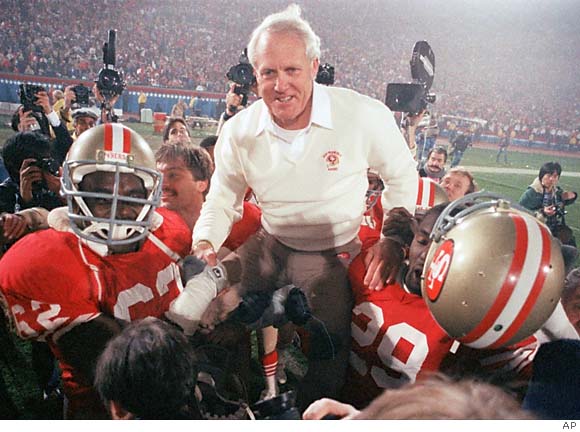
What Leadership Looks Like: Bill Walsh


When most people in the USA - sports fans, at least - think about the late Bill Walsh, they generally think about two things: (1) his creation of the "West Coast" offense, the fast-breaking, field-spreading plays that fundamentally changed football strategy on both sides of the ball; and (2) his three Super Bowl wins at the helm of the San Francisco 49ers during the 1980s.

He was a football icon, no doubt. But in the final analysis, he was really much, much more than that. He was a leader of the highest order, possessing attributes and approaches we can all learn from, regardless of vocation.

Here is an assessment of Bill Walsh and what his legacy as a model leader should encompass:

Intelligence: Without question, Bill Walsh was one of the brightest and most cerebral of NFL coaches. In fact, prior to being hired, some in NFL leadership viewed this as a negative, unsure how his brilliance as a behind-the-scenes strategist would translate into an on-the-field leader. The cynics were proved wrong and his brainpower became a priceless asset during his tenure as head coach at both Stanford and the 49ers.

Innovation: The West Coast offense was, in Clay Christensen's parlance, a "disruptive technology." In a similar vein as the forward pass, the West Coast offense caused competitors to rapidly change their schemes lest they get blown off the field by a high-percentage, fast-scoring offensive strategy. This meant re-fashioning both their offense and their defense, giving the 49ers a sizeable lead that translated into three Super Bowl titles in eight years.

Mentoring: Mr. Walsh was likely the one coach that seeded more future NFL head coaches than any other, creating a "coaching tree" that is hard to believe if you follow professional football. He was also a ground-breaker in promoting the case of minority coaches, including Super Bowl-winning coach Tony Dungy, Dennis Green and Ray Rhodes. He invested in his people and brought the best out of them, remaining involved in their professional and personal lives far beyond their tenure with his teams.

Confidence: Bill Walsh was certainly not cocky, but displayed a confidence in himself that clearly impacted his players and coaches alike. It also helped in recruiting. Who could turn down an approach from Mr. Walsh, whose intellect and on-field success built an already sizeable confidence in himself into an unstoppable force. His confidence was contagious and helped elevate those working with him to a higher level.

Respect: Bill Walsh had respect for his players, his staff, his opponents and the game itself. Notwithstanding the more aggressive techniques of other coaches, he treated his players as intelligent with men who were better motivated by teaching and guidance than by threats and intimidation. He respected the media, answering questions and not lashing out even in the face of defeat. His coaches were treated as integral parts of the system, not simply as cogs in his coaching machine.

Recruitment: He was one of the best judges of talent that ever lived. Whether it was Joe Montana, Jerry Rice, Steve Young or many others, his assessment of value and his ability to realise that value in his programme was unparalleled. But none of this would have mattered if the players weren't excited to play for him, giving their all that was critical to the success of his teams. But he had an uncanny sense of which players to field at what time, creating match-up problems that directly contributed to their historic achievement in the most important games.

Just a good guy: Players, fellow coaches, sportswriters... they all liked Bill Walsh. What wasn't there to like? He may not have been an electric guy but he was a good guy, a nice guy, a smart guy, a sometimes funny guy. He just got along with people, people from different walks of life who had their own agendas and motivations. But somehow, he almost always left a good impression that served him well at that moment and beyond.

There is nothing about the elements of Bill Walsh's success that are unique to football. They are applicable to all of us who either are or aspire to be leaders, be they of teams or entire companies.

It it sad that Bill Walsh died such a young man.
Share/Save/Bookmark

All Leaders Have a Brand


All leaders have a brand. Whether that term is used or not, leaders have an identifiable persona that is a reflection of what they do and how others perceive them. This is their leadership brand.

When it comes to cultivating a leadership brand, look no further than Oprah Winfrey, who recently announced that she would be ending her popular talk show in 2011. In a perceptive analysis, New York Times media columnist David Carr suggests that Winfrey's brand and the key to her longevity is a combination of things she didn't do as well as things that she did do. On the "don't do side," she did not over-merchandise nor take her company public; she kept control of her products and thereby her image, unlike Martha Stewart. On the "do side," she always stayed true to herself. As she told her business partner Gayle King years ago, "I don't know what the future holds but I know who holds it."

The lessons of Oprah's brand are relevant to any leader.

First and foremost, understand that brand is what you develop as well as what others perceive. The balance between reality and perception can be shaky if you are not careful, but as we have seen from Oprah, not impossible.


Here are some lessons for cultivating your own positive leadership brand.

Practice what you preach. It's easy to say, but when the going gets tough, how many supposed leaders disappear into the shadows? Those who lead by example are willing to make tough decisions and be accountable for the consequences. They are also willing to lend a hand to colleagues and direct reports. These are go-to people who work extra hard when necessary. Nothing is stronger than seeing the boss do heavy lifting alongside an employee during crunch time.

Act on principle. This applies to work, where principles determine the quality and attention you deliver, as well as to values, where principles determine behaviour. Employees who see their bosses standing up for the right way of doing things in the face of competition (from inside and outside the organisation) will believe and follow. For example, make certain that employees are compensated (either monetarily or in time off) for overtime and are receiving recognition for jobs well done.

Insist on integrity. When it comes to a leadership brand, integrity is the lever one uses to get things done the right way. That means treating people with respect, regardless of their positions. Act for the benefit of the organisation first and yourself second. Do things that honour the work you do as well as the people who work for you. Talking about integrity is one thing; insisting that you and your colleagues abide by is what matters. Integrity is not reserved for big corporate dealings; it can focus on small things. For example, in tough times, make the choice to fly economy class rather than business class.

Some who read this might be thinking, 'nonsense'! As a leader my job is to lead others not worry about my image. True, but not entirely. Your job as a leader depends upon getting others to follow your lead; they must trust you. Trust is essential to leadership, and a brand — how people perceive you — is critical to encouraging followership.

And there's one final point. Leaders make mistakes. A strong brand, just as a strong sense of self, can aid in a comeback. People will readily forgive a misstep if they believe your intentions were good. This applies not only to mistakes in business judgment but mistakes about people too. If you have done well, but make a bad call about a product or process, or even if you insult a colleague, a strong brand will give you a safety net. As long as you act quickly and make amends, you can restore trust because you have created a legacy of good will.

In short, your brand is a reflection of your credibility. Develop it wisely and nurture it carefully and it will help you create strong bonds of trust with your followers. Any doubt, just ask Oprah.
Share/Save/Bookmark